The drill rig is already on the bench. The crew flew in this morning. There is no grid power within forty kilometres, and the only question that actually matters right now is a small one: what size air compressor do I need?
On a site like this, the answer is not found in a machine catalogue. It is found at the end of the hose. Air is a utility you are manufacturing on the spot, and if you underbuild it, everything downstream slows down — the hammer stalls, the blast pattern goes patchy, the hole stops cleaning. If you overbuild it, you are burning diesel and hauling weight you did not need.
This guide is written for field engineers, fleet buyers and contractors who are sizing a mobile, diesel-driven, off-grid compressor for pneumatic tools. We will not repeat what an air compressor actually does or the difference between portable and stationary packages — that ground is covered in our pillar guide. Here we stay on the ground you are standing on: breakers, blast nozzles and down-the-hole hammers, and how to put a number on them.
- Size from the tool, not the machine. The thirstiest tool on site sets the minimum; everything else is secondary.
- Pressure is a gate, flow is a budget. If pressure is short the tool will not run at all; if flow is short it runs badly and overheats.
- Blasting and DTH are the two duties that break undersized machines. A single 6.4 mm (1/4 in) nozzle wants roughly 2.3 m³/min (82 CFM) continuously; a mid-size DTH hammer wants several times that at 14–18 bar.
- Count tools running at the same time, not tools owned. Two breakers on a 30% duty cycle are not two breakers’ worth of air.
- Always add margin for hose pressure drop, coupling leaks and tool wear — 15–25% is normal field practice.
- Correct for altitude. At 2,000 m you have roughly 78% of sea-level air to work with, and your compressor knows it.
Did you know? A blast nozzle does not wear smaller. It wears bigger. A 1/4 in nozzle that has run past its service life flows like a 5/16 in nozzle and can demand 50% more air than when it was new — which is why a compressor that was perfectly sized on day one starts starving the pot on day ninety.
Start With the Tool, Not the Machine
Most sizing conversations begin backwards. Someone sends a photo of a machine and asks whether it will run their tools. The correct starting point is a list of tools, each with two numbers on it: required working pressure and air consumption. Every pneumatic tool has a nameplate or a data-sheet figure for both. If you cannot find them, the tool manufacturer can supply them, and you should ask before you buy metal.
There is a reason this order matters. Consider our own diesel portable air compressors: the same engine platform can be built to deliver very different flow at very different pressure, and the version that is right for a chipping hammer is wrong for a 6-inch DTH hammer. The machine is a variable; the tool is the constraint.
So before anything else, write down:
- Every tool you expect to run
- Its pressure requirement (bar)
- Its air consumption (m³/min or CFM)
- How many hours per shift it actually runs
That last line is the one people forget, and it is where most of the money is saved.
Step 1: Pressure First — What Your Tool Actually Needs
Pressure is the gate. A pneumatic tool is designed around a pressure at the tool inlet, and below that pressure its behaviour changes in a way that is worse than simply “running slower.”
A rock drill that is starved of pressure loses percussive energy roughly with the square of the pressure drop through its mechanism; it does not half-work, it stops advancing. A breaker at 4 bar instead of 6 bar feels dead in the hands. An impact wrench will not reach torque. And a DTH hammer with insufficient pressure will not flush the hole, which means the cuttings recirculate, the bit re-grinds its own chips, penetration rate collapses and you start losing bits.
This is why pressure shortage is more damaging than flow shortage. Short of flow, the tool works in bursts and the compressor recovers. Short of pressure, the tool never gets to do its job, the operator compensates by leaning on it, and the wear lands on the tool and the hole rather than on the air.
Practical rule: take the highest pressure requirement on your tool list, then add the losses you will incur getting the air there (hose, filters, fittings, elevation in the line). That gives you the pressure class of the machine.
Step 2: Flow — Match the Tool’s Consumption
Flow is the budget. Once pressure is satisfied, m³/min (or CFM) decides how many tools can run and how hard.
The figures below are typical industry reference values — confirm against your tool and nozzle manufacturer data. Duty cycles, hammer designs and nozzle geometries vary, and a worn tool can consume materially more than a new one.
| Tool | Working pressure (bar) | Air consumption (m³/min) | Air consumption (CFM) | Typical duty |
| Chipping hammer / light scaler | 6 | 0.7 – 1.2 | 25 – 42 | Intermittent |
| Hand-held breaker, 20–30 kg class | 6 | 1.6 – 2.4 | 56 – 85 | Intermittent, 30–50% |
| Heavy breaker, 30–40 kg class | 6 – 7 | 2.0 – 2.8 | 71 – 99 | Intermittent, 30–50% |
| Hand-held rock drill | 5 – 6 | 2.5 – 3.5 | 88 – 124 | Intermittent |
| Jackleg / pusher-leg drill | 5 – 6 | 3.0 – 4.5 | 106 – 159 | Intermittent |
| Concrete poker vibrator | 5 – 6 | 0.8 – 1.5 | 28 – 53 | Intermittent |
| 1 in impact wrench | 6 | 1.5 – 2.5 | 53 – 88 | Very intermittent |
| Air winch / small hoist | 6 | 2.0 – 4.0 | 71 – 141 | Intermittent |
| Abrasive blast nozzle | 6 – 8 | see nozzle table below | see nozzle table below | Continuous while trigger held |
| DTH hammer, 4–6 in | 14 – 24 | see DTH section | see DTH section | Continuous while drilling |
| Blow-off lance / cleaning | 4 – 6 | 0.5 – 1.5 | 18 – 53 | Intermittent |
Note how wide the spread is. A “30 CFM compressor” is a serious machine for a chipping hammer and is nothing at all next to a blast pot or a hole.
Also note the unit convention. Field crews in blasting and drilling talk in CFM; equipment built to metric speaks in m³/min. Keep both on your sizing sheet: 1 m³/min ≈ 35.3 CFM, and 1 bar ≈ 14.5 psi.
Abrasive Blasting: Nozzle Size Sets Everything
If there is one duty where “what size air compressor do I need” has a crisp, unforgiving answer, it is abrasive blasting.
Blasting is a continuous-flow application with a hard physical relationship: the air you need is governed by the nozzle orifice diameter and the pressure at the nozzle. Nothing else on the site moves the number. Get the orifice and pressure, and the flow follows.
The table below gives widely used reference figures at 100 psi (≈6.9 bar) nozzle pressure, converted to metric. Scaling is close to linear with absolute pressure, so at 7 bar these values rise by roughly 2–3%, and at 8 bar by roughly 12–15%.
| Nozzle orifice (mm) | Orifice (in) | Air demand at 6.9 bar (CFM) | Air demand (m³/min) | Compressor FAD with 20% margin (m³/min) | Compressor FAD with 20% margin (CFM) |
| 3.2 | 1/8 | 18 | 0.51 | 0.61 | 22 |
| 4.8 | 3/16 | 45 | 1.27 | 1.53 | 54 |
| 6.4 | 1/4 | 81 | 2.29 | 2.75 | 97 |
| 7.9 | 5/16 | 127 | 3.60 | 4.32 | 152 |
| 9.5 | 3/8 | 183 | 5.18 | 6.22 | 220 |
| 11.1 | 7/16 | 249 | 7.05 | 8.46 | 299 |
| 12.7 | 1/2 | 326 | 9.23 | 11.08 | 391 |
Typical industry reference values — confirm against your tool and nozzle manufacturer data.
Two field notes on this table.
First, the pressure at the nozzle is not the pressure at the compressor. Your gauge at the machine could read 7 bar while the nozzle sees 5.5 bar, because of hose friction, the blast hose ID, moisture separators and the pot itself. A 50 m blast hose is a real pressure drop. Size the compressor so that the nozzle reaches its design pressure.
Second, productivity is bought with air. Going up one nozzle size is a large jump in air demand, but it is also a large jump in square metres per hour cleaned. Contractors who buy one nozzle size too small end up paying for it in labour hours every single shift. If your blast scope is significant, read our dedicated guide to air compressors for sandblasting alongside this one.
DTH Drilling: The Hardest Duty on Site
Down-the-hole drilling is the reason high-pressure mobile compressors exist. It asks for two things simultaneously, and that combination is what makes it expensive.
High pressure, typically 14–24 bar depending on hammer design and hole depth. The hammer needs it to develop blow energy, and just as importantly to generate enough up-hole velocity to lift cuttings out of a deep, possibly wet hole.
High flow, because a DTH hammer is effectively a large piston cycling many times per second, and the air is doing double duty: driving the piston and flushing the hole. Starve the flow and you do not simply drill slowly — you stop cleaning, the hammer recirculates chips, and you risk stuck steel.
DTH is also continuous. A breaker operator rests; a drill does not. That means the compressor must hold its rated output hour after hour in heat, dust and altitude, which is a cooling and engine-power question as much as a compressor question.
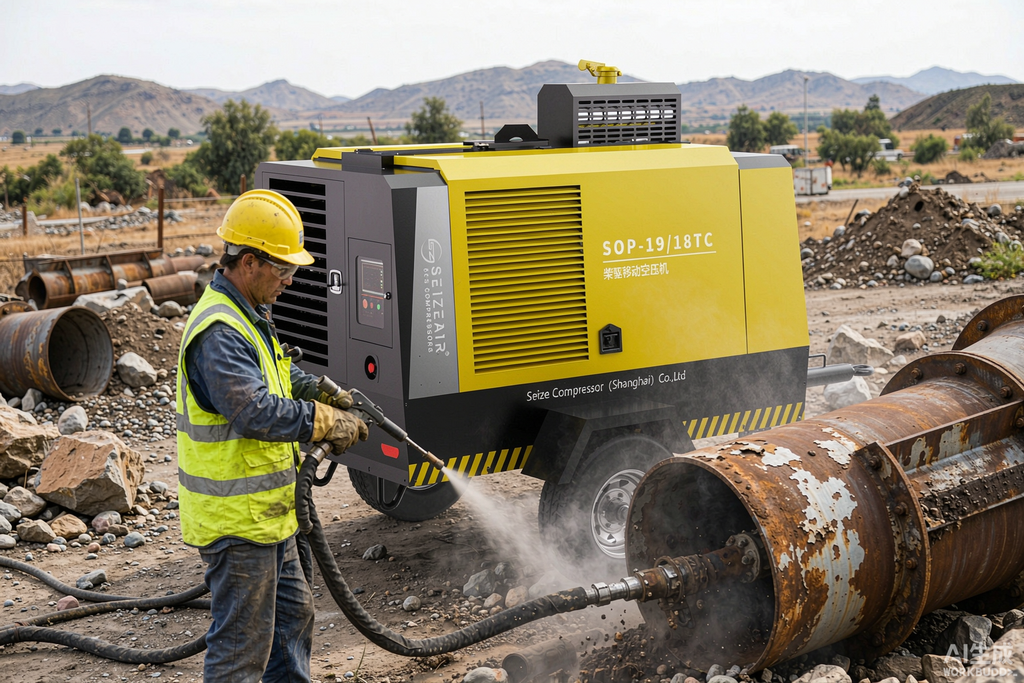
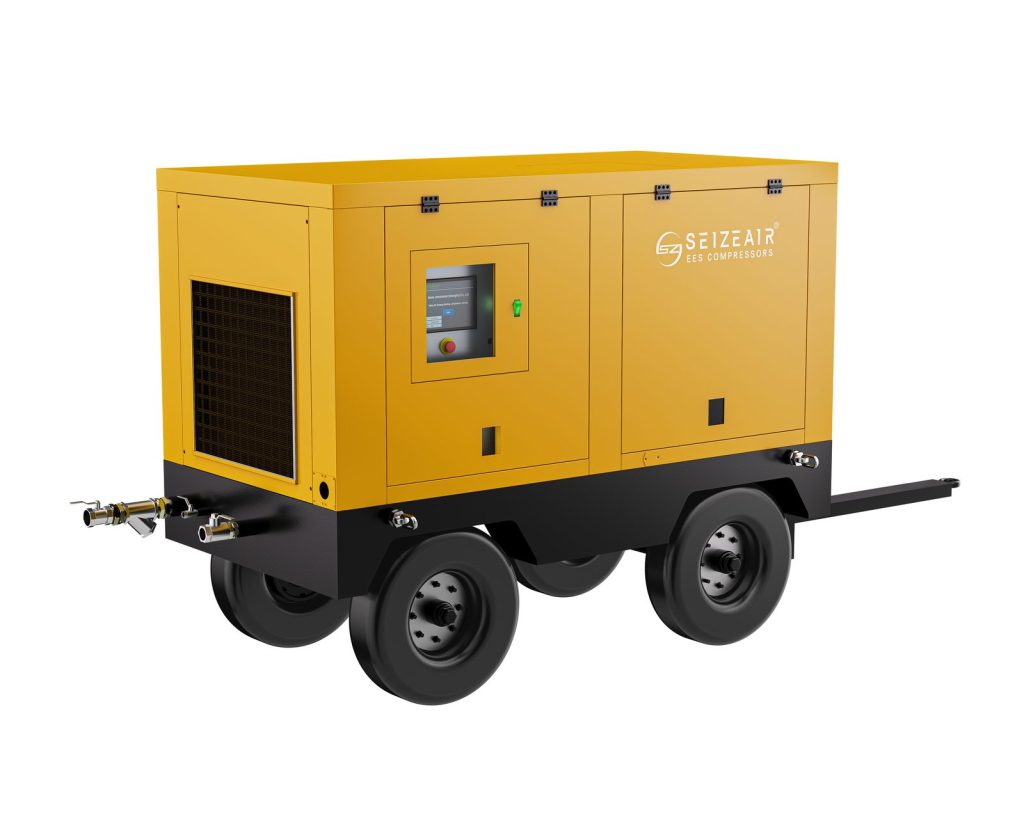
As a real-world reference point from our own range, the SDP-19/18TC is built for exactly this class of work: 19 m³/min (≈665 CFM) at 18 bar, driven by a Cummins 194 kW diesel engine, with a 260 L fuel tank, 3,500 kg operating weight and 3,200 × 1,800 × 2,380 mm footprint on four wheels, discharging through 1 × G2″ and 1 × G3/4″ outlets. Its stated applications are mining DTH drilling, heavy construction and rental fleets. If your tool list contains a mid-to-large DTH hammer, you are in that territory, not in the 5 m³/min territory.
For the deeper discussion of matching hammer size, hole depth and compressor output, see our article on DTH drilling air compressors.
Step 3: Count How Many Tools Run at Once
Now the crew question. You rarely run everything at once, and you should not pay for everything at once.
The field version of a diversity factor is simple: for each tool, estimate the fraction of the shift its trigger is actually pulled. Breakers and rock drills are physically demanding, so real duty cycles are far below 100% no matter what the schedule says. Blast nozzles are near-continuous while the pot is live. DTH hammers are continuous while tripping in and out.
Worked verbally: two 30 kg breakers at 2.4 m³/min each, each on a genuine 40% duty cycle, are not 4.8 m³/min of demand. They are 1.92 m³/min of average demand — but they can still peak at 4.8 m³/min for short spells, and your compressor plus its receiver volume has to ride through those peaks without collapsing pressure.
A practical approach:
- Continuous tools (blasting, DTH, some hoists): count at 100%
- Intermittent hand tools (breakers, drills, vibrators): count at 30–50%
- Occasional tools (impact wrenches, blow-off): count at 10–20%, or ignore and cover with margin
- Then sanity-check the peak simultaneous case, because two operators hitting the same seam at the same moment is a normal day, not an emergency
Step 4: Add Margin for Hose, Leakage and Wear
A compressor sized to the bare tool figures will disappoint you. Three things eat the difference.
| Loss source | What it costs you | Field mitigation |
| Hose length and internal diameter | Pressure drop that grows with length and falls sharply with larger ID; long runs can cost 0.5–1.5 bar | Use the largest practical hose ID; keep runs short; do not coil excess |
| Quick couplers, fittings, whip lines | Each connection is a restriction and a potential leak | Standardise on one high-flow coupler type; replace worn seals |
| Leakage in the system | Chronic wasted flow; rises steadily as fittings age | Allow a leakage allowance in sizing; walk the line at shift start |
| Tool wear | Worn hammers and nozzles consume more air for the same output | Rebuild on schedule; log nozzle changes |
| Filters, separators, dryers | Permanent pressure drop across the element | Include in the pressure budget; service elements |
| Future tools | Yesterday’s sizing does not fit tomorrow’s scope | Buy with headroom |
Conventional field practice is to add 15–25% to the calculated flow demand. Use the low end if your hose runs are short, your couplings are new and your duty is light. Use the high end if you are at altitude, running long hoses, blasting, or three shifts into a rental with an unknown maintenance history.
Step 5: Correct for Altitude and Ambient Conditions
Air gets thinner with height, and a compressor is an air-processing machine. Less dense inlet air means less mass flow, which means less delivered free air, at exactly the moment your diesel engine is also losing power.
The ambient pressure column below follows the ISA standard atmosphere. Use the ratio as a first-order correction: if your sea-level calculation says you need 8 m³/min and your site is at 2,000 m, you need roughly 8 ÷ 0.785 ≈ 10.2 m³/min of machine rating to deliver the same mass of air at the tool.
| Altitude (m) | Ambient pressure (kPa) | Ratio to sea level | Multiply required machine size by |
| 0 | 101.3 | 1.00 | 1.00 |
| 500 | 95.5 | 0.94 | 1.06 |
| 1,000 | 89.9 | 0.89 | 1.13 |
| 1,500 | 84.6 | 0.83 | 1.20 |
| 2,000 | 79.5 | 0.78 | 1.27 |
| 2,500 | 74.7 | 0.74 | 1.36 |
| 3,000 | 70.1 | 0.69 | 1.45 |
| 3,500 | 65.8 | 0.65 | 1.54 |
| 4,000 | 61.6 | 0.61 | 1.64 |
| 4,500 | 57.7 | 0.57 | 1.75 |
| 5,000 | 54.0 | 0.53 | 1.88 |
Ambient pressure per ISA standard atmosphere. The compressor-and-engine combined derate is installation-specific — confirm against your engine and compressor manufacturer data.
Two further corrections worth remembering. High ambient temperature reduces air density too, and it hits the engine’s cooling at the same time; a machine rated in a temperate climate will not hold that rating in 45 °C. High humidity and wet holes add water into the air system and slightly change flushing behaviour in drilling.
If you want the underlying explanation of why density drives all of this, the air compressor fundamentals pillar covers it in more depth.
Worked Example: Sizing for a Blasting + Breaker Crew
Let us put the steps together on a realistic job: a remote bridge repair at 2,000 m altitude. The crew runs one blast pot with a 6.4 mm (1/4 in) nozzle at 7 bar for surface prep, plus two 30 kg breakers breaking out damaged concrete. Ambient temperature is high in the afternoon.
| Step | Item | Calculation | Result |
| 1 | Blast nozzle demand at 7 bar | 81 CFM × 1.013 pressure correction ≈ 82 CFM | 2.32 m³/min (82 CFM) |
| 2 | Breaker demand, each | 2.4 m³/min at 6 bar, nameplate | 2.40 m³/min (85 CFM) each |
| 3 | Breaker duty cycle | 40% each (two operators, rest between sections) | 0.96 m³/min each |
| 4 | Simultaneous demand | 2.32 + 0.96 + 0.96 | 4.24 m³/min (150 CFM) |
| 5 | Hose, leakage, wear margin | +20% (long blast hose, unknown coupler condition) | 5.09 m³/min (180 CFM) |
| 6 | Altitude correction at 2,000 m | 5.09 ÷ 0.785 | 6.48 m³/min (229 CFM) |
| 7 | High-temperature allowance | +5% | 6.80 m³/min (240 CFM) |
| 8 | Pressure budget | 7 bar at nozzle + 1.0 bar hose + 0.5 bar filtration | 8.5 bar minimum at machine |
| 9 | Selected machine class | Round up for headroom | ≈8 m³/min (≈280 CFM) at 10 bar |
So this crew needs roughly 8 m³/min at 10 bar, not the 4 or 5 m³/min the raw tool list suggests. That gap — nearly double — is what steps 4, 5 and 6 exist to catch.
Now change one variable. Suppose the same site also has to drill rock anchors with a mid-size DTH hammer at 14–18 bar. The requirement jumps into a completely different class: roughly 15–19 m³/min at 18 bar, which is the duty the SDP-19/18TC is specified for (19 m³/min ≈ 665 CFM, 18 bar, Cummins 194 kW, 260 L tank, 3,500 kg, 3,200 × 1,800 × 2,380 mm, four wheels, G2″ + G3/4″ outlets). One extra tool moved the answer by a factor of two and a half. That is why the tool list comes first.
Diesel or Electric?
For the scenarios this article is written for, the question answers itself. There is no grid. A bench on a mountainside, a pipeline right-of-way, a mine access road, a demolition site before temporary power is energised — none of these have a 400 V supply waiting.
Electric portable compressors are excellent where power exists: lower noise, no fuel logistics, cleaner operation indoors. But a genset large enough to run a big electric compressor is itself a diesel machine with its own weight, fuel and maintenance, and you have now bought two prime movers instead of one. On an off-grid site, diesel direct-drive is the only realistic answer, and it has the additional advantage of being able to move with the work, hour by hour, over rough ground.
The engine sizing matters as much as the air end. Compressor output, cooling capacity and engine power all have to hold up at the same altitude and temperature. This is why the review of portable vs stationary air compressor basics is worth reading before you commit to a package — the derating behaviour is different.
One quality note on how output should be stated: reputable manufacturers quote free air delivery measured to ISO 1217, so that two machines can be compared on the same basis. Ask which standard a quoted figure was measured under. On the manufacturing side, our machining is done on equipment from OKUMA, KAPP NILES and Leitz, and our electric-motor range uses WEG IE4 motors — relevant to build consistency, though the portable diesel line is engine-driven.
Common Sizing Mistakes on Site
| Mistake | What happens on site | Correct approach |
| Sizing by engine kW or horsepower | A powerful engine on a small air end still delivers small air | Size by FAD at working pressure (m³/min or CFM at bar) |
| Matching flow but ignoring pressure | Tool will not start, will not reach torque, or stops flushing the hole | Set pressure from the highest-pressure tool plus all line losses |
| Using peak tool figures with no diversity | Machine two sizes too big; fuel and capital wasted | Apply realistic duty cycles, then check the peak case |
| Using peak tool figures without margin | Pressure collapses when three things happen at once | Add 15–25% for hose, leakage and wear |
| Ignoring altitude | A machine that was fine at the depot cannot hold pressure at 2,500 m | Apply the altitude correction factor before quoting |
| Long hose runs in the original hose size | Nozzle or hammer starves although the gauge looks fine | Upsize hose ID and shorten runs; measure at the tool, not the machine |
| Believing the receiver tank makes capacity | Tank smooths seconds, not minutes | Treat tank volume as a buffer, not as flow |
| Buying exactly for today’s tool list | No headroom when scope grows | Buy one class up if the next tool is plausible within a year |
Frequently Asked Questions
What size air compressor do I need for a jackhammer? A single hand-held breaker in the 20–30 kg class typically needs around 6 bar at 1.6–2.4 m³/min (56–85 CFM). Two breakers with realistic duty cycles plus hose and altitude margin commonly land around 5–7 m³/min at 7–10 bar. These are typical industry reference values — confirm against your tool and nozzle manufacturer data.
How many CFM do I need for sandblasting? It is set by the nozzle, not by the job. At roughly 6.9 bar (100 psi) nozzle pressure: a 4.8 mm (3/16 in) nozzle needs about 45 CFM, a 6.4 mm (1/4 in) nozzle about 81 CFM, a 7.9 mm (5/16 in) nozzle about 127 CFM, and a 9.5 mm (3/8 in) nozzle about 183 CFM. Add hose pressure drop and 15–25% margin on top.
Can one compressor run a blast nozzle and breakers at the same time? Yes, if the summed simultaneous demand plus margin fits the machine’s FAD at the highest required pressure. Blasting is continuous and unforgiving, so size the nozzle demand at 100% and add breakers at their duty cycle. If pressure drops at the nozzle, blasting quality drops first — which is usually the operation the client inspects.
Does altitude really change the size I need? Materially. At 2,000 m ambient pressure is about 78% of sea level, so you need roughly 27% more rated machine capacity to deliver the same air mass, and the diesel engine is derating at the same time. At 3,500 m the correction is over 50%. Always size for the highest bench you will actually work on, not for the depot.
Is a bigger compressor always better? Up to a point. Extra capacity gives headroom, steadier pressure and longer tool life, and it means the machine is not running at 100% load all shift. But above the requirement you are hauling more weight, burning more diesel and paying more capital for air you vent. One class above your calculated figure is usually right; three classes above is not.
What about warranty on these units? There is no standardised warranty policy on this portable line. After-sales terms are negotiated order by order, and should be confirmed in writing with your supplier before purchase. Ratings, duty cycles and service intervals should be agreed in the same conversation as the sizing, because a mis-sized machine is far more expensive than any warranty claim.
Putting the Number Together
Sizing a portable compressor is not a guessing exercise, and it is not a spec-sheet comparison. It is a short chain of reasoning that starts with a tool and ends with a number: pressure from the hungriest tool plus line losses; flow from the simultaneous demand; margin for hose, leaks and wear; correction for altitude and heat. Four steps, and the difference between a crew that works and a crew that waits.
If your list includes abrasive blasting, remember the nozzle decides. If it includes DTH drilling, remember you need pressure and flow together, continuously — and that is where a machine such as the SDP-19/18TC at 19 m³/min and 18 bar earns its place rather than being over-specification.
Send us your tool list, working altitude and ambient conditions, and we will size it with you. Request a quote, or browse more air compressor guides for the rest of the series.