You set up the blast pot, load the abrasive, pull the trigger — and the finish comes out patchy. In some spots the old coating peels away clean; in others it barely flakes. The blast pot keeps choking on media. The whole job runs at half speed and burns through abrasive you did not budget for. Nine times out of ten, the root cause is not the nozzle or the abrasive — it is that the portable air compressor for sandblasting was not sized to the actual demand.
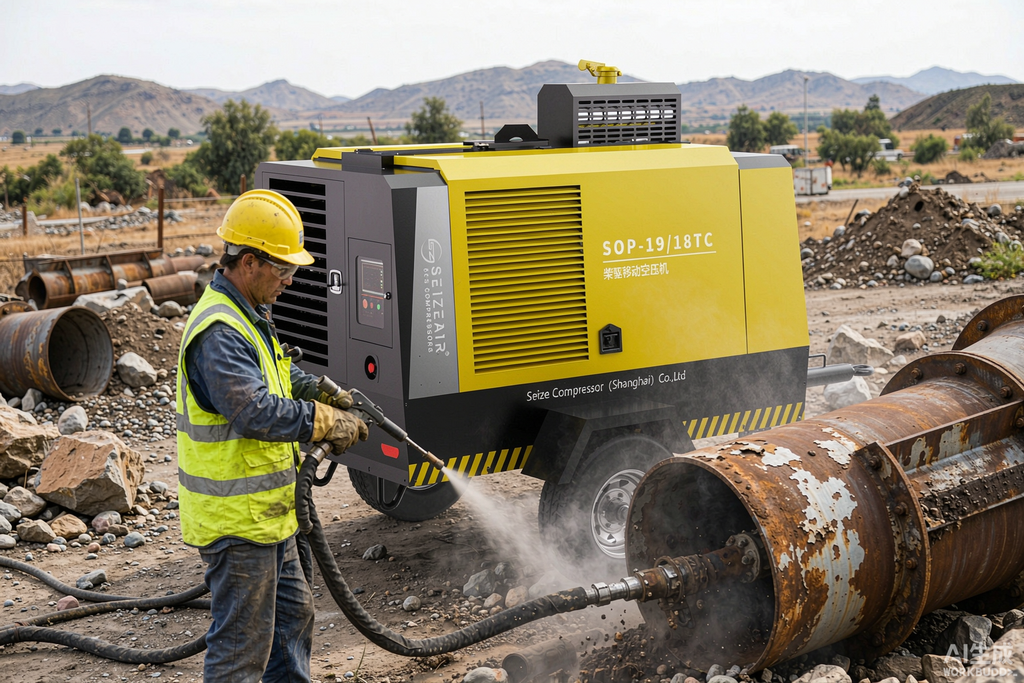
This guide shows you how sandblasting actually consumes compressed air, how to size CFM and pressure by nozzle, when a diesel portable unit beats electric, and how to wire up a blast pot and hose without fighting moisture and friction loss. By the end you will know exactly which numbers to check before you buy — and how to avoid the expensive mistake of buying a compressor that cannot keep your nozzle fed. When you are ready, contact SEIZE AIR and we will size a unit to your blast setup. [PLACEHOLDER: SEIZE nozzle×CFM table link]
Key Takeaways
- Sandblasting air demand is set by the nozzle — bigger nozzle, exponentially more CFM. The compressor must match the nozzle, not the other way around.
- Estimated CFM by nozzle (all figures below are estimates): #4 (~6 mm) ≈ 90–120 CFM @ 90–100 psi; #6 (~9.5 mm) ≈ 180–250 CFM; #7 (~11 mm) ≈ 300+ CFM.
- Remote, off-grid sites need a diesel portable unit. Electric only works where grid power is available and sized for the load.
- Moisture in the line is the second-biggest cause of clogged abrasive. An aftercooler plus dryer cuts clogging dramatically.
- Always add margin for hose friction loss, moisture, and the fact that you will likely upsize your nozzle later.
- SEIZE AIR portable diesel screw units (such as the SDP-19/18TC) are built for abrasive blasting, mining, and DTH drilling duty.
How Sandblasting Consumes Compressed Air
A blast nozzle works like a Venturi: compressed air accelerates through a carefully shaped orifice and pulls abrasive into the airstream, then throws the mixture at the surface. The air does two jobs at once — it propels the abrasive and it meters how much abrasive can be drawn in. If air volume (CFM) drops, abrasive flow drops with it, and the finish gets weak and uneven.
The single biggest driver of demand is the nozzle orifice diameter. Because flow scales roughly with the square of the diameter, stepping up from a #4 to a #6 nozzle does not add a little demand — it more than doubles it. Pressure (psi/bar) is the second lever: more pressure means more velocity, which means more abrasive delivered per minute, but also more total air consumed.
That is why “what size compressor do I need for sandblasting?” has no single answer. It depends on (1) your nozzle, (2) your working pressure, (3) hose length and diameter, and (4) how dry your air is. Get any one of those wrong and the job stalls. SEIZE AIR publishes a detailed nozzle-by-nozzle CFM reference for its portable line — but note that reference is not reproduced here. [PLACEHOLDER: SEIZE nozzle×CFM table]
The practical rule: size the compressor to the nozzle you plan to run, then add margin. Running a nozzle at the ragged edge of your compressor’s capacity guarantees pressure sag the moment the blast pot opens.
CFM and Pressure by Nozzle Size
The numbers below are estimated working ranges for common blast nozzles at typical blasting pressure. Treat them as planning figures, not guaranteed specs for any specific machine — always confirm against the manufacturer’s nozzle chart and your actual site conditions.
| Nozzle | Orifice (approx.) | Est. CFM @ 90–100 psi | Typical use |
| #4 | ~6 mm | 90–120 CFM | Small spot jobs, detail work, lighter coatings |
| #5 | ~8 mm | 130–180 CFM (est.) | General light-to-medium surface prep |
| #6 | ~9.5 mm | 180–250 CFM | Bridge steel, tanks, medium-to-heavy scale |
| #7 | ~11 mm | 300+ CFM | Large-area, high-production blasting |
A few things to keep in mind about these estimates:
- Pressure matters. Push to 100–125 psi and the same nozzle pulls more CFM than at 80 psi. If your job spec calls for higher pressure, size up.
- One nozzle, one compressor — usually. Running two operators off one compressor means you need the sum of both nozzles’ CFM, plus margin. Most portable setups run a single blast operator per machine.
- Margin is not optional. Plan for at least 15–25% headroom above the table value so the compressor is not pinned at 100% load all day. Continuous full-load running shortens service intervals and invites pressure dips.
If you are blasting at scale (think #6 or #7 nozzles), a single small electric unit will not keep up. That is where a high-FAD diesel portable comes in — more on that below.
Diesel Portable vs Electric for Blasting
The choice comes down to one question: is there grid power where you are blasting?
Electric makes sense when:
- You are in a shop, yard, or plant with three-phase power already sized for the load.
- Noise and emissions rules favor electric.
- You want the lowest running cost per hour where power is cheap.
Diesel portable is the answer when:
- The site is off-grid — bridges, pipelines, ships, quarries, remote tanks, rail.
- You need to move the air with the job (trailer-mounted, self-powered).
- You are already running other diesel plant and want one fuel type on site.
For abrasive blasting on remote infrastructure, diesel wins on mobility and independence. SEIZE AIR’s portable diesel screw line is engineered exactly for this — self-contained, trailer-mounted, and capable of feeding large nozzles without a grid connection. Learn more about the diesel portable air compressor and see how these units are applied in heavy industry.
A concrete example is the SEIZE SDP-19/18TC portable diesel screw compressor:
- Free Air Delivery (FAD): 19 m³/min (≈665 CFM)
- Working pressure: 18 bar (≈261 PSI)
- Fuel tank: 260 L
- Engine: Cummins 194 kW
- Weight: 3500 kg
- Outlets: G2″ × 1 + G3/4″ × 1
- Mounting: 4-wheel trailer
At ~665 CFM, the SDP-19/18TC comfortably feeds a #6 or even #7 nozzle with margin to spare, making it a realistic choice for production blasting and similar high-demand duties. The same diesel portable platform is widely used in mining and drilling — see diesel portable compressors for mining and diesel portable compressors in mining for field applications.
If your blasting is yard-based and grid power is available, a screw air compressor on fixed power can be the lower-cost route. The decision is site-specific, not ideological.
Note on warranty: SEIZE AIR’s portable line has no standard warranty policy; after-sales are handled per order/project. Confirm terms with your SEIZE AIR representative before purchase.
Sizing the Compressor to Blast Pot and Hose
Matching the compressor to the nozzle is only half the job. The air still has to travel through the hose and into the blast pot without losing its fight.
Hose friction loss. The longer and narrower the hose, the more pressure you lose between the compressor outlet and the nozzle. A small hose ID forces the air to squeeze through, dropping both pressure and effective CFM at the nozzle. Rule of thumb: use the largest practical hose ID for the run, and keep the distance short. If you must run long, step up hose diameter rather than squeezing through a thin line.
Blast pot compatibility. The pot’s metering valve and airline must accept the compressor’s outlet size and flow. The SDP-19/18TC, for instance, offers G2″ and G3/4″ outlets — match these to your pot inlet and downstream plumbing so you are not bottlenecked by a reducer.
Moisture in the line. Hot compressed air carries water vapor. As it cools in the hose, that vapor condenses into liquid that mixes with abrasive and cakes it. Wet abrasive flows poorly, clogs the pot, and leaves a streaky finish. This is why aftercooling and drying are not optional on real blast jobs (next section).
For routine care of the machine feeding your pot, a screw compressor maintenance guide covers the service habits that keep FAD and pressure where they should be.
Moisture and Abrasive Quality
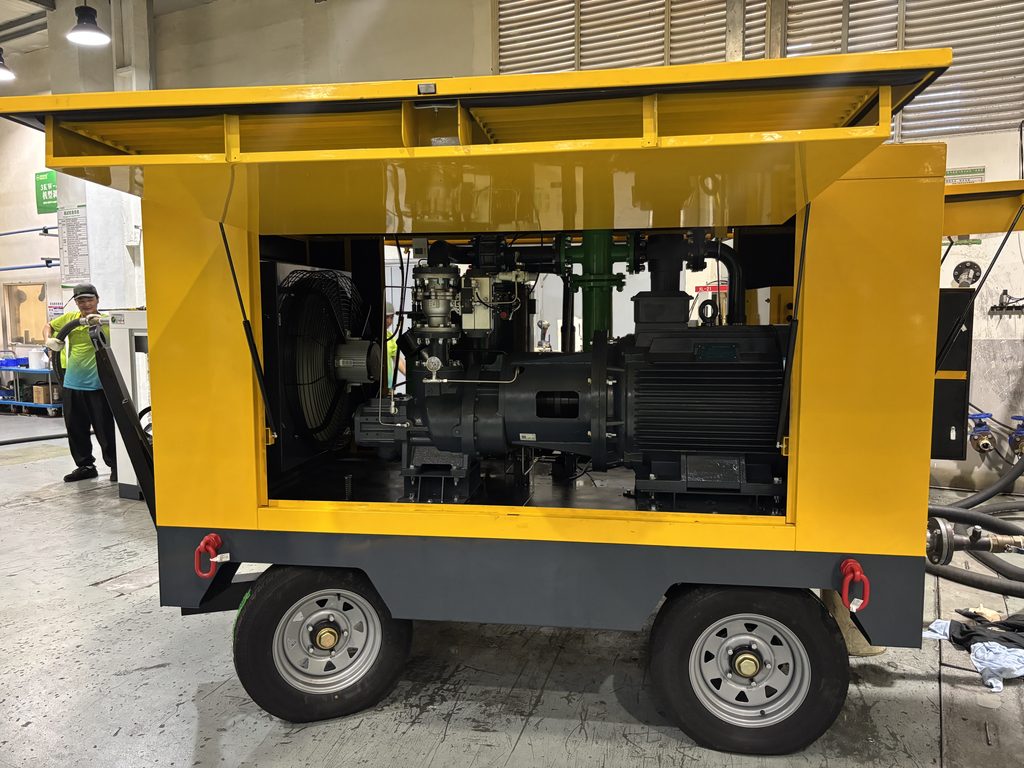
Moisture is the silent killer of blast productivity. Three things compound:
- Condensation in the hose wets the abrasive before it reaches the nozzle.
- Wet abrasive clumps, bridging inside the pot and choking the metering valve.
- Inconsistent flow then produces the uneven finish operators blame on the nozzle.
The fix is air treatment. An aftercooler drops the discharge temperature so most vapor condenses out early, and a dryer (refrigerated or desiccant, depending on your target dew point) removes the rest. On a diesel portable like the SDP-19/18TC, specifying the aftercooler/dryer option is the single most effective upgrade for blasting duty — it directly reduces clogging and improves finish consistency.
Abrasive quality matters too. Wet, contaminated, or poorly graded media flows unevenly regardless of your air supply. Store abrasive dry, screen it before use, and match grit size to the nozzle and substrate. Good abrasive plus dry air is what gives you a clean, uniform profile.
Site Factors: Dust, Abrasive, Ambient Temperature
Real sites are messier than spec sheets. Three field factors change your sizing:
- Dust. Abrasive blasting throws huge volumes of dust. Keep the compressor air intake upwind and away from the plume, or you will pull abrasive dust into the engine and airstream. Intake filtration and siting matter more on blast sites than almost anywhere else.
- Abrasive type. Heavy, sharp media (steel grit, slag) behaves differently than light media (soda, walnut). Heavier media needs more aggressive air to accelerate; lighter media can stall if air is too fast. Your nozzle/CFM table assumes a given media — adjust for what you actually run.
- Ambient temperature. Hot, thin air at altitude or in summer reduces effective output; very cold conditions can affect dryer performance and fuel behavior. [PLACEHOLDER: SEIZE fuel consumption L/h for SDP-19/18TC] Plan margin so a hot afternoon does not drop you below your nozzle’s CFM need.
These are exactly the variables a proper site assessment catches — something SEIZE AIR engineers review per project. [PLACEHOLDER: SEIZE site assessment]
Setup Checklist & Safety
Before you start the first blast, run through this setup list:
- Confirm compressor FAD and pressure exceed your nozzle demand by ≥15–25% margin.
- Match outlet size (e.g., G2″ / G3/4″ on the SDP-19/18TC) to pot inlet — avoid unnecessary reducers.
- Use the largest practical hose ID; keep runs short to limit friction loss.
- Fit aftercooler + dryer; verify dew point before blasting.
- Store and screen abrasive dry; check grade vs nozzle.
- Site compressor intake upwind of the dust plume.
- Inspect all clamps, couplers, and safety relief valves.
- Confirm blaster PPE: helmet with supplied-air respiratory protection, suit, gloves.
- Brief the crew on the emergency stop and dead-man valve at the nozzle.
- Verify trailer stability and braking if the unit is [PLACEHOLDER: SEIZE noise dB(A) rating] deployed on a slope.
Safety first: a dead-man control at the nozzle is non-negotiable, and anyone in the blast zone must be on supplied-air respiratory protection. Compressed-air and abrasive at 90–125 psi will maim in an instant.
How to Select a Sandblasting Air Compressor (Buyer Checklist)
Use this buyer’s checklist when specifying a portable air compressor for sandblasting:
- Lock the nozzle first. Decide the orifice you will run (and the one you might grow into). Size CFM from that, not from a guess.
- Set the pressure. Match the compressor’s rated pressure to your blast spec, with headroom.
- Pick diesel vs electric by site power. Off-grid → diesel portable; shop with grid → electric screw.
- Add hose + moisture margin. Budget 15–25% over table CFM; include aftercooler/dryer.
- Confirm outlets and mounting. Trailer-mounted diesel (e.g., 4-wheel) for mobility; verify G2″/G3/4″ style outlets suit your pot.
- Check the engine and tank. For diesel, confirm engine make (e.g., Cummins 194 kW on the SDP-19/18TC), fuel tank (260 L), and service network.
- Think about adjacent duties. The same portable can serve air compressors for DTH drilling or other site air needs — a flexible buy.
- Compare compressor types for the wider plant. If you also need plant air, review a centrifugal air compressor or a centrifugal vs screw compressor comparison to right-size stationary capacity.
- Consider clean-air needs separately. Blasting is oily/dirty air; if you also run oil-free air compressor duties (e.g., oil-free air for food and pharma), keep those on a dedicated oil-free train — never share a line with a blast pot.
- Confirm after-sales. Remember the portable line has no standard warranty; agree terms per order with SEIZE AIR.
FAQ
Q: What size air compressor do I need for sandblasting? A: It is driven by your blast nozzle and working pressure. Estimated ranges: a #4 nozzle (~6 mm) needs roughly 90–120 CFM at 90–100 psi; a #6 (~9.5 mm) needs about 180–250 CFM; a #7 (~11 mm) needs 300+ CFM. Add margin for hose friction and moisture, and confirm against the SEIZE nozzle-by-nozzle CFM reference. [PLACEHOLDER: SEIZE nozzle×CFM table]
Q: Can a diesel portable compressor run a blast pot on remote sites? A: Yes. A self-powered diesel portable needs no grid connection, which is exactly what off-grid blasting (bridges, pipelines, ships, quarries) requires. For blasting, a two-stage screw unit with an aftercooler/dryer is recommended to cut moisture — wet air is what clogs abrasive. The SEIZE SDP-19/18TC is a fit here: 19 m³/min FAD (≈665 CFM), 18 bar (≈261 PSI), 260 L fuel tank, Cummins 194 kW engine, 260 L-class 3500 kg 4-wheel trailer with G2″×1 + G3/4″×1 outlets. [PLACEHOLDER: SEIZE PROCONVE/EPA Tier 4 Final cert status for SDP-19/18TC]
Q: Why does my blast finish look uneven? A: Usually it is low or fluctuating CFM, or moisture in the line, both of which cause inconsistent abrasive flow. Check that the compressor actually meets your nozzle’s CFM demand (with margin), add an aftercooler + dryer to remove moisture, and verify the hose ID is not too small for the run. A site assessment will catch the specific cause. [PLACEHOLDER: SEIZE site assessment]
Conclusion
Sizing a portable air compressor for sandblasting is not guesswork — it is nozzle math plus margin for hose, moisture, and real-site conditions. Start from the orifice, confirm CFM and pressure with headroom, choose diesel for off-grid mobility, and never skip air drying. Get those right and the patchy finish, clogged pot, and slow job simply disappear.
SEIZE AIR builds portable diesel screw compressors — like the SDP-19/18TC at ~665 CFM and 18 bar — for exactly this work, backed by ISO 1217 and CE alignment, WEG IE4 motors, OKUMA/KAPP NILES/Leitz machining, and a global service network. Note that the portable line carries no standard warranty policy; after-sales are handled per order/project.
Ready to size your unit? Request a quote from SEIZE AIR and we will match a compressor to your blast setup. For more, browse more air compressor guides.