By SEIZE AIR | August 2026
Introduction
Compressed air is often called the fourth utility — alongside electricity, water, and natural gas — and for good reason. Across dozens of industries, pneumatic tools and processes depend on a reliable, high-volume supply of compressed air. When that air supply must move from site to site, adapt to rugged terrain, and perform under extreme conditions, portable air compressors become indispensable.
At sz-portable.com, SEIZE AIR has spent years engineering mobile air compressor solutions that meet the real-world demands of construction crews, mining operations, equipment rental fleets, and a growing range of specialty applications. This article explores how portable air compressors power each of these key industries, the specific challenges they solve, and what to look for when selecting a compressor for your operation.
1. Construction: The Backbone of Portable Compressed Air
Construction remains the largest consumer of portable air compressors worldwide. From roadbuilding to high-rise erection, virtually every major construction project relies on compressed air at some stage.
1.1 Pneumatic Tools on the Job Site
On a typical construction site, portable air compressors drive an arsenal of pneumatic tools:
| Tool | Typical Air Demand | Application |
|---|---|---|
| Jackhammers / Pavement Breakers | 60–90 CFM @ 90 PSI | Demolition, road cutting, trenching |
| Rock Drills | 100–185 CFM @ 100 PSI | Foundation drilling, anchoring |
| Chipping Hammers | 30–50 CFM @ 90 PSI | Surface preparation, concrete scaling |
| Impact Wrenches | 5–10 CFM @ 90 PSI | Structural bolting, steel erection |
| Sandblasters / Abrasive Blasters | 150–375 CFM @ 100 PSI | Surface cleaning, rust removal, coating prep |
| Nail Guns & Framing Tools | 2–5 CFM @ 90 PSI | Carpentry, formwork |
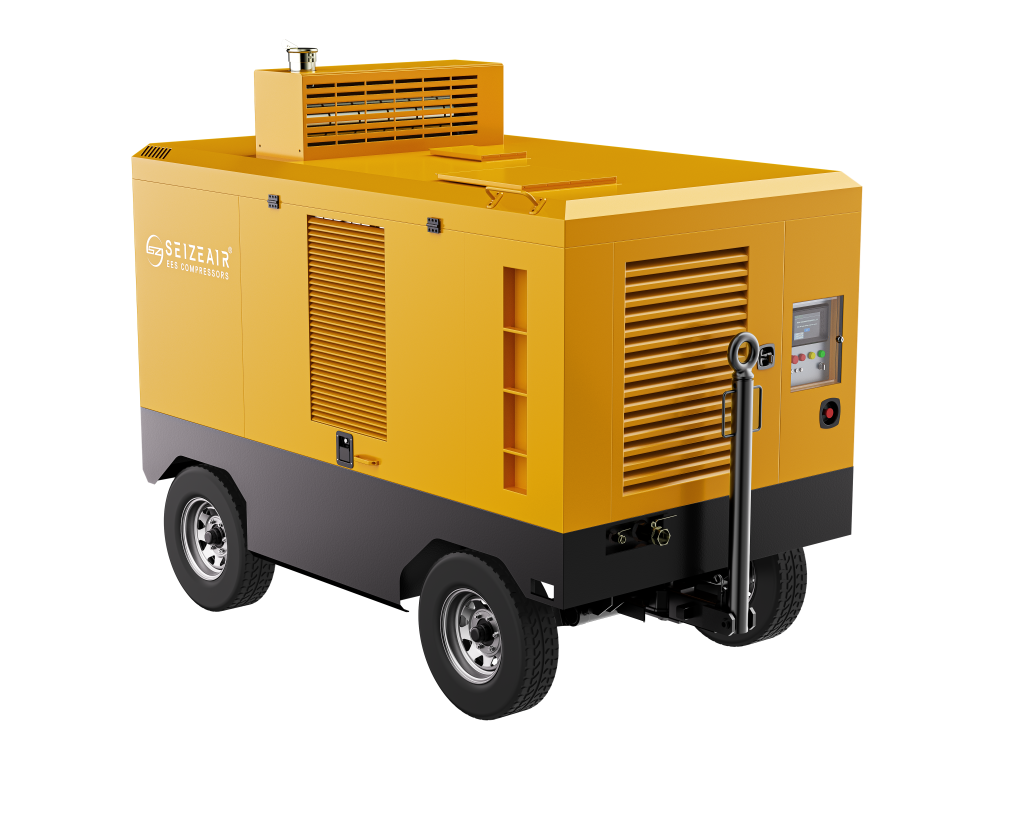
A single SEIZE AIR diesel portable compressor rated at 185 CFM can simultaneously run two jackhammers and a chipping hammer, or feed a sandblasting operation without pressure drop. This multi-tool capability reduces the number of machines a contractor needs on site, cutting both capital expenditure and fuel consumption.
1.2 Shotcrete and Concrete Applications
Beyond handheld tools, portable compressors play a critical role in shotcrete (sprayed concrete) applications for tunnel linings, slope stabilization, and swimming pool construction. Shotcrete demands a steady air stream at moderate pressure with zero pulsation — exactly the performance profile that rotary screw compressors deliver.
SEIZE AIR compressors with aftercooler and moisture separator options ensure the air delivered is dry and clean, preventing blockages in the shotcrete nozzle and voids in the finished concrete.
1.3 Utility and Pipeline Work
Trenching for water mains, gas pipelines, and fiber optic cables requires compressors that can operate in narrow easements and move frequently. The towable design of SEIZE AIR portable units — with highway-rated running gear, LED lighting, and torsion axle suspension — makes daily repositioning straightforward. A single operator can hitch, tow, and deploy the compressor in minutes, minimizing downtime between trench segments.
1.4 Construction Site Challenges Solved
Every construction site presents a unique combination of challenges that portable compressors must overcome:
- Dust and Debris: Heavy-duty two-stage air filtration with safety elements protects the compressor engine and airend in dusty environments. SEIZE AIR units feature cyclonic pre-cleaners and high-capacity primary filters designed for extended service intervals even in the harshest conditions.
- Noise Restrictions: Urban job sites often enforce strict decibel limits. SEIZE AIR silenced canopy models operate at noise levels as low as 70 dBA at 7 meters, making them suitable for residential areas, hospital zones, and night work — without sacrificing airflow output.
- Remote Locations: Sites without grid power depend entirely on diesel-powered compressors. SEIZE AIR diesel units incorporate large fuel tanks for all-day operation, electric start systems with cold-weather glow plugs, and automatic shutdown protection for low oil pressure and high coolant temperature, ensuring reliable autonomous operation far from the nearest service center.
Learn more about SEIZE AIR construction compressors at sz-portable.com
2. Mining: Compressed Air in Extreme Environments
Mining operations push portable air compressors to their limits. Underground mines, open-pit operations, and mineral processing plants each pose distinct demands that generic compressors cannot meet.
2.1 Surface Mining and Quarrying
In open-pit mines and quarries, portable compressors support:
- Blast Hole Drilling: DTH (down-the-hole) hammers require 350–900 CFM at pressures of 150–350 PSI. SEIZE AIR high-pressure diesel portable compressors deliver exactly this performance envelope, with two-stage rotary screw airends that maintain pressure stability even under fluctuating load.
- Secondary Breaking: Oversized boulders that cannot pass through the primary crusher are split using pneumatic rock breakers powered by portable compressors stationed near the crusher feed.
- Dust Suppression: Compressed air powers misting cannons and dust curtain systems that keep airborne silica within regulatory limits.
2.2 Underground Mining
Underground mines present the most demanding compressor application. Here, the compressor must:
- Fit Through Restricted Access: SEIZE AIR offers compact skid-mounted configurations that can be lowered through shafts and maneuvered through drifts where wheeled trailers cannot go.
- Handle High Ambient Temperatures: Underground ambient temperatures can exceed 40°C (104°F) at working faces. Oversized coolers, high-ambient fan packages, and synthetic compressor oils rated for extreme temperatures keep SEIZE AIR units running when lesser compressors overheat and shut down.
- Meet Ventilation Constraints: Diesel-powered compressors in underground mines must comply with strict emissions standards (MSHA / CANMET). SEIZE AIR diesel units equipped with Tier 3 / Stage IIIA or Tier 4 Final emissions-compliant engines meet most international underground mining regulations.
- Resist Corrosion: Acidic mine water and high humidity attack standard steel components. SEIZE AIR offers corrosion-resistant coating packages and stainless-steel fittings for mining-spec units.
2.3 Mineral Processing Support
Beyond extraction, portable compressors serve mineral processing plants for:
- Instrument Air: Control valves, actuators, and pneumatic instrumentation throughout the processing circuit require clean, dry air at consistent pressure. SEIZE AIR compressors paired with refrigerated or desiccant air dryers provide ISO 8573-1 Class 1.4.1 instrument-quality air.
- Filter Press Operation: Membrane filter presses used for tailings dewatering rely on compressed air to inflate the membrane and squeeze filtrate from the cake.
- Flotation Cell Agitation: Some flotation circuits use compressed air injection to generate the bubble columns essential for mineral separation.
3. Equipment Rental: The Compressor as a Revenue Asset
4. Beyond the Big Three: Specialty and Emerging Applications
While construction, mining, and rental dominate compressor demand, a growing number of industries are discovering the value of portable compressed air.
4.1 Geothermal Drilling and Water Well Installation
Geothermal heat pump installation and rural water well drilling require compressors that can handle high-pressure DTH hammer operation at remote sites. SEIZE AIR high-pressure series compressors (200–350 PSI) coupled to DTH hammers can drill through granite, limestone, and mixed overburden at rates exceeding 20 meters per hour, depending on formation hardness.
4.2 Emergency Response and Disaster Recovery
After earthquakes, hurricanes, or floods, portable air compressors become critical infrastructure tools:
- Debris Clearance: Pneumatic breakers and saws clear collapsed structures where electrical tools are unsafe due to gas leaks or flooding.
- Temporary Shelter Inflation: Large-volume, low-pressure air is needed for inflatable field hospitals and command tents.
- Water Pumping: Air-operated diaphragm pumps dewater flooded basements and tunnels without electrical shock risk.
SEIZE AIR compressors with highway-towable chassis and fast-deploy controls can be on the road within minutes of a mobilization order.
4.3 Shipbuilding and Marine Maintenance
Shipyards use portable compressors for:
- Hull Blasting and Painting: Large CFM requirements for abrasive blasting and airless spray painting demand compressors that sustain pressure under continuous load.
- Pneumatic Caulking and Riveting: Ship assembly relies on air tools for driving rivets and applying sealant along thousands of linear meters of seams.
Marine environments demand corrosion-resistant construction — a specialty that SEIZE AIR addresses with marine-spec coatings, stainless-steel fasteners, and enclosed electrical systems.
4.4 Agriculture and Food Processing
Surprising as it may sound, portable air compressors appear across agriculture:
- Grain Aeration: Portable compressors power perforated-tube aeration systems in temporary grain storage piles.
- Orchard Spraying: Air-blast sprayers use compressed air to atomize and propel pesticides through dense canopies.
- Dairy and Livestock: Pneumatic feeding systems, automated milking parlor gates, and waste handling equipment all depend on clean compressed air.
For food-grade applications, SEIZE AIR offers oil-free screw compressor options that eliminate the risk of lubricant carryover into food-contact air streams.
4.5 Renewable Energy Construction
Wind farm and solar array construction increasingly specify portable air compressors:
- Wind Turbine Foundation Bolting: Hydraulic torque wrenches require compressed air for pump operation during the precision tensioning of anchor bolts on hundred-meter turbine towers.
- Solar Farm Pile Driving: Pneumatic post drivers set ground-mount racking piles faster than hydraulic alternatives in sandy or rocky soil.
- Transmission Line Construction: Pneumatic compression tools for overhead conductor splicing and dead-ending perform reliably in remote, high-altitude settings.
4.6 Infrastructure Inspection and Maintenance
Bridge inspection crews and dam maintenance teams use portable compressors to power:
- Non-destructive testing equipment (ultrasonic flaw detectors, magnetic particle inspection yokes requiring air cooling)
- Under-bridge access platforms (pneumatic swing stages)
- Concrete spall repair tools (needle scalers, chipping hammers)
5. Selecting the Right Portable Compressor: A Decision Framework
Choosing the right compressor for your industry requires a structured evaluation. Use this five-step framework to narrow your options.
Step 1: Define Your Air Demand
Calculate the combined CFM (cubic feet per minute) and PSI (pounds per square inch) requirement of all tools that will run simultaneously. Add a 15–20% margin for leaks, hose friction losses, and future tool additions.
Rule of thumb: Running a compressor at 85–90% of its rated capacity maximizes fuel efficiency and component life. Oversizing by more than 30% wastes fuel; undersizing starves tools and shortens compressor life through constant full-load cycling.
Step 2: Diesel vs. Electric
| Factor | Diesel | Electric |
|---|---|---|
| Mobility | Fully autonomous, no grid required | Requires electrical supply (grid or generator) |
| Operating Cost | Fuel cost varies by region; higher maintenance (oil, filters) | Lower energy cost; reduced maintenance |
| Emissions | Exhaust must be managed (outdoor only unless Tier 4 Final + scrubber) | Zero on-site emissions — suitable for indoor and enclosed spaces |
| Noise | 65–75 dBA (silenced canopy) | 55–65 dBA (inherently quieter) |
| Initial Cost | Lower upfront, higher lifetime cost | Higher upfront, lower lifetime cost |
| Best For | Remote sites, construction, mining, quarrying | Indoor demolition, urban renovation, food/pharma, permanent installations |
Step 3: Pressure Rating
- 100 PSI: General pneumatic tools (impact wrenches, nailers, chippers)
- 125–150 PSI: Sandblasting, heavy breakers, pipeline testing
- 200–350 PSI: DTH drilling, geothermal, water well, high-pressure blasting
Step 4: Portability and Site Access
Assess the access route. Can a full-size trailer reach the compressor station? If not, consider a skid-mounted or utility-vehicle-portable configuration. Check for:
- Bridge weight limits on access roads
- Overhead clearance (tree canopies, tunnel entrances)
- Turning radius for the tow vehicle
- Ground bearing capacity (will the site support a 1,500–3,000 kg trailer?)
Step 5: After-Sales Support
A compressor is a long-term investment. Evaluate the manufacturer’s:
- Spare parts availability in your region
- Service network coverage
- Warranty terms (standard and extended)
- Technical documentation and training resources
SEIZE AIR maintains a growing global distributor network with regional parts warehouses and factory-trained service technicians. Visit sz-portable.com to locate your nearest dealer.
6. The SEIZE AIR Advantage: Engineering for the World’s Toughest Job Sites
What distinguishes SEIZE AIR portable compressors from the competition is a design philosophy rooted in field feedback. Every generation incorporates lessons learned from customers operating in temperatures from -25°C to +50°C, at altitudes from sea level to 4,000 meters, and in dust, mud, and salt spray.
Key engineering features across the SEIZE AIR portable compressor range include:
- Premium Rotary Screw Airends: Designed in-house or sourced from leading global manufacturers, with large-diameter rotors operating at low tip speeds for maximum efficiency and minimum wear. The low-speed design reduces heat generation, extends bearing life, and maintains tight internal clearances for consistent performance over thousands of hours.
- Heavy-Duty Filtration: Two-stage air intake filtration with safety elements, plus high-efficiency oil filtration and separation, ensure clean air delivery and extended fluid life. Oversized oil sumps with extended drain intervals reduce service frequency in remote locations.
- Smart Control Systems: Microprocessor-based controllers with auto-start/stop, load/unload regulation, and comprehensive gauge monitoring (discharge temperature, separator pressure, hour meter, battery voltage). Diagnostic LED indicators simplify troubleshooting for operators without specialized training.
- Robust Enclosures: Powder-coated steel canopies with sound-dampening foam lining withstand transport vibration, UV exposure, and minor impacts. Hinged, lockable access panels provide full service access without removing bodywork.
- Global Compliance: CE-certified for European markets, with EPA Tier 4 Final / EU Stage V engine options available for emissions-regulated territories. Electrical systems are available in 12V and 24V configurations to match regional standards.
Conclusion
Portable air compressors are more than auxiliary equipment — they are the primary power source for critical operations across construction, mining, rental, and an expanding array of specialty industries. The right compressor transforms project timelines, reduces operating costs, and improves safety. The wrong one becomes a daily bottleneck.
At sz-portable.com, SEIZE AIR is committed to helping customers identify and deploy the compressor configuration that matches their specific application. Whether you are breaking pavement in a dense city center, drilling blast holes in an open-pit mine at altitude, or equipping a rental fleet that must serve a hundred different customers, a purpose-built SEIZE AIR portable compressor is ready to deliver.
Contact our application engineering team today to discuss your compressed air requirements.