A comprehensive guide to how diesel and electric portable air compressors drive productivity across the world’s most demanding industries.
Introduction
Compressed air is often called the fourth utility — alongside water, electricity, and natural gas — for good reason. On job sites where fixed infrastructure doesn’t exist, mobile air compressors become the backbone of operations. From breaking concrete on a highway expansion project in Germany to drilling blast holes at an open-pit mine in Australia, portable air compressors deliver pneumatic power wherever it’s needed, whenever it’s needed.
SEIZE AIR’s range of mobile air compressors — spanning both diesel-powered and electric-driven models — is engineered to meet the diverse demands of construction, mining, rental fleets, and industrial applications across the globe. With operating pressures from 7 to 35 bar and free air deliveries ranging from 1.5 to 35 m³/min, our portfolio covers everything from light-duty service trucks to heavy-duty quarry operations.
This article explores the key application scenarios for mobile air compressors, how to match the right machine to the job, and why equipment choice directly impacts project timelines, fuel costs, and total cost of ownership.
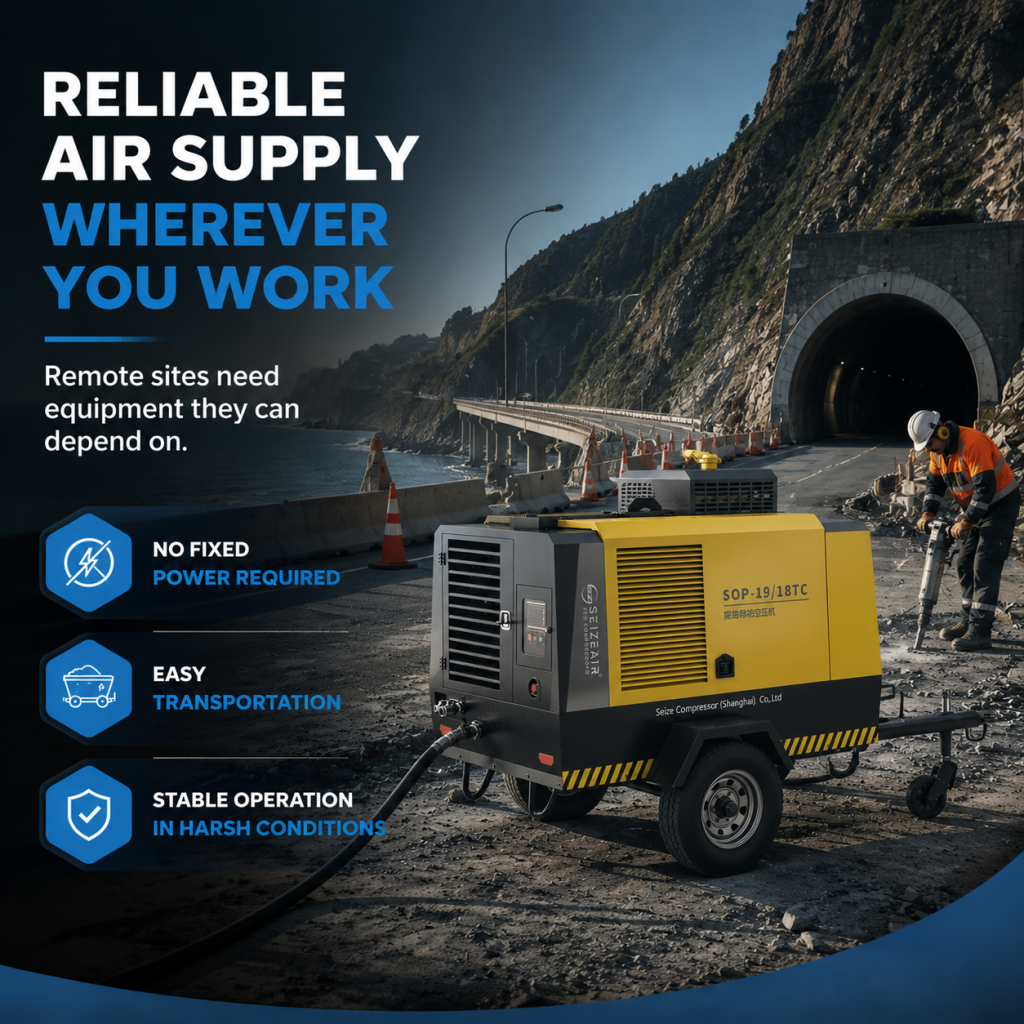
SEIZE AIR diesel portable air compressor on a mining site
1.1 Pneumatic Tool Operation
The most common construction application is powering handheld pneumatic tools. A single mobile compressor can simultaneously run multiple tools including:
- Pavement breakers (jackhammers): Require 25–40 cfm per tool at 90–100 psi. A medium-sized diesel portable compressor in the 375–425 cfm range can comfortably power a crew of 6–8 breakers on a road demolition project.
- Rock drills: Used for anchoring, bolting, and foundation preparation. These demand consistent pressure — any fluctuation reduces penetration rate and bit life.
- Chipping hammers and scalers: For surface preparation, coating removal, and concrete repair work on bridges and parking structures.
- Tamping and compaction tools: Pneumatic tampers are preferred in trench backfilling where electric alternatives risk cable damage or spark hazards.
1.2 Shotcrete and Concrete Applications
In tunnel construction and slope stabilization, shotcrete (sprayed concrete) relies heavily on mobile air compressors. The compressor supplies high-volume air to propel the concrete mix through a nozzle at high velocity onto the target surface.
For shotcrete applications, a diesel portable compressor delivering 600–900 cfm at 7–12 bar is typical. The key requirement here is air quality — moisture and oil carryover from substandard compressors can compromise shotcrete adhesion and structural integrity. SEIZE AIR compressors equipped with integrated aftercoolers and moisture separators deliver clean, dry air that meets the stringent requirements of modern shotcrete specifications.
Concrete cutting and drilling also depend on portable air. Diamond wire saws, core drills, and wall saws used in demolition and renovation frequently run on compressed air where water-cooled electric alternatives are impractical.
1.3 Sandblasting and Surface Preparation
Industrial sandblasting for structural steel, bridge components, storage tanks, and ship hulls consumes enormous volumes of compressed air. A single 3/8-inch blasting nozzle can demand 200–370 cfm at 100 psi, and many blasting operations run multiple nozzles simultaneously.
Portable diesel compressors in the 750–1,600 cfm range paired with proper aftercooling and filtration are the standard choice for field blasting. Electric portable compressors are increasingly favored for indoor or urban blasting projects where diesel exhaust restrictions apply — for example, tank lining removal inside a refinery or bridge maintenance in a city center.
1.4 Pipeline Testing and Purging
Before oil, gas, or water pipelines are commissioned, they must undergo pressure testing and drying. Mobile air compressors supply the high-volume, medium-to-high-pressure air required to pressurize kilometers of pipeline for hydrostatic test dewatering, pneumatic testing, and nitrogen purging support. The ability to tow a compressor along the pipeline right-of-way makes mobile units indispensable for this application.
2. Mining Applications: Compressed Air in Extreme Environments
Mining environments push equipment to its limits. High altitudes, extreme temperatures, abrasive dust, and round-the-clock operation demand compressors that are overbuilt, not just adequate.
2.1 Exploration and Development Drilling
Mineral exploration teams operating in remote regions — from the lithium-rich salt flats of South America to the gold belts of West Africa — rely on mobile air compressors to power exploration drill rigs. These compressors must deliver consistent high-pressure air (often 17–25 bar) to drive down-the-hole (DTH) hammers through hard rock formations.
A typical exploration setup pairs a diesel portable compressor rated at 700–1,100 cfm at 20–25 bar with a crawler or truck-mounted drill rig. The compressor’s duty cycle is punishing — often 10–12 hours continuous in ambient temperatures exceeding 45°C. SEIZE AIR’s mining-grade compressors feature oversized cooling systems, heavy-duty air filtration with cyclone pre-cleaners, and reinforced frames to handle transport over unsealed mine roads.
2.2 Production Blast Hole Drilling
In open-pit mining operations, blast hole drilling is the critical path activity — if drilling stops, the entire mine’s production schedule cascades into delay. Production drill rigs consume 1,000–1,800 cfm at 24–35 bar, making them among the most air-hungry applications in any industry.
For this tier of demand, mine operators often deploy multiple high-pressure diesel compressors in parallel or invest in large single-unit compressor packages rated above 1,450 cfm. Redundancy is key — mines typically keep a standby compressor on-site to ensure zero drilling downtime.
2.3 Underground Mining Ventilation and Utility Air
In underground hard-rock and coal mines, compressed air serves dual roles. It powers utility tools (rock bolts, drills, loaders) and — critically — can supplement emergency ventilation in the event of a primary fan failure. Many mining safety regulations mandate a minimum reserve of compressed air capacity specifically for emergency scenarios.
Electric portable compressors are gaining traction in underground mining for their zero-emission operation. Unlike diesel units, electric compressors don’t contribute to the mine’s ventilation load for exhaust gas dilution. SEIZE AIR’s electric portable compressor lineup offers models specifically configured for underground deployment, with IP65-rated motors, intrinsically safe control circuits, and compact dimensions to navigate mine headings.
2.4 Mineral Processing and Beneficiation
Beyond drilling, compressed air drives agitation in flotation cells, powers pneumatic conveying systems for dry bulk materials, and operates filter presses in tailings dewatering. While these are often served by stationary compressor installations, mobile units provide critical backup during plant shutdowns, maintenance windows, and capacity expansion projects — allowing processing to continue while permanent infrastructure is upgraded.
3. Rental and Fleet Applications
The equipment rental industry is one of the fastest-growing channels for mobile air compressors. Contractors increasingly prefer to rent rather than own, shifting capital expenditure to operational expenditure and offloading maintenance responsibility to rental providers.
3.1 What Rental Fleets Demand
Rental companies evaluate compressors differently than end users. Their priorities include:
- Durability across diverse users: A rental compressor may power a jackhammer crew one week and a sandblasting operation the next — with different operators each time. The machine must be tolerant of less-than-perfect operation.
- Low maintenance intervals: Every hour a compressor spends in the workshop is an hour it’s not generating rental revenue. Extended service intervals (500+ hours for engine oil, 1,000+ hours for compressor oil) directly impact rental ROI.
- Telematics and fleet management: Modern rental compressors increasingly feature GPS tracking, remote start/stop, and usage monitoring via cellular connectivity, allowing rental companies to optimize fleet utilization.
- Regulatory compliance: In Europe, Stage V emission standards for non-road mobile machinery are mandatory. In North America, Tier 4 Final applies. Rental fleets must be future-proofed against tightening regulations, which is driving a shift toward electric and hybrid models.
3.2 Common Rental Deployment Scenarios
- Emergency response: After natural disasters, portable compressors provide immediate pneumatic power for debris clearance, temporary structure erection, and utility restoration.
- Seasonal peaks: Agricultural processing plants, asphalt batch plants, and construction sites all experience seasonal demand spikes where rental compressors fill the gap.
- Plant turnarounds: Refineries, chemical plants, and power stations schedule maintenance shutdowns where dozens of portable compressors are brought in simultaneously for sandblasting, bolting, and pneumatic tooling.
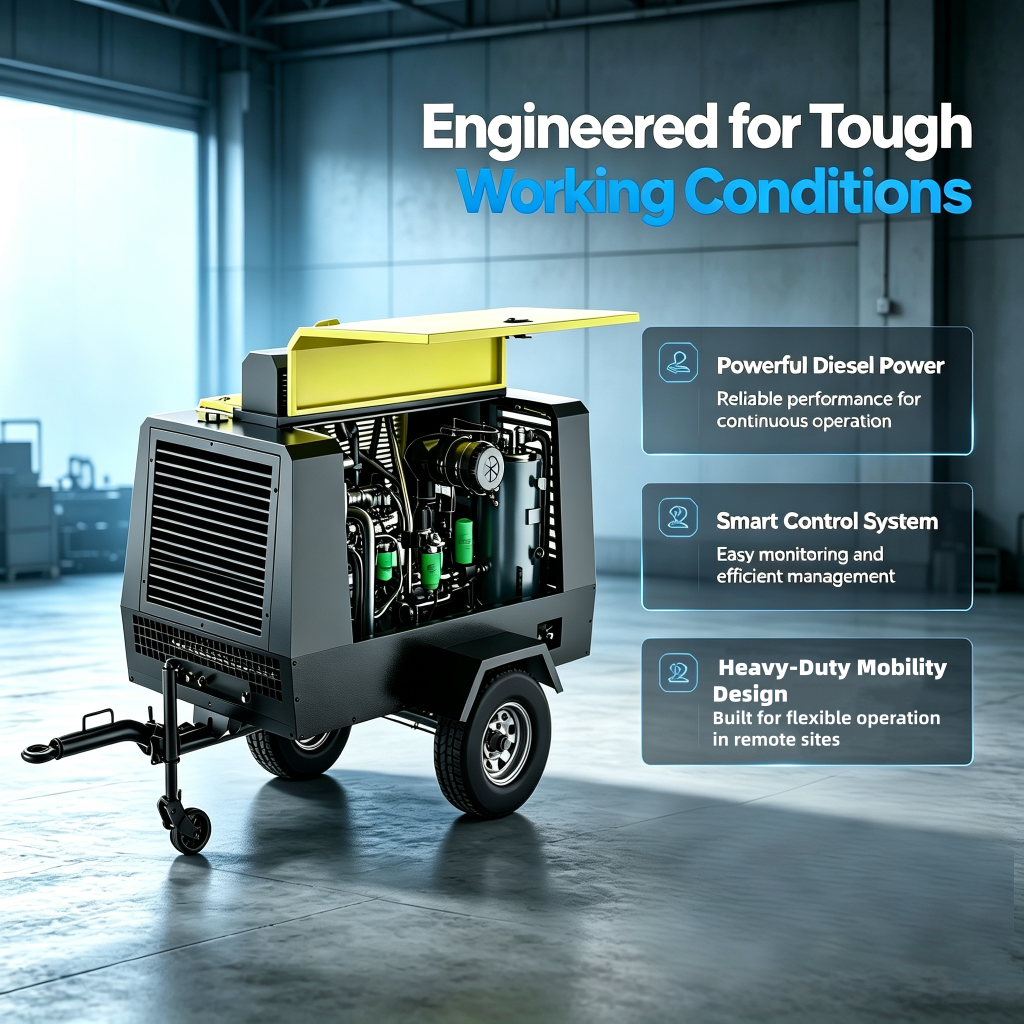
SEIZE AIR electric portable air compressor suitable for indoor and urban applications
4. Diesel vs. Electric: Choosing the Right Mobile Compressor for Your Application
One of the most frequent questions from buyers is whether to choose a diesel-powered or electric-driven mobile compressor. The answer depends entirely on the application environment.
4.1 Diesel Portable Compressors: Advantages
| Factor | Diesel Advantage |
|---|---|
| Autonomy | No external power source required. Operates anywhere with fuel supply. |
| Power density | Higher cfm output per footprint compared to electric equivalents at similar frame sizes. |
| Remote locations | Ideal for greenfield construction, mining exploration, and pipeline projects with no grid access. |
| Resale value | Diesel compressors hold value well in the secondary market, particularly in developing economies. |
4.2 Electric Portable Compressors: Advantages
| Factor | Electric Advantage |
|---|---|
| Emissions | Zero exhaust emissions at point of use. Compliant with the strictest urban air quality regulations. |
| Indoor use | Safe for tunnels, underground mines, warehouses, and enclosed industrial spaces. |
| Noise | Significantly quieter operation — typically 65–72 dBA vs. 75–85 dBA for equivalent diesel units. |
| Operating cost | Electricity cost per operating hour is typically 40–60% lower than diesel fuel cost, depending on local energy prices. |
| Maintenance | No engine oil changes, fuel filters, DEF fluid, or DPF regeneration cycles. Electric motor maintenance is minimal. |
4.3 The Hybrid Sweet Spot
A growing trend in the mobile compressor market is the “electric-ready” or hybrid configuration. These units feature an onboard electric motor with a VSD (variable speed drive) that can plug into site power when available, while retaining a diesel engine as backup or for remote operation. This flexibility is particularly attractive for rental fleets, where a single machine can serve both grid-connected urban projects and off-grid rural deployments.
For a deeper dive into diesel vs. electric compressor selection criteria — including detailed TCO (total cost of ownership) calculations — visit SEIZE AIR’s product comparison tools.