Introduction
A portable diesel air compressor is vital for remote job sites. These sites face unique challenges. Fuel supply can be difficult and costly. Long-distance transport adds expense. Extreme weather impacts performance. Tool load demands often fluctuate wildly. These factors directly hit your operating budget. This guide aims to help site managers and procurement teams. It provides actionable strategies for fuel savings. We cover intelligent selection and operational best practices. A Total Cost of Ownership (TCO) model is also included. Our goal is to boost your site’s profitability and reliability. Let’s explore how to maximize the value of your compressed air investment.
1. Why Fuel Efficiency Matters on Remote Job Sites
On remote sites, fuel is not just an expense. It is the lifeblood of operations. For a typical mid-range portable diesel air compressor, daily fuel consumption can range from 20 to 60 liters. Weekly usage can easily exceed 300 liters. Fuel often represents the largest variable cost over the machine’s life. But the impact goes beyond direct fuel costs. Inaccessible locations make delivery complex and expensive. Unplanned downtime waiting for fuel halts all pneumatic tools. This delay results in significant project losses. Therefore, fuel efficiency is critical. It ensures operational continuity and budget control. True efficiency combines three elements. These are correct machine sizing, intelligent control systems, and disciplined site management. Understanding this is key for any diesel engine air compressor buying guide. Choosing the right portable diesel air compressor for field work starts here.
2. Core Factors That Determine Fuel Use
Several key factors drive fuel consumption. Addressing them unlocks major savings.
2.1 Load Matching
Oversizing is a common mistake. A compressor delivering more CFM than needed wastes fuel. Always match the CFM output to your tool requirements.
2.2 Control Strategy
Traditional units run at a constant high speed. Modern systems adjust engine RPM to demand. Variable speed and auto-stop/start (ECO) modes are crucial. They drastically cut fuel use during low demand.
2.3 Pressure Settings
Operating pressure is a major fuel driver. For every 2 PSI reduction in system pressure, you save about 1% in energy. Avoid setting pressure higher than necessary.
2.4 Leaks & Piping Losses
Air leaks are wasted fuel. A small leak can cost hundreds annually. Poorly designed piping creates pressure drop. This forces the compressor to work harder.
2.5 Filtration & Cooling
Dirty air filters and blocked coolers increase resistance. The engine must work harder to maintain airflow. This leads to higher fuel consumption.
2.6 Duty Cycle & Idle Time
Letting a diesel compressor idle is costly. Idling consumes fuel without productive output. Minimizing idle time is a simple, effective saving tactic. As noted by the City of Seattle, reducing compressed air system pressure and fixing leaks are among the top energy-saving measures.
3 How to Size and Select a Fuel-Efficient Unit
Proper sizing is the first step to efficiency. Start with a detailed tool list. Calculate the total required CFM and PSI.
3.1 Calculate Your Air Demand
Sum the CFM of all tools that may run simultaneously. Add a safety factor of 10-15%. Do not overestimate. For example, two drills (10 CFM each) and a breaker (60 CFM) need ~88 CFM total. A 300 cfm diesel air compressor would be oversized. A 125-150 CFM unit may suffice.
3.2 Prioritize Intelligent Controls
For variable demand, choose units with smart controls. Atlas Copco’s PACE and FuelXpert systems are examples. They electronically regulate pressure and engine speed. This matches output precisely to demand. It can save up to 40% fuel at partial load compared to fixed-speed models.
3.3 Compare Specifications
Evaluate options based on your typical load. A 500 cfm diesel air compressor at 50% load may use more fuel than a properly sized 300 CFM unit at 80% load. Request fuel consumption curves from suppliers. Compare data at your expected average load, not just full load. For specialized tasks like sandblasting, a high pressure diesel engine air compressor is needed. Ensure its control system is equally efficient.
4 On-site Operational Practices to Cut Fuel Use
Technology alone is not enough. Smart site practices are essential.
- Reduce Idle Time. Implement automatic ECO stop-start. Shut down during extended breaks. This can cut idle fuel waste by over 90%. Atlas Copco units often feature this.
- Match Pressure to Tools. Set the system pressure to the minimum required by the highest-demand tool. Avoid a “one-size-fits-all” high pressure setting.
- Find and Fix Leaks. Use ultrasonic leak detectors weekly. A single 1/8-inch leak can waste thousands annually. The City of Seattle recommends regular leak audits as a best practice.
- Maintain Filters and Coolers. Schedule regular cleaning. A clogged filter can increase fuel use by 5-10%. Keep cooling fins clean for optimal engine efficiency.
- Use Load-Sharing Controls. For multiple compressors, use a central controller. It sequences units to operate near optimal load.
- Train Your Operators. Educate crews on fuel-efficient habits. This includes proper startup/shutdown and reporting leaks.
Operating actions and expected fuel savings
| Operational Actions | Expected Fuel Savings |
|---|---|
| Activate Automatic Start-Stop (ECO Mode) | Reduce Idle Fuel Consumption by 90%+ |
| Reduce System Pressure by 10-15 PSI | Savings of 5-8% |
| Perform Regular Leak Detection and Repair | Savings of 10-30% |
| Regularly Clean Air Filter and Cooler | Savings of 3-10% |
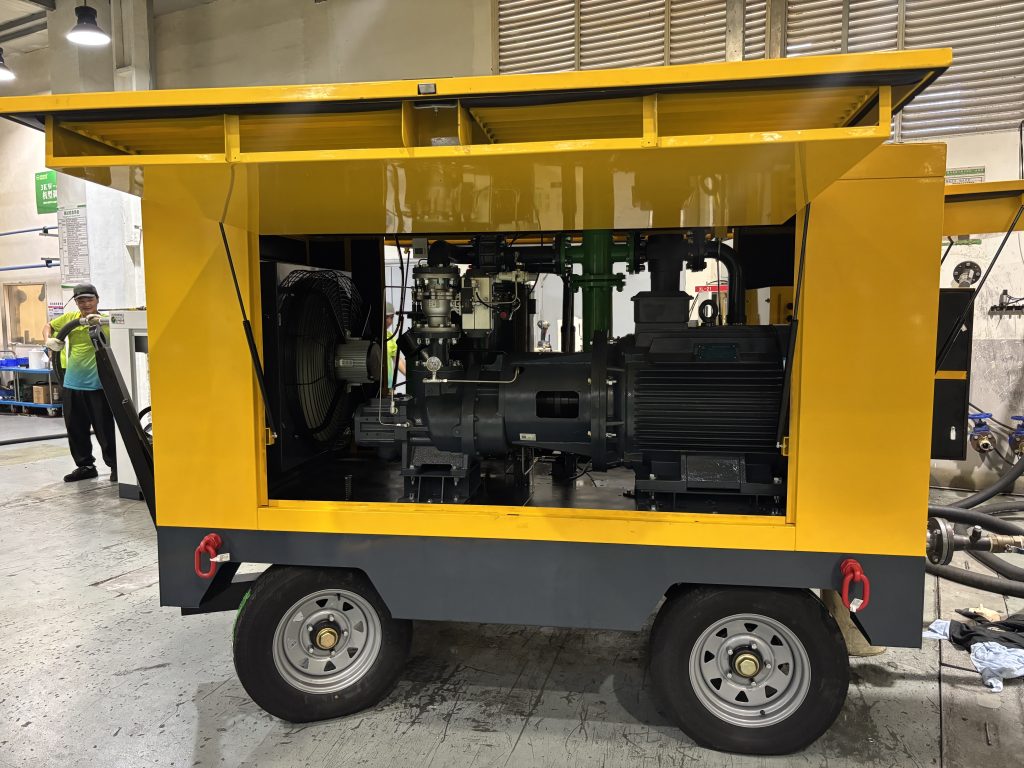
5 Technology & Features That Improve Fuel Efficiency
Modern portable diesel air compressor technology focuses on fuel savings.
5.1 Variable Speed Drive (VSD) / Intelligent Governor
This is the most significant innovation. The engine speed varies with air demand. At low demand, it runs slower, consuming far less fuel than a fixed-speed unit.
5.2 Electronic Pressure Regulation
Systems like Atlas Copco’s PACE maintain pressure within a very tight band (±1 psi). This eliminates over-pressurization. It reduces the “load/unload” cycling that wastes fuel.
5.3 Efficient Air-End Design
Advanced screw element designs minimize internal leakage (parasitic loss). This improves volumetric efficiency, delivering more air per engine revolution.
5.4 Effective Cooling Systems
Efficient aftercoolers and air intakes lower compressed air temperature. Cooler, denser air is more effective for tools. It also reduces strain on the engine.
5.5 Telemetry & Remote Monitoring
Remote monitoring platforms track fuel consumption in real-time. They provide analytics to identify waste patterns. This data is invaluable for optimizing a portable diesel air compressor for field work.
6 Cost Modeling: Estimate Fuel & TCO for Remote Sites
A simple TCO analysis reveals true value. Look beyond the purchase price.
Basic Fuel Cost Formula:
- Daily Fuel (L) = Engine Fuel Consumption at Load (L/h) × Daily Run Hours (h)
- Annual Fuel Cost = Daily Fuel (L) × Operating Days/Year × Local Fuel Price/L
Total Cost of Ownership (TCO) Model:
TCO = Purchase Price + (Annual Fuel Cost × Life in Years) + Estimated Maintenance + Downtime Cost
Example Comparison: 300 CFM Compressor
| Cost Items | Model A: Constant Speed Control | Model B: Variable Speed/Intelligent Control | 备注 |
|---|---|---|---|
| Purchase Price | $25,000 | $32,000 | Higher Initial Investment |
| Average Load Ratio | 70% | 70% | |
| Average Fuel Consumption @ Load | 12 L/h | 8.5 L/h | Model B has higher partial load efficiency |
| Annual Fuel Cost (2000 hours) | $24,000 | $17,000 | Fuel price at $1.25/L |
| Estimated Total Cost Over 5 Years | $145,000 | $129,000 | (Includes purchase and fuel costs) |
This model shows a $16,000 saving over five years for Machine B. The $7,000 premium pays back in less than two years through fuel savings alone. For remote sites with high runtime, investing in efficiency features offers a clear ROI.
7 Procurement & Supplier Considerations
When evaluating portable diesel air compressor manufacturers, consider these points:
- Engine Brand & Tier: A reliable, fuel-efficient engine is the core.
- Efficiency Data: Request official fuel consumption curves and test reports. Don’t rely on marketing claims.
- Support & Service: For remote sites, strong dealer support and parts availability are critical. Check service network coverage.
- Warranty & Terms: Understand the warranty length and what it covers.
Ask potential industrial diesel air compressor suppliers for real-world case studies. Request data from projects similar to yours. A comprehensive diesel engine air compressor buying guide should stress verifying performance data. Choose partners who provide transparency and support your long-term efficiency goals.
Conclusion & Actionable Checklist
Fuel costs on remote sites are controllable. The key is a strategic approach. Select the right machine and operate it intelligently.
Here is your immediate action plan:
- Audit & Size: List all pneumatic tools. Calculate your true CFM and PSI needs. Use this to guide your selection.
- Prioritize Smart Tech: Choose a unit with variable speed or intelligent pressure control. It is the single best investment for fuel savings.
- Implement Site Discipline: Start a leak detection program. Train crews to minimize idle time and match pressure settings.
By focusing on the total cost of ownership, you make smarter investments. The right portable diesel air compressor becomes a profit center, not a cost center. For those seeking reliable and energy-conscious solutions, manufacturers like SEIZEAIR offer robust rotary screw diesel air compressors designed with operational efficiency and durability for demanding environments. Contact us.
Appendix
Table 1: Common Tool Air Requirements (Approximate)
| Tool Type | Typical CFM Range | Typical PSI Range |
|---|---|---|
| Impact Wrench | 4-10 | 90 |
| Drill | 3-10 | 90 |
| Breaker Hammer | 60-90 | 90 |
| Sandblaster | 50-150 | 90+ |
| Paint Sprayer | 5-15 | 40-70 |
FAQ (People Also Ask)
- Q: What size portable diesel air compressor do I need?
A: Create a list of all tools running simultaneously. Sum their CFM requirements. Add a 10-15% safety factor. This is your minimum required CFM. - Q: Are variable speed compressors worth the higher price?
A: On sites with fluctuating demand, yes. The fuel savings typically pay back the premium within 1-3 years, especially with high fuel costs or long run hours. - Q: How much fuel does a diesel compressor use at idle?
A: It varies by engine size but can be 0.5 to 1.5 liters per hour. Over a week, this wasted fuel adds up significantly. Always use eco-stop modes. - Q: How do I find air leaks on site?
A: Ultrasonic leak detectors are the most effective tool. They can pinpoint even small leaks in noisy environments during regular maintenance checks.