Introduction
In today’s demanding industrial, construction, mining, and field service environments, the need for a reliable, powerful source of compressed air is non-negotiable. From powering rock drills at a remote mine site to sandblasting on a construction project, operations depend on equipment that can deliver consistent performance without fail. When tasks move beyond the reach of the electrical grid or demand extreme durability, the diesel industrial air compressor frequently emerges as the backbone of the job site. This article provides a clear comparison of different models across three critical dimensions: Power, Cost, and Reliability. Our goal is to equip procurement managers, engineers, and distributors with the insights needed to make a selection that ensures productivity, controls long-term expenses, and maximizes uptime.
1. Key Performance Metrics — What Matters (Power & Capacity)
Choosing the right diesel industrial air compressor starts with understanding key performance parameters. Misunderstanding these can lead to underpowered equipment that stalls projects or an oversized unit that wastes fuel and capital.
1. The Core Parameters: CFM, PSI, Duty Cycle, and Runtime
- CFM (Cubic Feet per Minute): This measures the volume of air the compressor can deliver. It is the most critical factor in determining if the compressor can keep your tools running effectively. Flow, or the rate of air delivery, directly impacts task efficiency and completion time.
- PSI (Pounds per Square Inch): This measures the force of the delivered air. Different tools require specific pressure levels to operate; insufficient PSI means a tool cannot perform its intended work.
- Duty Cycle: This indicates the time a compressor can operate within a given period (e.g., a 75% duty cycle means it can run for 45 minutes of every hour). For continuous operations, a 100% duty cycle is essential.
- Runtime: Dictated by fuel tank size and engine efficiency, this determines how long the unit can work before refueling—a vital consideration for remote locations.
2. Matching Tools to Compressor Output
Selecting a compressor requires matching its output to your tools’ demands. The following table provides a general guideline, though you should always consult your tool’s specifications-3.
| Application / Tool Type | Typical CFM Requirement (Approx.) | Typical PSI Requirement (Approx.) |
|---|---|---|
| Impact Wrench / Pneumatic Tools | 3 – 10 CFM | 90 – 120 PSI |
| Sandblasting | 6 – 25+ CFM | 70 – 90 PSI |
| Demolition Hammer / Rock Drill | 60 – 100+ CFM | 90 – 120 PSI |
| Paint Spraying | 4 – 8 CFM | 30 – 50 PSI |
| Pipeline Testing | Varies Widely | 100 – 200+ PSI |
A practical step in how to choose a diesel engine air compressor is to list all tools, note their individual CFM/PSI needs, and apply a simultaneous use factor (typically 0.7-0.8) to calculate your total required airflow.
3. The Significant Leap: 300 CFM vs. 500 CFM Diesel Air Compressors
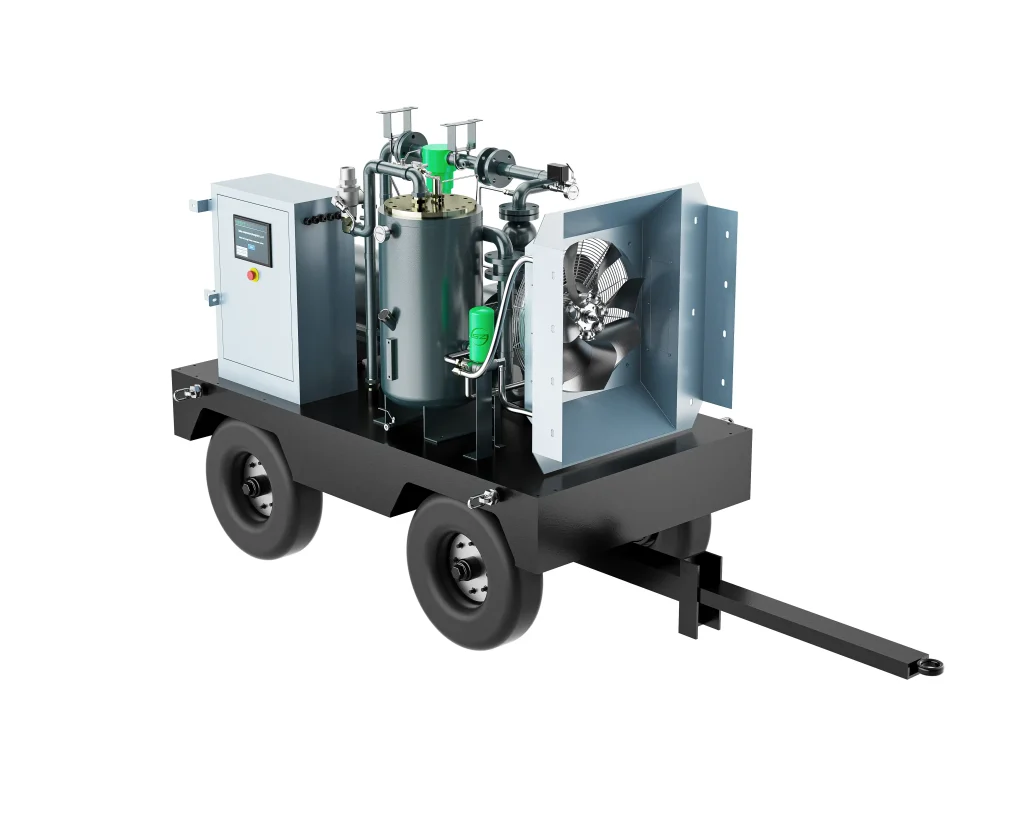
The difference between a 300 cfm diesel air compressor and a 500 cfm diesel air compressor is substantial, impacting more than just air volume:
- Power & Capability: A 500 CFM unit can simultaneously run multiple heavy-duty tools (e.g., two rock drills) or a single, very demanding application that a 300 CFM unit cannot support.
- Fuel Consumption & Stability: The higher-output compressor has a larger, more powerful diesel engine, leading to higher fuel consumption. However, for a demanding job, a correctly sized 500 CFM machine will run efficiently at its optimal load. An undersized 300 CFM unit would be overloaded, potentially consuming more fuel while failing the task and suffering accelerated wear.
- Stability Under Load: A 500 CFM compressor provides a greater air reserve, ensuring stable pressure even during peak demand, which is crucial for tool performance and longevity.
2. Cost Considerations — Fuel, Maintenance, and Total Cost of Ownership (TCO)
The purchase price is just the entry point. A savvy buyer evaluates the diesel engine air compressor through the lens of Total Cost of Ownership (TCO), which includes fuel, maintenance, repairs, and downtime.
Analyzing Operating and Maintenance Costs
- Fuel Consumption: This is the largest ongoing expense. Consumption rates (liters/hour) vary by engine size, load, and technology (e.g., Tier 4 Final engines are more efficient). A real-world case showed a large diesel compressor consuming about 13,000 liters of diesel weekly under full load.
- Routine Maintenance: Diesel engines require regular oil changes, and air, fuel, and oil filter replacements. The compressor element (screw or piston) also needs specific lubrication and service. Proactive maintenance is far less costly than major repairs following a failure.
- Comparative Running Costs: A higher horsepower compressor naturally has higher absolute fuel and maintenance costs. However, the cost per unit of compressed air (CFM) is often lower for a correctly sized, efficient larger unit compared to a smaller one running at its limit.
The Critical Balance: Purchase Price vs. Long-Term Cost
Emphasizing only the upfront price is a common pitfall. A cheaper, lower-quality portable diesel air compressor for field work may have higher fuel consumption, less durable components, and shorter service intervals. The “savings” can quickly evaporate through excessive energy use, frequent breakdowns, and project delays. As highlighted in industry studies, the long-term costs of energy and maintenance often outweigh the initial investment-5.An electric compressor, for instance, can have weekly energy costs nearly half that of a diesel unit in a grid-connected scenario, highlighting the impact of fuel choice on TCO-1.
Simple TCO Estimation Framework
Consider these annual cost components for a realistic budget:
- Fuel: (Rated fuel consumption at avg. load) x (Annual operating hours) x (Local diesel price).
- Routine Maintenance: Cost of oil, filters, and labor for scheduled services (e.g., 250, 500, 1000-hour checks).
- Repairs & Downtime: An annual reserve (e.g., 5-15% of purchase price) for unscheduled repairs and the cost of project delays.
- Consumables & Parts: Cost of spare air/oil filters, belts, and other wear items kept on hand.
3. Reliability & Suitability in Field / Heavy-Duty Applications
For outdoor engineering, mining, and remote heavy-duty applications, reliability isn’t just a feature—it’s the primary requirement. This is where a well-built diesel industrial air compressor truly proves its worth.
Why Diesel Dominates in Harsh and Remote Environments
Diesel compressors are the default choice for heavy-duty applications because of their inherent strengths:
- Energy Density & Autonomy: Diesel fuel provides a high energy output per liter, allowing compressors to run for long shifts without refueling, independent of any electrical infrastructure.
- Robustness & Torque: Diesel engines are built to withstand continuous high-load operation and deliver high torque at low RPMs, which is ideal for driving air compressor elements.
- Proven Durability: The mechanical simplicity and sturdy construction of diesel engines contribute to a long service life in tough conditions.
Key Design Features for Field Readiness
When evaluating a portable diesel air compressor for rugged use, look for these design attributes:
- Environmental Protection: High-grade air filters for dusty sites (mining, demolition), weatherproof and corrosion-resistant enclosures, and efficient cooling systems that perform in high ambient temperatures.
- Mobility & Deployment: True portability means integrated trailers with proper axle, suspension, and braking systems for safe highway and off-road towing. Quick-connect couplers and accessible control panels enable fast setup.
- Operational Stability: Features like a large base fuel tank, heavy-duty frame for vibration dampening, and automatic shutdown systems for low oil pressure or high temperature ensure safe, stable, long-term output.
4. Diesel vs. Other Compressor Types — When Diesel Wins, and When Alternatives Are Better
While diesel compressors are powerful and independent, they are not the universal solution. An informed choice requires a transparent comparison.
Comparative Overview
| Compressor Type | Primary Advantages | Primary Limitations | Ideal Application Scenario |
|---|---|---|---|
| Portable Diesel | High power, grid-independent, durable, mobile. | Emissions, noise, higher fuel/running cost. | Remote sites, mining, construction, multiple job sites, heavy-duty continuous use. |
| Stationary Electric | Lower operating cost-1, quieter, zero on-site emissions. | Requires robust electrical supply, immobile. | Indoor factories, workshops, facilities with stable, high-capacity power. |
| Portable Electric | Lightweight, quiet, low cost for small tasks. | Limited power, requires generator or outlet. | Indoor finishing, small workshops, residential areas with power access. |
| Oil-Free vs. Oil-Lubricated | Oil-free: Delivers 100% oil-free air for sensitive uses. | Higher initial cost, may have shorter component life. | Food & pharma, chemical processing, electronics manufacturing where air purity is critical-10. |
Making the Right Choice for Your Project
The decision matrix is often clear:
- Choose a Diesel Compressor When: The job site has no grid power; the location is remote or moves frequently; the application is heavy-duty and requires continuous, high-volume air; or environmental regulations on noise/emissions are manageable.
- Consider an Electric or Other Alternative When: Operating inside buildings, warehouses, or residential areas with strict noise and emission limits; stable and affordable grid power is readily available; or the application requires ultraclean, oil-free air. For detailed guidance on assessing your specific needs, you can explore resources on how to choose a diesel engine air compressor and related selection criteria.
5. Supplier & Manufacturer Factors — Not All Compressors Are Equal
The brand and supplier behind the equipment are as critical as the technical specifications. Reliability is engineered by the manufacturer and supported by the distributor.
Indicators of a Reliable Manufacturer
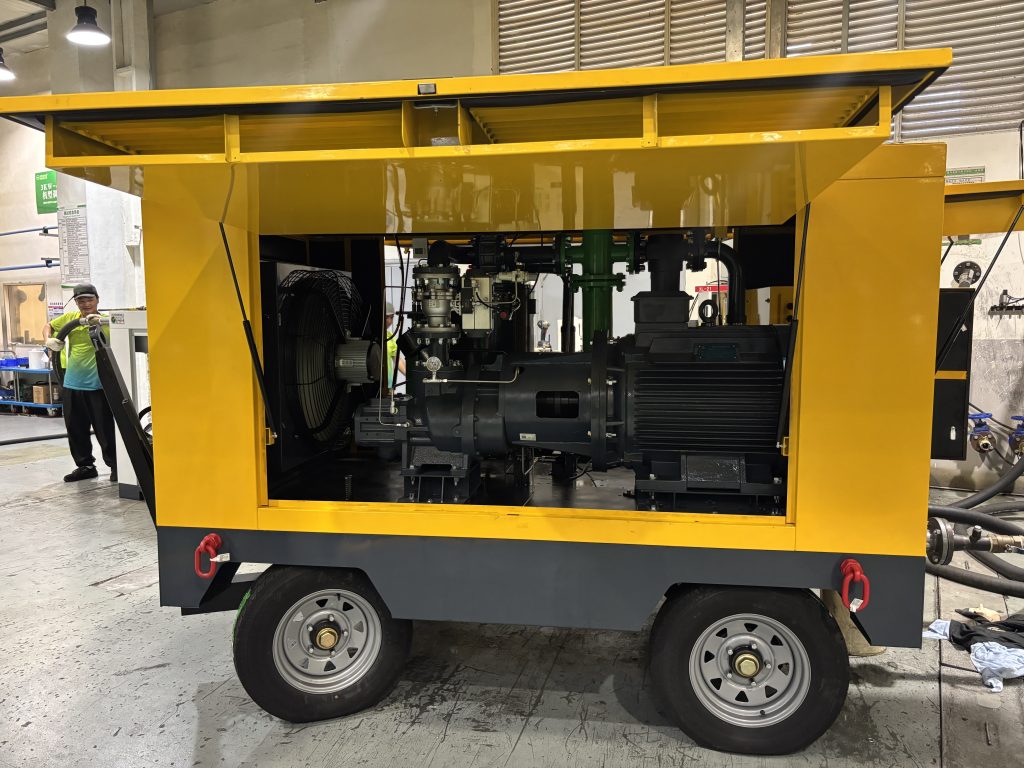
When assessing diesel industrial air compressor manufacturers, prioritize those with:
- Proven Track Record: Longevity in the industry and a strong reputation among professionals in your field (e.g., mining, construction).
- Quality Certifications: Adherence to international standards (e.g., ISO) for manufacturing and environmental compliance (like EPA Tier 4 or EU Stage V for engines).
- Technological Investment: Commitment to R&D in fuel efficiency, emissions control, and durability.
The Critical Role of Service and Support
A machine will eventually need service. The value of your supplier is tested when maintenance is due or a breakdown occurs.
- Service Network: Does the manufacturer or distributor have trained technicians and service centers within a reasonable distance of your typical operating areas?
- Parts Availability: Are genuine spare parts (filters, gaskets, sensors) readily available locally or through fast shipping? Long lead times for parts equate to extended downtime.
- After-Sales Support: Does the supplier offer comprehensive warranties, expert technical advice, and potentially loaner equipment during major repairs?
Evaluating Brands and Suppliers
When comparing top portable diesel air compressor brands and their suppliers, move beyond the brochure. Ask for customer references in similar industries. Inquire about typical parts inventory and standard service response times. Remember, the lowest purchase price often comes with the highest risk of inadequate support. Your goal is to secure a partner who ensures your equipment’s productivity over its entire lifecycle.
6. Pre-Purchase and Post-Purchase Checklist
Use these actionable lists to guide your procurement process and protect your investment.
Pre-Purchase Questions for Your Supplier
- Specifications & Match: Does the CFM/PSI at working pressure meet my peak demand with a 15-20% safety margin? What is the fuel consumption at my expected average load?
- Design & Compliance: What is the duty cycle? What emissions standard (Tier 4, Stage V) does it meet? What are the sound pressure levels? Is it equipped for the dust/weather conditions at my sites?
- Support & Terms: What is the warranty period and coverage? What is the expected delivery time for common wear parts (filters, separators)? Do you provide on-site operator training?
- Total Cost: Can you provide a detailed TCO estimate based on my projected annual usage?
Post-Purchase Maintenance & Best Practices
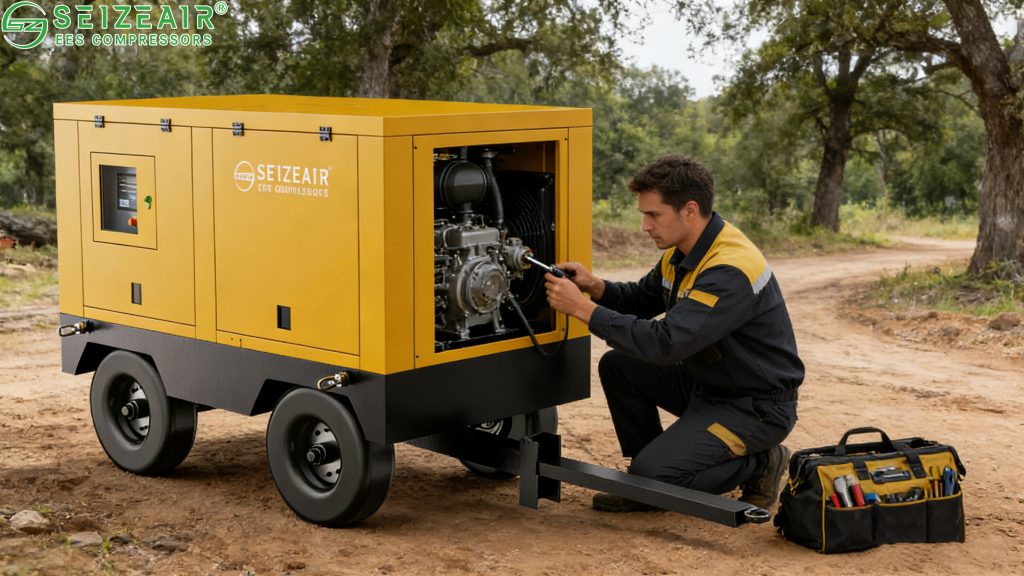
Proper care is non-negotiable for a diesel industrial air compressor.
- Daily/Weekly: Check engine oil and coolant levels. Drain moisture from air tanks and after-coolers. Inspect for leaks and unusual vibrations.
- Scheduled Service: Strictly follow the manufacturer’s service intervals for oil changes and replacement of air, fuel, and oil filters. Service the compressor element as specified. Regularly clean cooling surfaces.
- For Heavy-Duty Users (Mining, Multi-Site): Implement a strict logbook for hours and maintenance. Carry a critical spare parts kit (filters, belts, sensors). Consider a fuel management plan to ensure clean, reliable fuel supply. Monitor hour-meter readings to plan downtime proactively.
Conclusion
For the majority of remote, heavy-duty, and multi-site industrial applications, a well-selected diesel industrial air compressor stands as the most reliable and powerful solution. Its independence, durability, and high output make it indispensable for keeping critical projects on schedule. However, this value is only realized through a disciplined selection and care process. The key to success lies in accurately assessing your true air demand, prioritizing total lifetime cost over initial price, partnering with a reputable manufacturer and supplier with strong support, and committing to a rigorous preventive maintenance regimen. By balancing these four pillars, you secure not just a piece of equipment, but a dependable asset that powers your productivity for years to come.
For continued learning about optimizing your compressed air system, you may find value in exploring topics like compressor preventive maintenance schedules or techniques for monitoring fuel and energy consumption.
About SEIZEAIR: Among the manufacturers committed to robust and efficient air solutions is SEIZEAIR, a provider known for its focus on reliable and energy-conscious screw air compressor technology.