Choosing an air compressor used in construction demands careful planning. Construction sites present unique challenges. These environments often lack stable power. They generate immense dust and debris. Temperatures can swing to extremes. Here, compressed air proves indispensable. It powers a vast array of critical tools. But not all compressors are created equal. A tool’s performance hinges on your compressor’s specs. Mismatched equipment leads to costly downtime. It causes premature tool wear and project delays. This guide will explain key technical requirements. We focus on airflow (CFM), pressure (PSI), and power. You will learn to match the compressor to your specific job site needs. This ensures optimal efficiency, reliability, and total cost control.
1. Why Construction Sites Rely on Air Compressors
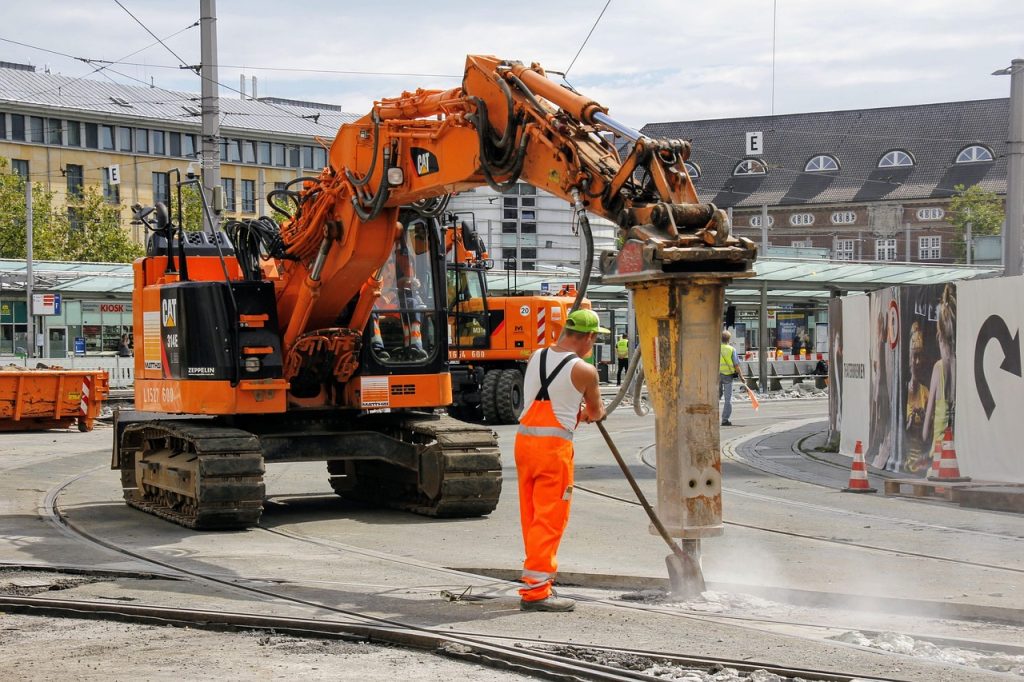
Pneumatic tools dominate construction for good reasons. They offer a superior power-to-weight ratio. This makes them lighter and easier to handle than electric equivalents. They are inherently explosion-proof. This is vital in environments with flammable vapors. Their simple design translates to rugged durability. They withstand drops, impacts, and harsh conditions better. Maintenance is often easier and less costly. The air compressor used in construction acts as a versatile powerhouse. It reliably drives dozens of different tools from a single source.
Common construction pneumatic tools fall into two load categories:
- Continuous Load Tools: These demand a constant, high airflow. Examples include sandblasters, grinders, and industrial spray painters. They cannot operate effectively with pulsating air.
- Intermittent Load Tools: These use air in short, powerful bursts. Jackhammers, nail guns, and impact wrenches are prime examples. They require a compressor that can recover air pressure quickly between cycles.
Understanding your tools’ duty cycle—the ratio of run time to rest time—is fundamental. A high-duty-cycle tool needs a compressor built for near-continuous operation.
2. Airflow Requirements: Understanding CFM and Tool Matching
2.1 What is CFM and Why It Matters
CFM stands for Cubic Feet per Minute. It measures the volume of air a compressor can deliver. It is the most critical specification for construction air compressor CFM requirements. Your tools have a minimum CFM rating. Your compressor’s output must meet or exceed that rating. Using a tool with a higher CFM need than your compressor can supply will cause a pressure drop. This results in weak tool performance and potential damage.
2.2 Typical CFM Requirements for Construction Tools
The table below provides a general guideline. Always consult your tool’s manual for exact specifications.
| Construction Tool | Average CFM Requirement (at 90 PSI) | Typical Pressure (PSI) |
|---|---|---|
| Framing Nailer | 2.0 – 2.5 CFM | 70 – 120 |
| Finish Nailer | 0.5 – 1.0 CFM | 70 – 120 |
| Rotary Hammer / Demolition Hammer | 40 – 90 CFM | 90 – 120 |
| Pavement Breaker | 70 – 100 CFM | 90 – 120 |
| Sandblaster (Medium Nozzle) | 50 – 150 CFM | 90 – 150 |
| Air Drill (1/2″) | 20 – 30 CFM | 90 – 120 |
| Paint Spray Gun (HVLP) | 8 – 20 CFM | 40 – 60 |
| Grinder / Sander | 20 – 50 CFM | 90 – 120 |
| Impact Wrench (1″) | 30 – 40 CFM | 90 – 120 |
2.3 How to Calculate Total Job-Site Air Demand
Do not simply add up all tool CFM ratings. Follow this practical method:
- Identify Peak Simultaneous Use: Determine which tools will run at the same time. For example, maybe two jackhammers and one drill operate concurrently.
- Sum Their CFM: Add the CFM requirements of those simultaneously operating tools.
- Apply a Redundancy Factor: Add a 20-30% safety margin. This accounts for air line leaks, tool wear, and unforeseen demands. It also prevents the compressor from running at 100% capacity constantly, extending its life.
Formula: Required Compressor CFM = (CFM_Tool1 + CFM_Tool2 + …) x 1.3
2.4 Real-World CFM Sizing Examples
- Road Construction Crew: Running two 90 CFM rock drills and one 30 CFM air drill. Peak demand is 210 CFM. With a 30% buffer, they need a compressor rated for at least 273 CFM.
- Bridge Repair Team: Using a 120 CFM sandblaster and a 25 CFM grinder for surface prep. Peak demand is 145 CFM. A compressor delivering ~190 CFM would be appropriate.
3. Pressure Requirements: PSI Matching for Heavy-Duty Work
PSI (Pounds per Square Inch) measures air force. While CFM is about volume, PSI is about pressure. Most standard tools operate between 90-120 PSI. However, demanding construction applications require much higher pressures.
| Low-Pressure (90 – 120 PSI) | This is the standard range for nail guns, staplers, small drills, and most impact wrenches. A standard portable compressor often suffices. |
| Medium-Pressure (120 – 175 PSI) | Required for efficient sandblasting, some concrete cutting saws, and heavy-duty grinding. This range provides greater cleaning and cutting power. |
| High-Pressure (200 – 500+ PSI) | Required for efficient sandblasting, some concrete cutting saws, This is the domain of specialized industrial construction. A high pressure air compressor for construction is essential for: Drilling Rigs: Deep foundation and rock drilling. Heavy Rock Demolition: Large, hydraulic breakers often need high pilot pressure. Pipeline Testing: Newly installed pipelines require high-PSI air for integrity testing (e.g., 300-500 PSI). Mining and Tunneling: Pneumatic equipment in these sectors is designed for very high operating pressures. |
4. Types of Air Compressors Used in Construction
Selecting the right type is as crucial as sizing it correctly. The primary air compressor used in construction falls into these categories:
4.1 By Power Source & Mobility
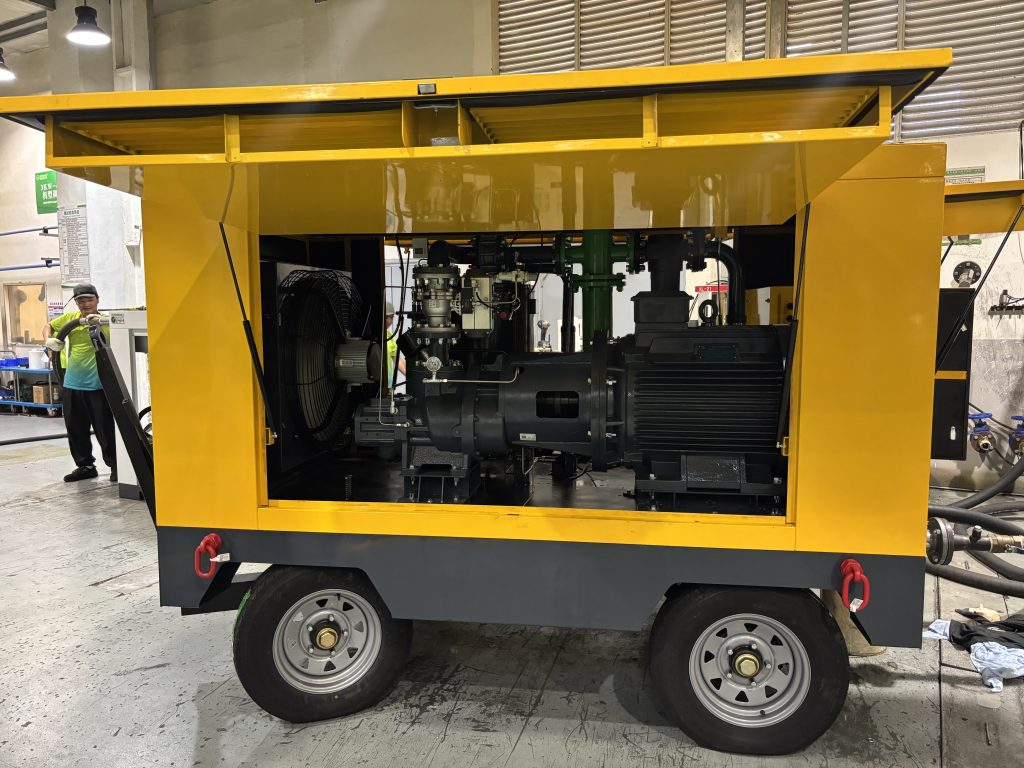
- Diesel Portable Air Compressors: The undisputed king of remote sites. They are self-powered, highly mobile, and built for tough conditions. Ideal for roadwork, mining, and new ground-up construction. They are the default choice for diesel air compressor for construction applications.
- Towable / Portable Compressors: Mounted on a wheeled chassis for easy towing behind a truck. They combine high capacity with good mobility, perfect for large job sites that move periodically.
- Electric Stationary Compressors: Used when reliable grid power is available, such as indoor renovations, workshops, or large industrial plants. They are quieter, have zero emissions, and lower operating costs.
4.2 By Compression Technology
- Rotary Screw Compressors: Dominant in industrial construction. They deliver a continuous, smooth airflow ideal for high-CFM, high-duty-cycle tools like sandblasters and large drills. They are designed to run constantly with less heat buildup than pistons.
- Piston (Reciprocating) Compressors: Common for smaller, intermittent tasks. They are cost-effective for lower CFM needs but can struggle with continuous demand due to heat and duty cycle limitations.
5. Environmental Factors: Heat, Humidity, Dust, Altitude
A comprehensive construction site air compressor selection guide must address environmental challenges ignored by many.
- Heat Management: In desert or tropical sites, ambient heat reduces compressor efficiency. Look for models with large, efficient cooling systems and high-temperature rated components.
- High Humidity: Moisture in compressed air causes tool rust and pipeline corrosion. A high-capacity air dryer and quality aftercooler are non-negotiable in humid climates.
- Sand & Dust: Construction sites are dusty. Multi-stage intake filtration (pre-filter, main filter, and sometimes safety filter) is critical to protect internal components from abrasive wear.
- Altitude Effects: At high altitudes, engine power drops. Air is also less dense. A compressor rated for 100 CFM at sea level may deliver only 80 CFM at 5,000 feet. Always check altitude-derated performance specs.
6. Fuel Type, Power Source & Energy Efficiency
The power source directly impacts operational flexibility and cost.
- Diesel-Powered: Offers maximum power and fuel availability. Best for remote, long-duration work. Modern Tier 4 Final engines are cleaner and more fuel-efficient.
- Electric-Powered: Lower noise, zero on-site emissions, and lower energy cost per hour. Requires a stable, high-capacity power connection.
- Energy Efficiency: For electric screw compressors, variable speed drive (VSD) technology can save 30-50% in energy costs by matching motor speed to air demand. For diesel units, look at specific fuel consumption (g/kWh) ratings.
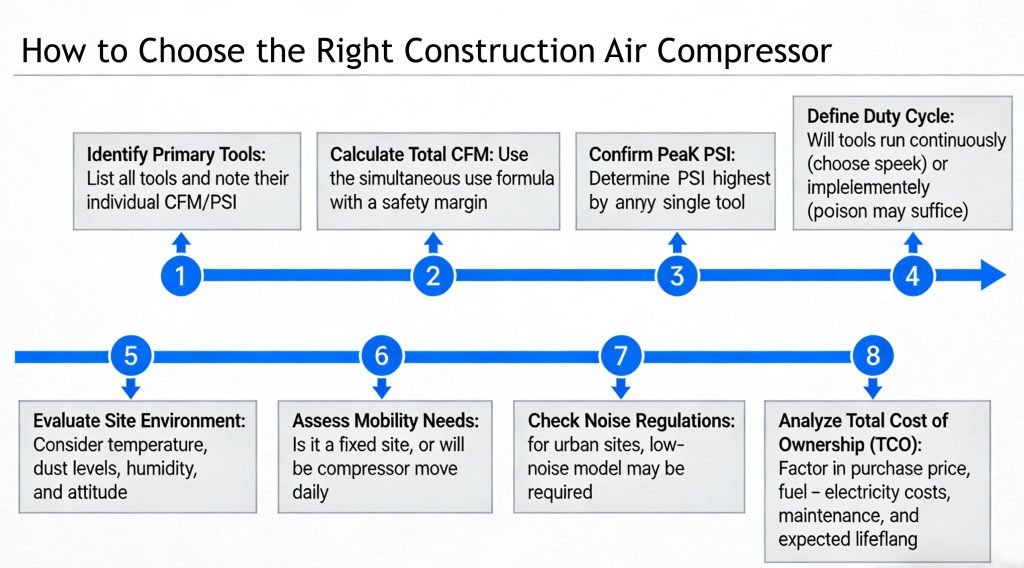
7. How to Choose the Right Construction Air Compressor
This decision framework for how to choose an air compressor for construction provides a systematic approach:
- Identify Primary Tools: List all tools and note their individual CFM/PSI.
- Calculate Total CFM: Use the simultaneous use formula with a safety margin.
- Confirm Peak PSI: Determine the highest PSI required by any single tool.
- Define Duty Cycle: Will tools run continuously (choose screw) or intermittently (piston may suffice)?
- Evaluate Site Environment: Consider temperature, dust levels, humidity, and altitude.
- Assess Mobility Needs: Is it a fixed site, or will the compressor move daily?
- Check Noise Regulations: For urban sites, low-noise models may be required.
- Analyze Total Cost of Ownership (TCO): Factor in purchase price, fuel/electricity costs, maintenance, and expected lifespan.
8. Comparing Top Air Compressor Categories for Construction
Here’s a quick guide to the best air compressor for construction jobs by application:
- Best for Concrete Breaking: High-CFM (70-100+), high-PSI rotary screw diesel portable.
- Best for Sandblasting: Continuous-duty rotary screw compressor with a CFM rating 30-50% above the blaster’s requirement and integrated dryers.
- Best for Remote Off-Grid Construction: Heavy-duty diesel portable or towable screw compressor with large fuel tank.
- Best for Tunnel Drilling: Ultra-high-pressure (300+ PSI), large-CFM stationary or custom skid-mounted units.
- Best for Indoor Renovation: Quiet, electric-powered, oil-free rotary screw or scroll compressor.
9. Maintenance Requirements for Construction Environments
A proactive construction air compressor maintenance checklist prevents failures. Harsh sites demand stricter schedules.
- Daily: Check engine oil/coolant (diesel), drain air tank condensate, inspect for leaks.
- Weekly: Clean pre-filters, check belt tension, inspect hoses and couplings.
- Scheduled: Change air/oil/fuel filters per manufacturer hours, not just calendar time. In dusty sites, change air filters 2-3 times more often.
- Lubrication: For oil-injected screws, use the correct synthetic oil and change it strictly as prescribed.
- Cooling System: Regularly clean radiator and cooler fins of dust and debris—this is the #1 cause of overheating on site.
10. Pre-Purchase Checklist (High SEO Value)
Use this list before finalizing your purchase:
- Required CFM (with 30% buffer) is: _______
- Required Maximum PSI is: _______
- Primary Tool Types: _____________________
- Estimated Running Hours/Day: _______
- Power Source Available: Diesel / Electric / Both
- Max Operating Temperature & Dust Level: _______
- Required Tank Size for buffer: _______
- Local Noise Restrictions (dB limit): _______
- Total Budget & 5-Year TCO Estimate
- Warranty Terms & Local Parts/Service Support
- Required Delivery Timeline
Conclusion
Selecting the correct air compressor used in construction is a technical investment. It directly impacts your project’s productivity and profitability. The process starts with a deep understanding of your tools’ airflow requirements for construction tools. It is completed by matching those needs to a machine’s CFM, PSI, and durability. Never compromise on the safety margin for airflow. Always factor in your specific environmental challenges. Prioritize robust construction and reliable service support over brand name alone. By starting with a detailed analysis of your operational demands, you will choose a compressor that delivers reliable power, maximizes uptime, and provides the best return on investment across its entire service life. For projects demanding robust and energy-efficient performance, industrial-grade rotary screw compressors from manufacturers like SEIZEAIR offer a reliable solution, engineered to meet the rigorous demands of modern construction sites.