For contractors, mining companies, or industrial maintenance teams requiring frequent relocation between different sites, a reliable mobile air compressor is the core equipment ensuring project progress and construction efficiency. However, when it comes to the actual procurement stage, the price of mobile air compressors often becomes one of the most perplexing issues—market quotations range from several thousand to hundreds of thousands of yuan, representing a substantial disparity.
The crux lies in understanding that price signifies more than mere cost; it directly correlates with performance suitability, operational context alignment, and operational expenditure over subsequent years. Selecting an unsuitable model may entail prolonged high fuel consumption, elevated maintenance expenses, or even frequent downtime losses.
This article systematically analyses the price composition, mainstream price ranges, selection logic, and total cost of ownership (TCO) of mobile air compressors from an engineering and procurement decision-making perspective. It aims to help you find a truly reasonable balance between budget, performance, and reliability.
What is a mobile air compressor? Why is there such a wide variation in price?
A mobile air compressor is a self-contained air supply unit integrating an air compression host, power system (diesel engine or electric motor), air storage system, and a mobile chassis. It is designed to operate reliably in scenarios without a fixed power supply or where frequent relocation of the work site is required.
Its core operating principle involves compressing air through piston, screw, or scroll mechanisms, delivering a steady flow and pressure output to power various pneumatic equipment.
Typical application scenarios include:
- Construction sites (rock drills, sprayers, nail guns)
- Mines and quarries (drilling, crushing)
- Industrial maintenance and manufacturing (sandblasting, spraying, assembly)
- Remote engineering and emergency operations
The fundamental reason for significant price variations in portable air compressors lies in:
Divergent operational requirements for airflow (CFM), pressure (PSI), continuous duty capability, power source, and environmental adaptability. These parameters directly dictate equipment structural complexity and manufacturing costs.
Six Key Factors Influencing Portable Air Compressor Pricing
1. Airflow (CFM) and Pressure (PSI)
CFM (Cubic Feet per Minute) determines the number of tools that can be driven simultaneously and the power output.
PSI (Working Pressure) determines tool stability under long-hose or heavy-duty conditions.
Each increase in airflow and pressure grade significantly raises demands on the compressor unit, engine, and cooling system, constituting the primary drivers of price escalation.
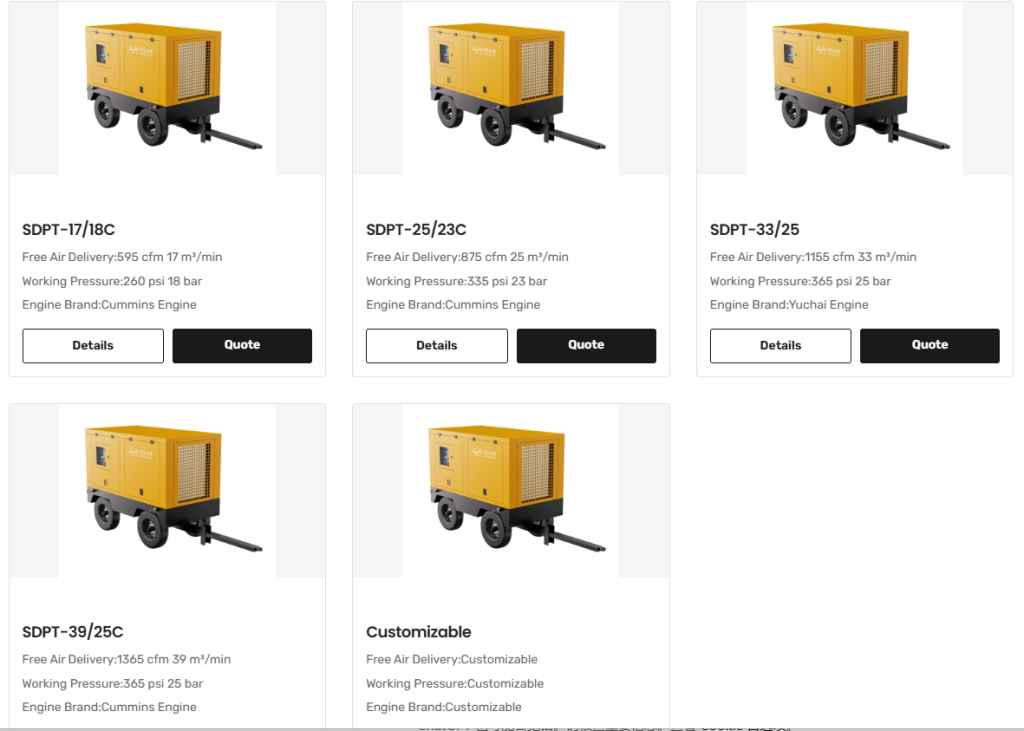
2. Drive Type: Diesel vs Electric
- Diesel mobile air compressors typically command a price premium of 30%–50% over equivalent electric models.
- This stems from diesel engines incorporating comprehensive fuel, cooling, and control systems.
- However, in scenarios lacking mains power, outdoor environments, or demanding continuous high-load operation, diesel engines remain virtually the sole viable option.
3. Compression Technology Types
- Piston-type: Simple construction, low cost, suitable for intermittent use
- Screw-type: Stable air delivery, high efficiency, the mainstream for industrial-grade mobile air compressors
- Scroll-type: Low noise, compact size, often used in specialised applications
- Among these, mobile screw compressors command significantly higher prices than piston models, yet their continuous operation capability
4. Energy Efficiency and Control Systems
The inclusion of Variable Speed Drives (VSD) and intelligent control systems significantly impacts pricing.
While high-efficiency designs increase initial investment, they substantially reduce long-term operating costs.
5. Brand and Manufacturing Standards
Leading industrial brands justify higher pricing through investments in reliability, energy efficiency, and extensive after-sales networks, thereby minimising downtime and failure risks.
6. Procurement Methods and Market Factors
- Direct Purchase vs. Leasing
- Regional tariffs, transport costs, and market supply and demand all influence the final transaction price.
Price Range Overview for Portable Air Compressors (by CFM and Application)
| Equipment Type | Typical CFM Range | Price Range (US dollar) | Typical Applications |
|---|---|---|---|
| Small Portable Air Compressors | < 5 CFM | 10– 1,50 | Tyres, emergency inflation |
| Domestic / DIY Grade | 2 – 10 CFM | 1,50 – 8,00 | Nail guns, basic spraying |
| Light Industrial Mobile Air Compressors | 20 – 100 CFM | 30,00 – 150,00 | Small construction sites, maintenance |
| Medium diesel mobile air compressors | 100 – 400 CFM | 150,00 – 600,00 | Construction, roadworks |
| Large industrial mobile air compressors | > 400 CFM | 600,00 以上 | Mining, infrastructure projects |
Users searching for ‘200CFM mobile air compressor prices’ or ‘250CFM diesel mobile air compressor prices’ typically focus on the decision-making range of 150,000–400,000 yuan.
Selecting Portable Air Compressors for Different Budgets
Under ¥5,000 US dollar: Basic Models and Supplementary Air Sources
Suitable for low-load, intermittent use; unsuitable for continuous industrial applications.
5,000–20,000 US dollar: Mainstream Industrial-Grade Options
Covering 100–250 CFM
Offers the best value for money in small to medium-sized construction projects
The most common price bracket for mobile air compressor decisions
Above 20,000 US dollar: Heavy-Duty Diesel Mobile Air Compressors
Engineered for high-intensity, continuous operation
Lower failure rates and higher uptime
Suitable for mining and large-scale infrastructure projects
How to select a mobile air compressor based on operational requirements, rather than solely on price?
Step 1: Calculate Required CFM and PSI
Sum the CFM of all pneumatic tools operating simultaneously, allowing a 20–50% margin.
Step 2: Confirm Power Supply Conditions
No stable power supply → Diesel
Stable power supply available → Electric is more economical
Step 3: Assess Environmental Factors
High temperatures, high dust levels, and high altitudes all increase configuration requirements.
Step 4: Consider Fuel and Maintenance Costs
Do not merely compare purchase prices while overlooking long-term expenditure.
Total Cost of Ownership (TCO) Analysis for Portable Air Compressors
The purchase price is merely the beginning; the true costs arise from long-term usage.
- Energy/Fuel Costs: The largest expenditure item
- Maintenance and Consumables: Filter elements, lubricants, labour
- Downtime Losses: The hidden cost of project delays
- Residual Value: High-quality equipment retains greater second-hand value
In many instances, high-efficiency equipment proves more economical due to its lower overall operating costs.
Frequently Asked Questions (FAQs) Regarding Mobile Air Compressor Pricing
1. How much does a mobile air compressor cost?
Prices range from several thousand to hundreds of thousands of yuan, depending on CFM capacity, power source, and industrial grade.
2. What is the price for a 2000 CFM air compressor?
Typically classified as large-scale industrial equipment, these units often command prices in the millions of yuan.
3. Why are diesel-powered mobile air compressors more expensive?
Diesel systems are more complex but offer fully independent power supply.
4. Can mobile air compressors be rented?
Yes, daily rental rates are typically 0.5%–1.5% of the equipment’s value.
5. Can small portable air compressors inflate tyres?
Yes, but only for low-frequency, emergency use.
6. How can one reduce the operating costs of mobile air compressors?
By selecting the correct model, performing regular maintenance, minimising leaks, and prioritising energy efficiency.
Conclusion: Price is not the key factor; compatibility is.
Selecting a mobile air compressor fundamentally involves balancing initial cost, operational compatibility, and long-term expenditure.
The cheapest equipment often incurs the highest future costs; only a judicious industrial-grade investment can truly safeguard project efficiency and profit margins.
Should you be evaluating mobile air compressor price ranges, specific models, or long-term operating costs, obtaining professional operational analysis and tailored recommendations prior to decision-making will significantly mitigate procurement risks. Contact SEIZEAIR Compressors for a complimentary, bespoke air compressor solution.