Introduction
Walk into almost any production hall in Europe and you will hear it before you see it: the steady hum of a compressor room behind a closed door. In a German car plant, compressed air drives the welding guns, clamps the fixtures and atomises the paint. In an Italian food factory, it moves powder through pipes and blows PET bottles into shape. In a Polish furniture workshop, it powers the sanders and the spray guns.
Very few people outside the maintenance team think about it. Yet when the compressor stops, the line stops too — usually within minutes. That is why plant engineers across the EU treat compressed air alongside water, electricity and gas as a site utility, produced on site, metered, maintained and budgeted for.
This guide explains what an air compressor is from a European industrial point of view. It covers how compression works, the full range of machine types used in EU factories, the units you will see on a European datasheet (kW, bar, m³/min, 50 Hz, 400 V), where the air is actually used, and what the EU regulatory and efficiency landscape means for your next purchase.
- An air compressor converts electrical energy into pneumatic energy by raising ambient air to a higher pressure; it does not “create” air.
- There are two physical families: positive displacement (screw, piston, scroll, vane) and dynamic (centrifugal). They behave very differently at partial load.
- European datasheets are quoted in bar, m³/min (FAD) and kW at 50 Hz / 400 V — not psi, CFM or HP.
- Size a compressor on pressure + flow + air quality, in that order. Buying on kW alone is the most common specification error.
- Compressed air is expensive per unit of energy delivered, so motor efficiency class, control strategy and leakage matter more than the sticker price.
- EU placement rules (CE marking under Machinery Directive 2006/42/EC, motor ecodesign levels, ISO 1217 testing) shape which machines can legally be sold and how their performance is measured.
What Is an Air Compressor?
An air compressor is a machine that takes in ambient air at atmospheric pressure and reduces its volume, so the same mass of air occupies less space and exerts a higher pressure. That pressurised air is then stored and distributed through a pipe network as a source of controllable mechanical energy.
In simpler terms: it is a pump for air. Instead of moving a liquid from A to B, it squeezes a gas so that the gas itself can do work at the point of use — turn a tool, move a cylinder, blow a bottle, or carry powder down a line.
The important nuance is that a compressor does not make air. Every cubic metre delivered at 7 bar started as roughly seven to eight cubic metres of ambient air drawn in through the intake filter. That ratio is called the compression ratio, and it is the reason intake conditions — dust, humidity, temperature — have such a large effect on what comes out of the pipe.
How Does an Air Compressor Work?
Every industrial compressor follows the same four-stage path, whatever its internal design.
1. Intake. Ambient air is drawn through an inlet filter. In a European plant this is where the first quality decision is made: a filter sized correctly protects the compression element, while a neglected one starves the machine and raises its energy draw.
2. Compression. Here the two design families diverge. A positive displacement compressor traps a fixed volume of air and mechanically reduces it — a screw pair meshing, a piston rising in a cylinder, a scroll orbiting. Pressure rises as volume falls. A dynamic compressor, in practice the centrifugal type, accelerates air with a high-speed impeller and then converts that velocity into pressure in a diffuser. Positive displacement machines hold their flow well when pressure changes; dynamic machines are far more sensitive to system pressure and have a defined surge limit.
3. Cooling and separation. Compressing air generates heat, so the discharge passes through an aftercooler and then a condensate separator. This step is not optional housekeeping — without it, water would travel down the pipe and into valves, actuators and product.
4. Storage and distribution. Dried, filtered air enters a receiver vessel, which buffers pressure peaks and lets the compressor cycle efficiently, and then flows into the ring main.
Did you know? A large share of the electrical energy a compressor draws leaves the machine as heat in the cooling air and the condensate. That is exactly why heat recovery — using warm cooling air for space heating or process water preheating — is one of the first measures a European energy auditor will look at.
Main Types of Air Compressors
European industry uses a wider mix than many buyers expect. Workshops still run pistons. Most factories run screws. Large continuous processes run centrifugals. The right choice depends on flow, duty cycle and air quality, not on habit.
| Compressor type | Working principle | Typical pressure range (bar) | Typical flow range (m³/min FAD) | Best-fit application |
| Reciprocating (piston) | Piston reduces cylinder volume; single or multi-stage | 7–15 (higher with multi-stage) | 0.1–5 | Workshops, intermittent duty, small garages |
| Rotary screw, oil-injected | Two meshing rotors; oil seals, cools and lubricates | 5–13 | 0.5–60+ | General factory compressed air, the European default |
| Rotary screw, oil-free | Dry or water-lubricated rotors, no oil in the air path | 2.5–13 | 5–[PLACEHOLDER: confirm max flow per model] | Food, pharma, electronics, sensitive processes |
| Scroll | One fixed and one orbiting spiral | 8–10 | 0.2–2 | Laboratories, dental/medical, small clean-air duties |
| Rotary vane | Sliding vanes in an eccentric rotor | 6–13 | 0.5–10 | Low-pressure process air, some specialist duties |
| Centrifugal | High-speed impeller plus diffuser; dynamic | 3.5–20 | 20–[PLACEHOLDER: confirm upper range] | Large continuous plants, steel, chemicals, PET |
Ranges above are indicative industry ranges for comparison only. Always confirm pressure, flow and power against the specific machine datasheet.
The two families most European buyers compare side by side are the oil-injected screw and the centrifugal. A screw set is forgiving on partial load and easy to stage; a centrifugal set excels where flow is high and steady, but it punishes badly matched systems. If you are weighing them up, our comparison of centrifugal vs screw air compressors goes through the trade-offs in detail, and the centrifugal air compressor guide covers the dynamic design on its own.
On the oil-free side, the answer to “oil-free” is not one technology but at least two: dry-running screws and water-lubricated screws. The distinction changes both energy use and maintenance profile, and it is set out in our article on dry vs water-lubricated oil-free compressors.
Key Specifications Explained
European datasheets look unfamiliar if you are used to North American units. The physics is identical; the convention is not.
| Quantity | European unit (used here) | Imperial/US equivalent | Why it matters |
| Pressure | bar (g) | 1 bar ≈ 14.5 psi | Most EU plants run a 7–8 bar(g) ring main |
| Flow | m³/min (FAD) | 1 m³/min ≈ 35.3 CFM | FAD is measured at intake conditions, not outlet |
| Power | kW (shaft or input) | 1 kW ≈ 1.34 HP | Input kW is what you pay for |
| Frequency | 50 Hz | 60 Hz | Determines motor speed and delivered flow |
| Voltage | 400 V, three-phase | — | Standard EU low-voltage industrial supply |
| Air quality | ISO 8573-1 class | — | Class, not a “filter micron” rating |
| Noise | dB(A) at 1 m | — | Declared in the technical documentation |
Pressure: bar and psi
Pressure in a European plant is almost always quoted in bar(g) — gauge pressure, relative to atmosphere. A ring main at 7 bar(g) is the common reference point for general manufacturing. Note that every unnecessary bar costs energy: if only one tool in your plant needs 8 bar, running the whole network at 9 bar to serve it is an expensive compromise. Boosters and local pressure control usually beat raising the whole system.
Flow: m³/min, CFM and FAD
Flow is the specification most often got wrong. FAD stands for Free Air Delivery, and it expresses output as the volume the compressor would take in at ambient conditions — not the compressed volume sitting in the pipe. Two machines quoting the same “m³/min” may not be comparable unless both figures are FAD measured to the same test method. That is precisely why ISO 1217, the compressor acceptance test standard, exists: it defines how flow and input power are measured so that two suppliers’ numbers can be compared honestly.
Power: kW and motor efficiency class
European machines are rated in kW, and the number that matters to your electricity bill is the input power at the package terminals, not the motor nameplate alone. Motor efficiency class is the other half of the story. IE3 is the current minimum efficiency level for most three-phase motors placed on the EU market; IE4 sits one class above it. Our screw packages are built with WEG IE4 motors — details are in our screw air compressor overview.
Where Compressed Air Is Used in European Industry
Compressed air is not a niche utility. It appears in nearly every branch of manufacturing, and the pressure and quality requirements differ sharply between them.
| Industry (typical EU example) | Main uses | Typical pressure requirement (bar) | Air quality sensitivity |
| Automotive (Germany) | Pneumatic tools, welding clamps, robotics, paint atomisation | 6–8 | High for paint — see oil-free air for automotive paint |
| Food & beverage (Italy, France) | Conveying, PET blow moulding, packaging, filling | 6–10 (higher for PET) | Critical where air contacts product — oil-free air for food and pharma |
| Pharmaceuticals | Fermentation, coating, tablet pressing, packaging | 6–8 | Highest; ISO 8573-1 class specified and validated |
| Electronics (Nordics, CEE) | PCB assembly, pick-and-place, cleanroom tools | 6–8 | Very high — oil-free air in electronics |
| Plastics | Blow moulding, extrusion, mould clamping | 6–40 (PET at the top end) | Moderate |
| Chemicals & refining | Instrument air, valve actuation, nitrogen generation | 6–8 | High for instrument air |
| Wood & furniture (Poland) | Sanders, saws, spray finishing, CNC clamping | 6–8 | Moderate to high |
| Construction & site work | Breakers, drilling, sandblasting | 7–12 | Low; usually portable units |
This table is also a reminder that “one compressor for the whole site” is not always the right answer. A plant with a cleanroom and a plate shop in the same building may be better served by two smaller systems at two different quality levels than one oversized central unit.
Did you know? The same compressor model sold at 50 Hz and at 60 Hz does not deliver the same FAD. Motor speed changes, and therefore swept volume changes. When you move a specification between a European and a non-European datasheet, always convert the flow figure — never the plate power alone.
Why Compressed Air Is Called the “Fourth Utility”
Water, electricity and gas arrive from outside and are metered at the gate. Compressed air is generated inside the plant, but it behaves like the others: it is distributed through fixed infrastructure, it is consumed continuously, and production collapses when it is interrupted.
The comparison is not just rhetorical. It changes how good plants manage it. A utility gets metered at several points, not just at the source. It gets a maintenance plan rather than a breakdown response. It gets an energy budget, because the true cost of compressed air is not the purchase price of the machine but the electricity it draws over [PLACEHOLDER: expected service life in hours] of operation.
That last point is where many European sites find their cheapest savings. Leaks, artificial demand — running the network at a higher pressure than any tool needs — and inappropriate uses such as blow-off cleaning are well-documented sources of waste. Industry analysts commonly put the share of industrial electricity consumed by compressed air systems at around [PLACEHOLDER: verified EU/industry figure] per cent.
Energy Efficiency and EU Requirements
Buying a compressor in the EU is not purely a commercial decision. Several layers of rules and standards affect what can be sold, how performance is declared, and how safe the installation must be.
| Dimension | What it governs | What to ask your supplier |
| Machinery safety | CE marking under Machinery Directive 2006/42/EC (to be replaced by the Machinery Regulation on the date set out in that Regulation) | Declaration of Conformity and full technical file — see CE marking for air compressors in the EU |
| Motor efficiency | Minimum efficiency classes (IE3 baseline, IE4 as the higher class) for three-phase motors | Which IE class is fitted, and is it from a recognised motor maker? |
| Product policy | Ecodesign framework and the Ecodesign for Sustainable Products Regulation (ESPR) | Is the machine covered by a specific implementing measure? |
| Performance testing | ISO 1217 acceptance testing — how FAD and input power are measured | Are figures ISO 1217 tested, and at what reference conditions? |
| Air quality | ISO 8573-1 contamination classes for particles, water and oil | Which class is guaranteed, and where is it measured? |
| Pressure equipment | Applicable pressure equipment rules for receivers and vessels | Vessel documentation, design code and inspection interval |
| Energy management | ISO 50001 energy management; EU energy audit obligations | Can the package report energy data to your monitoring system? |
Two of these deserve a closer look because they change how you compare quotes.
ISO 1217 is the acceptance test standard. Without it, “m³/min” is a marketing number. With it, you have a repeatable measurement of free air delivery and the input power needed to achieve it, which allows a fair comparison between suppliers and a meaningful check at commissioning.
ISO 8573-1 is the air quality standard. Rather than vague claims about filter ratings, it defines classes for solid particles, water and total oil content. A food or pharma specifier will normally name the class they require; a general engineering plant may not need to. Understanding where your process sits on that scale is the single biggest determinant of whether an oil-free air compressor is justified or whether well-managed oil-injected air plus treatment is sufficient.
How to Choose the Right Air Compressor
Work through the five steps in order. Each one narrows the field.
1. Establish the pressure you actually need. List every consumer and its minimum required pressure at the point of use, then add the pressure drop across dryers, filters and pipework. Do not simply copy the setting on your old machine.
2. Calculate real flow demand. Sum the consumption of all tools and processes, then apply a diversity factor — not everything runs at once. Where possible, measure the existing installation for a representative production week rather than estimating from nameplates.
3. Set the air quality class. Determine whether air contacts the product, and whether dry, oil-free or standard plant air is required. This step decides the technology, not just the filtration.
4. Match the control strategy to the duty profile. Fixed-speed, variable-speed drive, and staged multi-machine setups each suit a different load pattern. A plant with a flat, continuous load and a plant with sharp peaks should not buy the same configuration.
5. Evaluate total cost of ownership, not purchase price. Compare input kW at your actual load profile, expected maintenance intervals, filter and separator change costs, and the residual value of heat recovery. Over a typical industrial service life, energy dominates the equation.
On build quality, look past the brochure: machines produced on precision equipment such as OKUMA, KAPP NILES and Leitz machining centres tend to hold rotor tolerances better over time, which shows up as stable flow years after commissioning rather than as a claim on a datasheet.
Maintenance Basics
- Check the intake filter on a fixed schedule. A blocked intake starves the element and pushes energy consumption up before any alarm appears.
- Keep the cooler clean. Dust on an air-cooled aftercooler raises discharge temperature and shortens oil and separator life.
- Drain condensate reliably. Timed drains that fail silently are a common cause of downstream water damage; zero-loss drains are worth considering.
- Log operating data. Discharge pressure, running hours, load/unload cycles and motor temperature reveal problems while they are still cheap to fix.
- Survey the distribution network. Leaks in a large plant are rarely visible and rarely silent; an annual ultrasonic survey usually pays for itself.
- Use genuine consumables and respect service intervals. Separator and oil change intervals are set by operating temperature and hours, not by calendar convenience.
Frequently Asked Questions
What is an air compressor in simple terms? It is a machine that squeezes atmospheric air into a smaller volume so the air can be stored and used to do work. Think of it as a pump that turns electricity into controllable pressure at the end of a pipe.
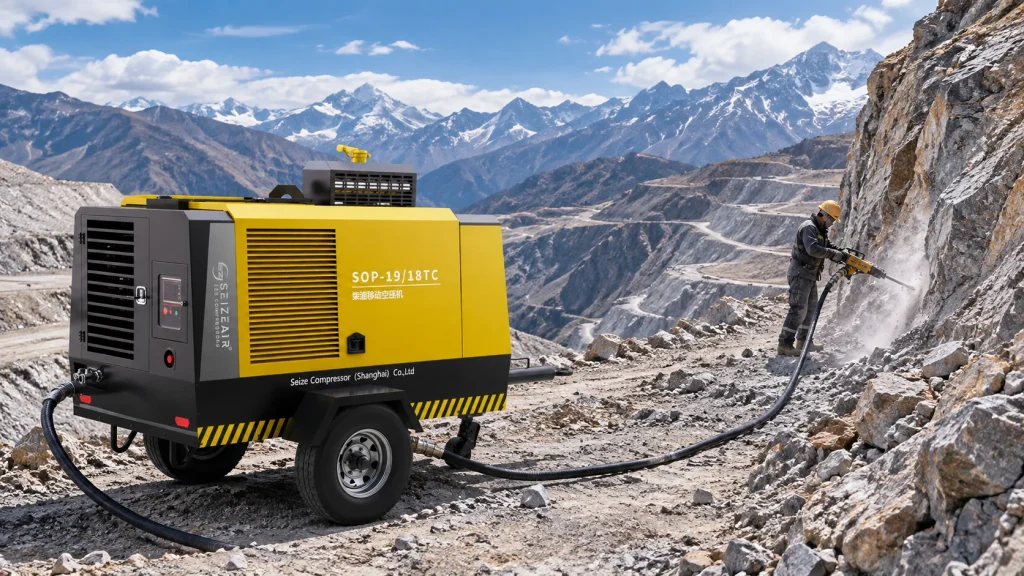
What are the main types used in European factories? Oil-injected rotary screw compressors dominate general manufacturing. Oil-free screws serve food, pharma and electronics. Pistons remain common in small workshops. Centrifugal machines serve large continuous processes, and scroll compressors fill small clean-air duties. If your work happens outdoors rather than in a plant, the category changes entirely — see diesel portable air compressors for that case (em português: compressor de ar portátil diesel).
What pressure does a typical factory need? Most European manufacturing networks run at around 7–8 bar(g). Specific processes sit outside that range: PET blow moulding needs substantially more, while some conveying and aeration duties need less.
How do I convert m³/min to CFM? Multiply by roughly 35.3. More importantly, confirm that the figure you are converting is FAD measured to ISO 1217; otherwise the comparison is not meaningful.
Do I need an oil-free compressor? Only if your air quality specification requires it. Where air contacts food, pharmaceutical product or sensitive electronics, oil-free is usually the straightforward route. Where it only drives cylinders and tools, treated oil-injected air is normally adequate — but the decision should follow a named ISO 8573-1 class, not a general preference.
What does CE marking mean on a compressor? It means the manufacturer declares that the machine meets the applicable EU health, safety and environmental requirements — including the Machinery Directive 2006/42/EC for the machinery currently placed on the market — and has compiled the supporting technical documentation. Our company-level CE reference is 8.0-2116-09. Always ask for the Declaration of Conformity for the specific model you are buying.
Wrapping Up: What an Air Compressor Really Is for Your Plant
An air compressor is not a box in a corner. It is a small on-site utility: a machine that turns electricity into pressurised air, sized in bar and m³/min FAD, powered at kW on 50 Hz / 400 V, and regulated by a framework that runs from ISO 1217 performance testing through ISO 8573-1 air quality to CE marking under the Machinery Directive.
Getting it right means specifying pressure, flow and air quality in that order, choosing a control strategy that matches your real duty cycle, and judging the machine on its energy input over its whole life rather than on its purchase price. Do that, and compressed air stops being an invisible overhead and becomes a utility you can manage like any other.
If you are sizing a new installation or reviewing an existing one, Request a quote and our team will work through your pressure, flow and air quality requirements with you. For deeper dives on specific technologies, browse more air compressor guides.