Introduction
If your drill rig is crawling forward while the meter runs, your DTH hammer is wearing out faster than the rock should allow, or your crew is stuck at a remote, off-grid exploration site with no power to lean on, the problem is rarely the drill steel. Far more often, the bottleneck is the air. A down-the-hole (DTH) hammer is, at its core, an air-powered percussion tool — and when the DTH drilling air compressor behind it cannot deliver the right volume and pressure at the hammer, everything downstream degrades: penetration rate drops, cuttings do not clear, the hammer overheats, and bit life collapses.
The painful part is that this is a buying mistake that shows up months later. Operators spec a machine that looks “big enough” on paper, ship it to a mine site 2,000 km from the nearest service center, and only then discover that 90% of rated pressure arrives at the hammer as 60% — because of hose losses, depth, altitude, and an under-sized flow curve. That is the exact failure mode this guide is built to prevent.
In the next sections we will show you how to size compressed air by hole diameter and depth, how to read CFM and PSI the way a DTH hammer actually consumes them, why a diesel portable compressor for mining exploration is the default choice for off-grid blast-hole work, and what to put on your buyer checklist before you sign a purchase order. By the end you will be able to avoid the wrong buy and move straight to a quote request with numbers that hold up on site.
Key Takeaways
- A DTH hammer is air-driven: its impact energy and cuttings removal both come from compressed air, so air volume (CFM) and pressure (PSI/bar) are the two variables that decide drill speed.
- Flow, not just pressure, is the trap. Undersized CFM starves the hammer and slows cuttings return even when gauge pressure looks fine.
- Pressure loss grows with depth. As a planning estimate, add ~0.3–0.5 bar of compensation per 10 m of hole depth (this is an estimate, not a measured SEIZE figure).
- For remote, no-grid sites, a self-powered portable air compressor for blast hole drilling — typically a diesel two-stage screw unit — is the practical standard.
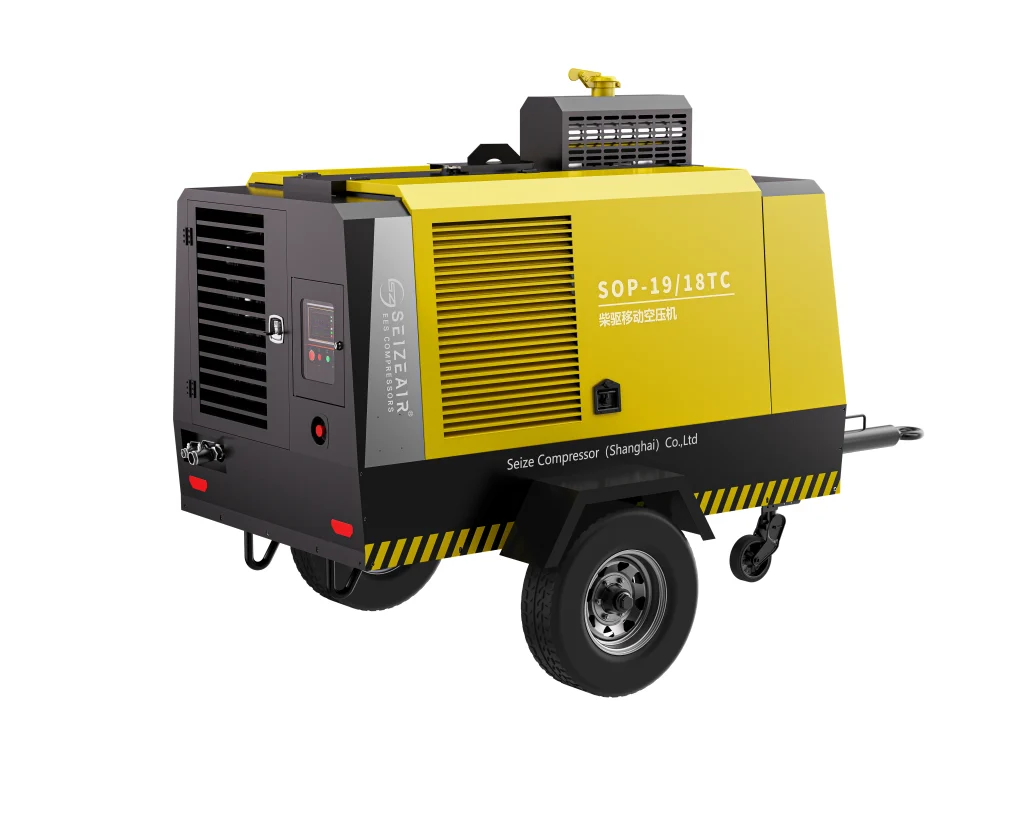
- The SEIZE SDP-19/18TC (19 m³/min, 18 bar, Cummins 194 kW) is a real high-flow example for large-hole, hard-rock DTH work.
- Internal selection should match hammer size: small hammers (90–110 mm) sit in the ~300–500 CFM range; large hammers (140–203 mm) in hard rock need ≥1,000 CFM at 20–25 bar.
What Is DTH Drilling and Why Compressed Air Is Critical
Down-the-hole drilling is a method where a percussion hammer runs inside the borehole, directly behind the bit, rather than on the surface like a top-hammer rig. The drill string turns the hammer slowly while a steady stream of high-pressure air drives the piston and, just as importantly, flushes the rock cuttings back up the annulus between the drill steel and the hole wall.
Compressed air plays two jobs at once:
- Power the hammer. The hammer’s piston is actuated by pulses of compressed air. More consistent pressure at the hammer face means more consistent blow energy per stroke, which translates directly into penetration rate in hard rock.
- Clean the hole. Cuttings must be lifted out continuously. If the air volume is too low, cuttings fall back, re-grind under the bit, and both penetration and bit life suffer.
This dual role is why a best air compressor for down the hole drilling is judged on both CFM (volume to clean) and PSI/bar (energy to drive). A machine that wins on one and loses on the other will still leave you drilling slow.
Air Requirements: CFM, PSI, and Pressure Drop
When operators ask about DTH drill air requirements CFM PSI, they are really asking two questions: how much air and how hard should it push. Here is the practical breakdown.
- CFM (flow) decides whether cuttings clear. Too little and the hole “loads up.” Rough planning ranges by hammer class:
- 3″ class hammer, 90–110 mm holes: ~300–500 CFM at 10–15 bar.
- 4″ class hammer, 110–140 mm holes: mid-range flow, higher than the 3″ class.
- 5–6″ class hammer, 140–203 mm holes in hard rock: ≥1,000 CFM at 20–25 bar.
- PSI / bar (pressure) decides hammer impact energy. DTH hammers are rated for a working pressure window; operating below it cuts blow energy, operating well above it wastes fuel and stresses the hammer.
Pressure drop is the silent killer. Air loses pressure in three predictable places:
- Hose and coupling friction — every long, narrow, or kinked line costs you bar.
- Hole depth — deeper holes need more line pressure to push air back up the annulus. As a planning estimate only, budget ~0.3–0.5 bar of additional compensation per 10 m of depth. This is an estimate to size against, not a measured SEIZE test result.
- Altitude and heat — thin air at altitude and high ambient temperature both reduce effective density, which quietly lowers delivered energy.
The takeaway: spec your compressor against the pressure at the hammer, not the pressure at the compressor gauge.
Diesel Portable Compressors for Blast-Hole and Exploration Drilling
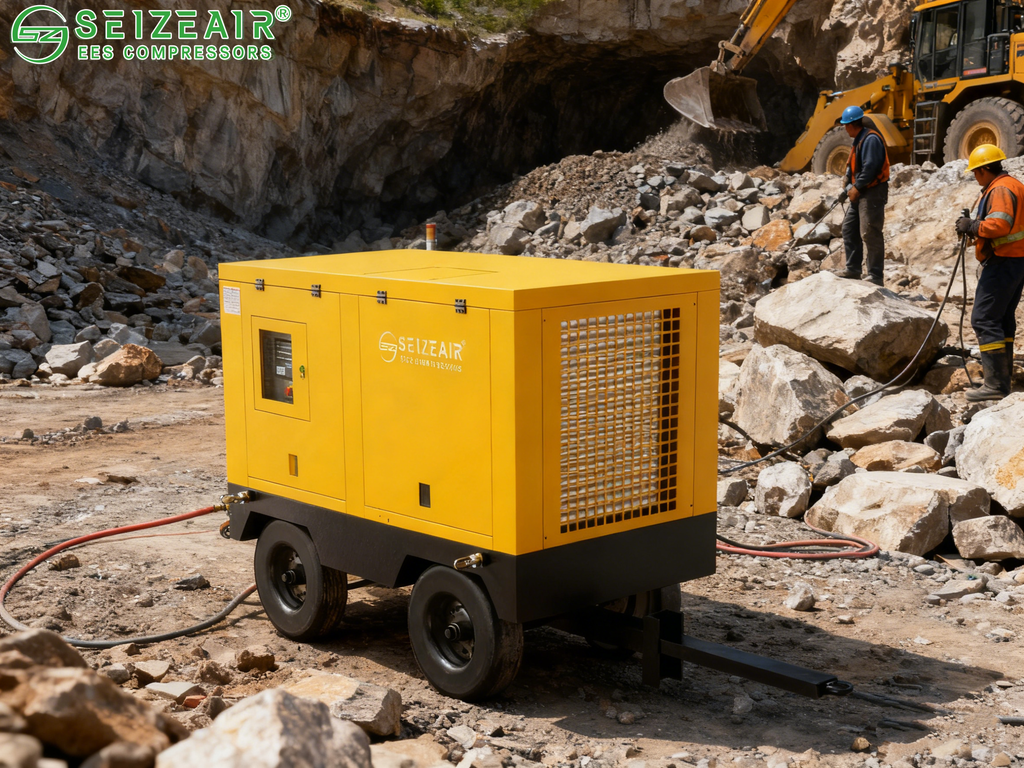
Most blast-hole and exploration drilling does not happen next to a 400 V grid. It happens on a ridge, a desert bench, or a greenfield tenement hours from the nearest town. That is why the air compressor for DTH hammer drilling in these environments is almost always a self-contained diesel portable compressor for mining exploration — a trailer-mounted screw unit with its own engine, fuel tank, and filtration, ready to roll behind a 4WD and run from the moment it arrives.
If you want the fundamentals of this machine class, our guide to the diesel portable air compressor covers the core design. For mining-specific deployment, see our notes on diesel portable compressors for mining and the broader discussion of diesel portable compressors in mining operations.
What makes a diesel portable the right call here:
- No grid dependency. The engine is the power plant. Exploration camps with no line power can still drill.
- Mobility. A 4-wheel trailer unit moves with the rig between benches instead of being poured into a fixed plant.
- High, sustained flow. Two-stage screw elements hold high CFM at high pressure without the duty-cycle limits of smaller machines.
- Harsh-environment hardening. On real sites this means 3-stage intake filtration (for dust) and tropical-rated cooling (for heat) — exactly the features you want when the nearest filter is a day’s drive away.
Sizing the Compressor to Hole Diameter and Depth
This is the section that prevents the expensive mistake. Match the compressor to the hammer, not to a vague idea of “big enough.”
Step 1 — Identify the hammer class from your hole diameter.
- 90–110 mm holes → 3″ hammer class.
- 110–140 mm holes → 4″ hammer class.
- 140–203 mm holes → 5–6″ hammer class (large blast holes, hard rock).
Step 2 — Apply flow and pressure ranges.
- 3″ class (90–110 mm): ~300–500 CFM / 10–15 bar.
- 4″ class (110–140 mm): step up in flow and pressure toward the upper-mid band.
- 5–6″ class (140–203 mm) in hard rock: ≥1,000 CFM / 20–25 bar.
Step 3 — Add depth and site compensation. Using the planning estimate of ~0.3–0.5 bar per 10 m of depth, a 100 m hole may need an extra 3–5 bar of line pressure simply to push air back out. Fold that into your target pressure before you size.
A real example: the SEIZE SDP-19/18TC. For large-hole, hard-rock DTH, the SEIZE SDP-19/18TC portable diesel screw compressor is a concrete reference point. Its real, published parameters are:
- Free Air Delivery (FAD): 19 m³/min (≈665 CFM)
- Working pressure: 18 bar (≈261 PSI)
- Fuel tank: 260 L
- Engine: Cummins 194 kW
- Weight: 3,500 kg
- Outlets: G2″ × 1 + G3/4″ × 1
- Mount: 4-wheel trailer
At 665 CFM and 18 bar, the SDP-19/18TC sits in the upper flow band suited to large hammer classes and demanding blast-hole programs. [PLACEHOLDER: SEIZE recommend-by-hammer/depth table — a selection table mapping hammer size, hole diameter, and depth to a specific SEIZE model and recommended CFM/PSI.]
Site Factors: Altitude, Dust, and Ambient Temperature
Three environmental variables quietly shrink the air your hammer actually receives, and all three matter for DTH:
- Altitude. Thin air means the same engine displacement ingests fewer oxygen molecules, so both combustion power and air density at the hammer fall. High-plateau mines should expect derating and should spec headroom in flow and pressure. [PLACEHOLDER: SEIZE altitude selection note — derating guidance and recommended headroom for high-altitude DTH sites.]
- Dust. Blast-hole and exploration sites are dusty by definition. Fine cuttings drawn into the intake accelerate wear. This is why 3-stage intake filtration is not optional on a mining-rated unit; a clogged pre-filter strangles CFM just as surely as an undersized compressor.
- Ambient temperature. Tropical and desert heat raises intake air temperature, lowering density, and pushes the cooling system. Tropical-rated cooling and proper shade/airflow at the package keep the screw element in its efficient band.
Maintenance and Uptime on Remote Mining Sites
On a remote mine, “downtime” is measured in flown-in parts and lost shift hours, not just repair minutes. The maintenance philosophy for a diesel portable compressor for mining exploration is therefore: protect the air end, protect the engine intake, and keep service intervals predictable.
Practical uptime measures:
- Intake filtration discipline. Inspect and service the 3-stage filter string on a schedule tied to site dust load, not the calendar alone.
- Fluid and separator intervals. Oil, oil separator, and coolant checks should follow the equipment manual. [PLACEHOLDER: SEIZE service intervals — recommended hours for oil change, separator replacement, and coolant service on the SDP portable line.]
- Pre-shift walkaround. Fuel level (the SDP-19/18TC carries a 260 L tank — plan refueling around shift length), leaks, hose condition, and gauge behavior.
- Spares strategy. For fly-in sites, pre-position the few high-wear items rather than waiting for a courier.
For screw-specific care across the wider range, our screw compressor maintenance guide walks through interval logic that applies to the portable screw line as well.
Note on coverage: the SEIZE portable line has no standard warranty policy; after-sales are handled per order/project. Do not assume a fixed warranty period on a portable unit — confirm the terms attached to your specific order.
How to Select a DTH Drilling Air Compressor (Buyer Checklist)
Use this checklist before you request pricing. It keeps the conversation anchored to real site data instead of guesses.
- Define the hole. Diameter range and expected max depth. These fix your hammer class and your depth-compensation math.
- Fix the CFM first. Start from cuttings removal — the flow needed to keep the hole clean — then confirm the hammer’s rated pressure. If you only chase PSI, you will under-spec flow.
- Add depth compensation. Apply the ~0.3–0.5 bar per 10 m estimate to your target line pressure.
- Confirm the power source. No grid? A diesel portable (e.g., SDP-19/18TC class) is the answer. Grid available? A fixed screw or even a screw air compressor plant may serve better.
- Check the alternatives honestly. For very high, steady plant demand, a centrifugal air compressor can be the right technology; our centrifugal vs screw compressor comparison helps you weigh the two. For contamination-sensitive work downstream, an oil-free air compressor or oil-free air for sensitive applications matters — though DTH drilling itself is rarely the contamination-sensitive step.
- Verify site hardening. 3-stage filtration for dust, tropical cooling for heat, and altitude headroom.
- Plan fuel and service. Tank capacity (260 L on the SDP-19/18TC) vs. shift length; service intervals vs. fly-in logistics. [PLACEHOLDER: SDP fuel consumption curve L/h — needed to size refueling logistics.]
- Get the numbers in writing. Confirm model, FAD, pressure, engine, outlets, and the per-order after-sales terms.
FAQ
Q: What size air compressor do I need for DTH drilling? A: It depends on your DTH hammer size, hole diameter, and depth. Planning ranges: a 3″ hammer (90–110 mm) typically needs ~300–500 CFM at 10–15 bar; a 5–6″ hammer (140–203 mm) in hard rock needs ≥1,000 CFM at 20–25 bar. Deep holes add ~0.3–0.5 bar per 10 m of depth as a planning estimate. Confirm against the SEIZE selection table or an application engineer. [PLACEHOLDER: SEIZE recommend-by-hammer/depth table.]
Q: Can a diesel portable compressor run DTH drilling in remote mines? A: Yes. Being self-powered, a diesel portable needs no grid and suits off-grid mines and exploration camps. We recommend a two-stage screw with high flow — for example the SEIZE SDP-19/18TC: 19 m³/min (≈665 CFM), 18 bar (≈261 PSI), Cummins 194 kW engine, 260 L fuel tank, 4-wheel trailer — paired with 3-stage intake filtration and tropical cooling. [PLACEHOLDER: altitude/desert selection note & fuel curve L/h.]
Q: How do I know if my compressor is undersized for DTH? A: Watch for these signs: drilling slows despite adequate gauge pressure; abnormal or accelerated hammer wear; cuttings return is slow or clumps instead of blowing clean; the compressor overheats frequently; and the hammer sound shifts from a steady “thump” to an irregular “clack.” If you see these, re-check that CFM and pressure actually match the hammer’s requirement at the bit.
Conclusion + CTA
Sizing a DTH drilling air compressor is not a guess — it is a calculation of flow, pressure, depth, and site conditions, anchored to the hammer you actually run. Get CFM right and the hole stays clean; get pressure right and the hammer stays productive; plan for depth, altitude, dust, and heat and the machine keeps delivering at the bit instead of just at the gauge. For off-grid blast-hole and exploration work, a hardened diesel portable screw — such as the SEIZE SDP-19/18TC at 19 m³/min and 18 bar — is the practical backbone of a productive rig.
Ready to size yours against real numbers? Request a quote with your hole diameter, depth, and site conditions, and our application team will match a model to your program. For more practical walkthroughs across the range, browse our more air compressor guides.