A diesel portable air compressor is the machine that keeps a remote mine, a road-building crew, or a rental yard running when there is no power line in sight. It delivers high-volume compressed air on a trailer, straight from a diesel engine, wherever your drill rig or blast pot happens to be. If you are buying one for mining, heavy construction, or a rental fleet, this guide shows you how to read the specifications, size the right model, and avoid the procurement mistakes that quietly drain budgets. By the end you will understand CFM, pressure, engine power, and duty cycle — and you will know exactly which questions to put to a supplier before you order.
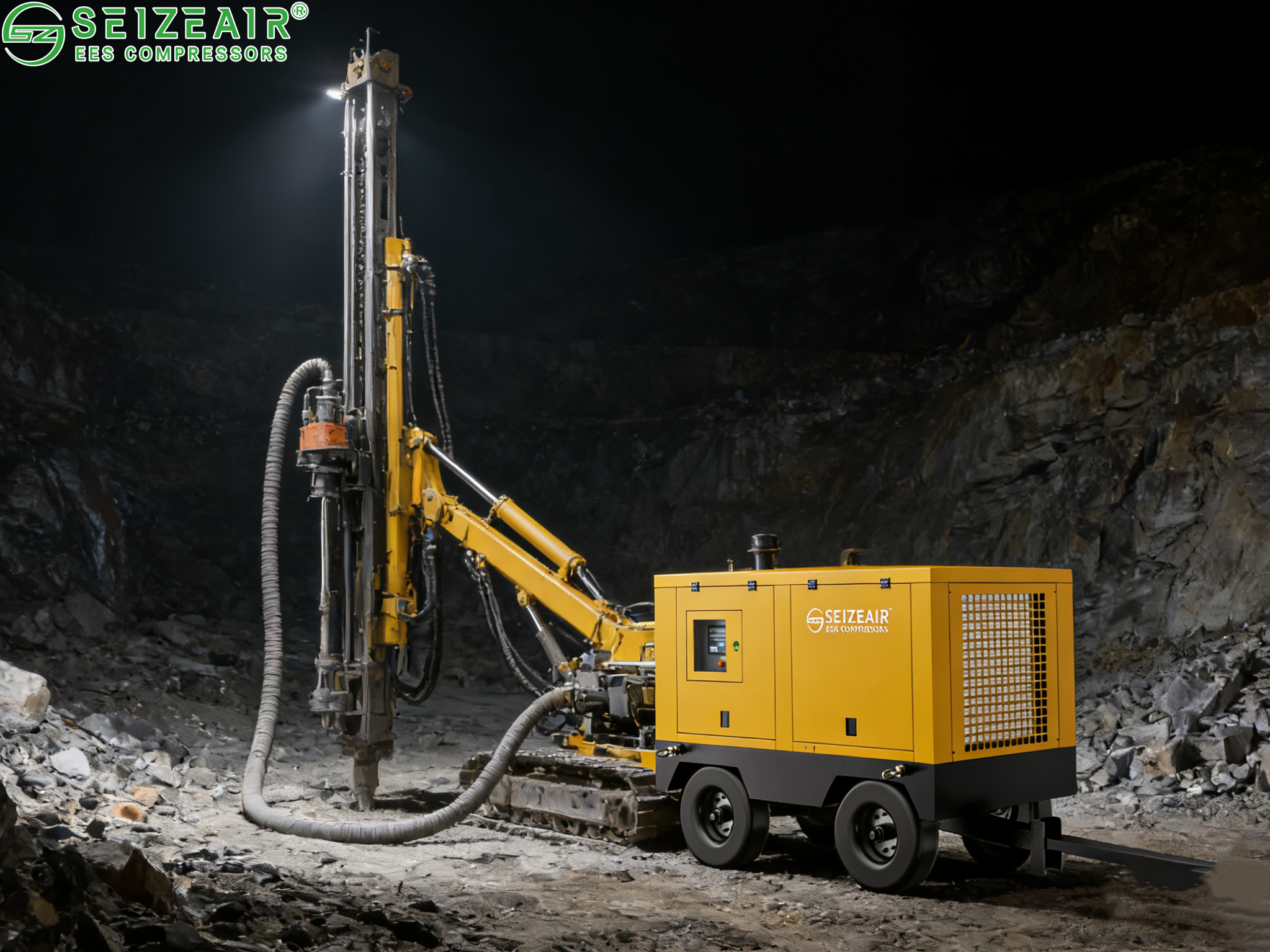
Picture a copper exploration camp three hours from the nearest town. The grid stops at the highway. The drilling contractor arrives with an electric compressor — and realizes there is nowhere to plug it in. The rig sits idle for two days while a diesel portable air compressor is trucked in. That delay cost more than the compressor’s freight. Down-the-hole (DTH) drilling, abrasive sandblasting, and pneumatic breakers do not care how far you are from civilization; they only care that steady, high-pressure air keeps arriving. A diesel portable air compressor is purpose-built for exactly that job.
Below we cover what these machines are, how a rotary screw unit works, and why diesel beats electric or gasoline off-grid. We compare screw against piston, decode the nameplate, walk through a three-step sizing method with a worked example, and review the top applications. We also outline emission rules by region, the questions to ask a supplier, and a reference model to benchmark against. When you are ready for real numbers, request a diesel portable air compressor quote and spec sheet.
Key Takeaways
- A diesel portable air compressor is the only practical air source for off-grid mining, remote construction, and mobile rental fleets.
- For DTH drilling, plan for roughly 10–25 bar of pressure (verified industry range) and match CFM to hammer size; an 18-bar, 665-CFM unit covers common 6–8 inch blast-hole work.
- Choose a rotary screw machine whenever you run more than about 4 hours continuously — piston units are built for intermittent duty (50–70% duty cycle) and overheat under constant load.
- Size by total CFM demand + 25–30% margin, then confirm pressure and engine power; never size on horsepower alone.
- After-sales terms are agreed per order — there is no standardized warranty policy, so supplier support and spare-parts access matter as much as the spec sheet.
What Is a Diesel Portable Air Compressor?
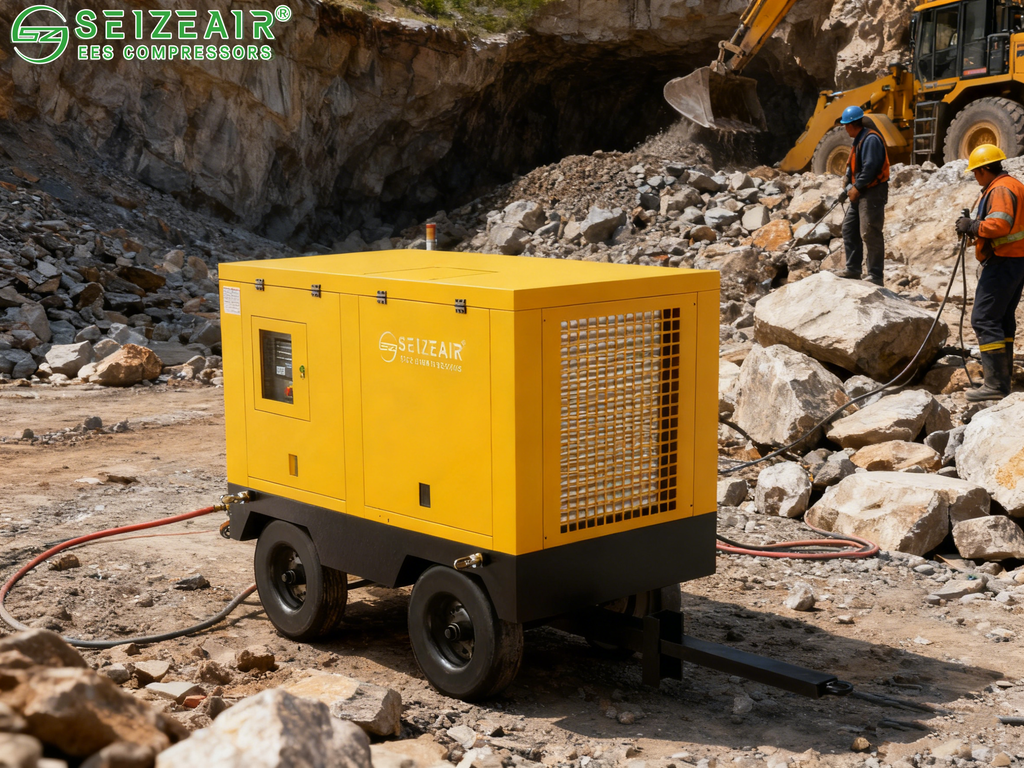
A diesel portable unit is a self-contained machine that mounts a rotary screw (or piston) air end directly onto a diesel engine, packages both onto a road-towable skid or trailer with a fuel tank and aftercooler, and delivers compressed air through one or more outlets. There is no building, no electrical supply, and no fixed foundation. You park it next to the work, start the engine, and air flows.
The “portable” part is not a gimmick. These machines are engineered to be moved constantly — between drill holes on a mine bench, between bridge piers on a highway job, or between customer sites on a rental truck. Four wheels, a drawbar, and a compact footprint let a single pickup tow the unit where the air is needed.
Diesel vs. Electric vs. Gasoline — When Diesel Wins
The first buying decision is the power source, and for your applications the answer is usually diesel.
- Electric compressors are quiet and clean, but they need a grid connection or a generator. On a remote mine bench or a greenfield construction site, that connection does not exist. Electric also limits you to fixed locations.
- Gasoline portable units exist, but they top out at lower power and are less fuel-efficient at continuous load. They suit small workshops and light site work, not 18-bar DTH drilling.
- Diesel wins on energy density, runtime, and raw output. A modern diesel engine delivers the kilowatts needed to push 600+ CFM at high pressure, sips fuel relative to the work done, and runs for a full shift on one tank. For mining, heavy construction, and rental fleets, diesel is the default — and often the only viable — choice.
The trade-off is emissions compliance and noise, which we cover later. But if your site has no power and your tools need serious air, diesel is the answer — no grid, no generator, just a trailer and a fuel tank.
Want the bigger picture on how these units fit a fleet? Our blog on portable compressor selection covers related buying topics.
How a Diesel Portable Screw Compressor Works
Understanding the machine helps you buy it well. A diesel portable screw unit has two halves: a diesel engine that makes power, and a rotary screw air end that turns that power into compressed air. They are joined by a coupling, and the whole system is managed by a controller that watches pressure, temperature, and load.
The Rotary Screw Air End
The air end is the heart of the machine. Inside a sealed housing sit two interlocking helical rotors. As the diesel engine spins them, air is drawn in at one end and squeezed to working pressure by the time it reaches the discharge port.
Two features make this design ideal for field work. First, the rotors never touch — they are separated by a thin oil film — so internal wear is minimal and service intervals are long. Second, the output is a smooth, pulse-free stream of air, not the pulsating delivery of a piston pump. That steady column of pressure is exactly what a DTH hammer needs to keep drilling without stalling.
Diesel Engine + Coupling Drive
The diesel engine provides shaft power. In a well-matched unit, the engine’s rated power lines up with the air end’s demand at full load, leaving margin for altitude, heat, and filter restriction. Power transfers through a direct coupling or gear drive — no long belt to slip or snap on a dusty site.
The controller ties it together: it modulates engine speed or load to hold your set pressure as demand rises and falls, protects against over-temperature, and reports faults. Diesel makes the torque, the coupling delivers it, the screw makes the air, and the controller keeps all three honest.
Screw vs. Piston — Which One Do You Actually Need?
This is the question that separates a smart purchase from an expensive mistake. Both compressors squeeze air, but for different duty.
A rotary screw unit runs a 100% duty cycle — built for continuous, all-shift operation. A reciprocating (piston) unit is built for intermittent use, typically a 50–70% duty cycle, and needs cool-down pauses. Run a piston flat-out for ten hours and you cook the valves and rings.
Side-by-Side: Screw vs. Piston
| Factor | Rotary Screw | Reciprocating Piston |
| Duty cycle | 100% continuous | 50–70% intermittent |
| Air delivery | Smooth, pulse-free | Pulsating |
| Noise level | Lower (60–80 dB) | Higher (80–95+ dB) |
| Maintenance | Lower over time (fewer wear parts) | Higher (valves, rings, bearings) |
| Upfront cost | Higher | Lower |
| Best for | DTH drilling, sandblasting, 24/7 fleet use | Occasional, start-stop hand tools |
Rule of Thumb: >4 Hours Continuous Run → Choose Screw
Here is the simplest test. If your tool runs air for more than about four hours at a stretch — DTH drilling, sandblasting, or feeding a rental customer all day — buy a screw machine. Short bursts a few times a shift? A piston unit’s lower price may win.
Marcus runs a regional rental fleet and learned this the hard way. He stocked piston compressors because they were cheaper to buy, then watched them come back with burned valves from customers running them eight hours straight on demolition jobs. He shifted his continuous-duty inventory to screw units and his comeback rate dropped. The higher purchase price paid for itself in fewer repairs.
Key Specifications to Understand Before You Buy
The nameplate tells you everything — if you know how to read it. These are the terms that matter for these machines.
| Specification | What it means | Why it matters |
| FAD / CFM | Free Air Delivery, the actual air volume at working pressure | Drives how many tools or how big a hammer you can run |
| Pressure (bar / psi) | Working pressure the unit sustains | DTH drilling needs 10–25 bar; light tools need less |
| Engine power (kW) | Diesel output driving the air end | Must cover full-load air demand with margin |
| Fuel tank (L) | Diesel capacity | Sets shift runtime between refuels |
| Weight (kg) | Unit mass | Affects tow vehicle and site access |
| Outlets | Thread type and count (e.g. G2″ + G3/4″) | Matches your hose couplings and tool count |
| Towability | Wheels, drawbar, dimensions | Determines what can move and store it |
Two notes. First, FAD (Free Air Delivery) is the honest number — the air you actually get at pressure, not a theoretical displacement. Always compare FAD, never just tank size or horsepower. Second, outlets matter more than buyers expect; a single G2″ port throttles you if you need two tools at once.
How to Size a Diesel Portable Air Compressor
Sizing is the single most important step, and the method is straightforward. Follow three steps, then pad for reality.
Step 1 — Total your CFM demand. List every tool you will run at the same time and add their air consumption. A 60 lb jackhammer draws about 60–120 CFM at 60–100 PSI, and a sandblaster can need 10–100+ CFM depending on nozzle size. Add them up.
Step 2 — Add a 25–30% margin. Hose friction, leaks, altitude, and filter restriction all steal air. Multiply your total by 1.25–1.30. Industry guidance consistently recommends this buffer (e.g. NiGen’s 25–30% rule; EquipNearby’s 20–30% for elevation and losses).
Step 3 — Confirm pressure and engine power. Make sure the unit holds your required bar/psi at that CFM, and that the diesel engine has enough kW to sustain it. Pressure and volume must both be sufficient — one without the other fails in the field.
Worked Example
Suppose you run DTH drilling with a 6-inch hammer, plus a 60 lb breaker for cleanup. A 6-inch DTH hammer in hard rock typically needs around 250–400 CFM at 150–200 PSI (10–14 bar). Your breaker adds ~60–120 CFM.
- Tool demand: 350 CFM (drill) + 90 CFM (breaker) = 440 CFM
- Add 30% margin: 440 × 1.30 ≈ 572 CFM required
- Required pressure: at least 14 bar to drive the hammer effectively
A unit like the SDP-19/18TC — 19 m³/min (about 665 CFM) at 18 bar — clears this demand with headroom for deeper holes or a second tool. The 194 kW Cummins engine supplies the shaft power to hold that output. You have sized correctly when your calculated demand sits comfortably below the unit’s FAD at the needed pressure.
Ready to turn these numbers into a real proposal? Request a diesel portable air compressor quote and we will match a model to your tools.
Top Applications
A diesel portable unit earns its keep wherever air must travel to the work. Three applications dominate.
Mining & DTH Drilling
Mining is the most demanding use. DTH hammers run entirely on compressed air: it drives the piston that breaks rock and flushes cuttings up the hole. Get the pressure or volume wrong and penetration slows, the hammer jams, or the hole fills with cuttings. Typical DTH working pressure runs about 10–25 bar, with high-pressure mining hammers in the 17–24 bar band. A high-pressure diesel portable screw compressor is the standard rig companion on a mine bench.
Heavy Construction & Sandblasting
From bridge repainting to tank coating, sandblasting eats air. Consumption scales with nozzle size — a small cabinet needs ~10–20 CFM, a large blast pot with a wide nozzle can pull 50 CFM or more. A diesel portable unit on a trailer follows the blast crew along a structure, delivering steady high-volume air without a power drop. Breakers, chipping hammers, and pile drivers draw on the same supply.
Rental Fleet Deployment
Rental yards live on flexibility. A diesel portable unit is one of the most-requested items because almost every site eventually needs air and rarely has it. As a market reference, North American rental yards list towable diesel compressors at roughly 165–320/day for a 185-CFM class unit and 280–550/day for a 375-CFM class unit, with monthly rates in the thousands. For fleet planning, the lesson is uptime: screw units with long service intervals keep earning while piston units sit in the shop.
A Reference Model: SDP-19/18TC
To make the specs concrete, here is a real reference model you can use as a benchmark when comparing units.
| Parameter | SDP-19/18TC |
| Free Air Delivery (FAD) | 19 m³/min (≈665 CFM) |
| Working pressure | 18 bar (DTH-grade) |
| Fuel tank | 260 L |
| Engine | Cummins, 194 kW |
| Weight | 3,500 kg |
| Dimensions (L×W×H) | 3,200 × 1,800 × 2,380 mm |
| Outlets | G2″ × 1 + G3/4″ × 1 |
| Mobility | 4-wheel towable |
| Typical applications | Mining DTH, heavy construction, rental fleets |
| Noise level |
[specific noise level to be confirmed with factory]
Fuel consumption
[fuel consumption L/h to be confirmed with factory]
Brazil emissions
[PROCONVE Brazil compliance to be confirmed with factory]
This machine is built for exactly the buyers in this guide: high-pressure DTH drilling, heavy construction air, and demanding rental duty. The two bracketed figures — noise and fuel consumption — are shown as confirmed-with-factory placeholders because they are application- and option-dependent; we do not publish numbers we cannot stand behind. The same honesty applies to Brazil’s PROCONVE emission status, which we confirm per order.
A note on manufacturing: production uses precision equipment including OKUMA, KAPP NILES, and Leitz machine tools, and compressors are built and tested to ISO 1217 (the international standard for displacement and performance measurement) with CE marking (CE 8.0-2116-09). High-efficiency WEG IE4 motors are used in our electric fixed-speed machines — a different product line from these diesel portables, but part of the same precision-manufacturing base.
Questions to Ask a Supplier Before You Order
The spec sheet is only half the story. Before you commit, ask:
- What is the true FAD at working pressure? Insist on Free Air Delivery, not displacement or tank size.
- What is the service interval and local parts availability? For remote sites, a 1,000-hour oil-change interval can halve your service visits.
- What emissions standard does this engine meet for my market? Tier 4 Final, Stage V, or other — and get it in writing for your region.
- What is the outlet configuration, and can it be adapted? Confirm G-thread sizes match your hoses.
- What are the after-sales terms? Be clear on this point: there is no standardized warranty policy; after-sales terms are agreed per order. Ask exactly what support, spare parts, and response times are included in your agreement.
- Can you supply a verified spec sheet and test data for my exact configuration? Particularly for noise and fuel consumption, which vary by options.
The last question protects you most. Because warranty is not standardized, the per-order after-sales agreement is where your real protection lives — read it as carefully as the price.
Fuel, Runtime & Operating Cost Considerations
Diesel is the dominant life-cycle cost after purchase. Runtime on a tank is simple: runtime = fuel tank capacity ÷ fuel consumption at load. A 260 L tank with a moderate burn gives a long shift; a thirsty engine means frequent refuels.
The honest part: we do not publish a fuel consumption figure for the SDP-19/18TC because it depends on load, altitude, and options — so it reads as [fuel consumption L/h to be confirmed with factory]. When you request a quote, ask for the consumption curve at your expected load to compute true runtime and cost per hour.
Two levers matter. First, right-sizing: an oversized compressor wastes fuel, an undersized one runs flat-out and wears out. Second, duty profile — screw units at 70–80% load last far longer than those pinned at 100% (portable compressor durability data shows 8,000–12,000 hour lifespans at moderate load). Match the machine to the work and fuel becomes predictable.
Diesel Emission Standards by Region
Where you operate decides which engine you can run. The two global benchmarks are the U.S. EPA Tier 4 Final and the EU Stage V; Brazil follows PROCONVE.
- United States — EPA Tier 4 Final. Regulated under 40 CFR Part 1039 for nonroad diesel engines, including compressors on trailers. Limits for the 56–560 kW band are 0.02 g/kW-hr particulate matter and 0.40 g/kW-hr NOx — roughly a 90% cut versus early tiers. Full compliance was required by 2015 for most engine sizes.
- European Union — Stage V. Set by Regulation (EU) 2016/1628. For engines at or above 56 kW, limits are about 0.015 g/kW-hr PM and 0.40 g/kW-hr NOx, and Stage V introduced a particle-number (PN) limit. Ultra-low-sulfur diesel (≤10 ppm) is required.
- Brazil — PROCONVE. Brazil’s emission program covers nonroad diesels, but the specific PROCONVE compliance status for any given portable model must be confirmed — so we list it as [PROCONVE Brazil compliance to be confirmed with factory]. Tell your supplier your deployment country and ask for written confirmation before ordering.
If you ship to multiple regions, confirm each market’s standard in writing. Emission compliance is not something to assume at the border.
Frequently Asked Questions
1. What size diesel portable air compressor do I need for DTH drilling? Match both pressure and volume to your hammer. DTH working pressure typically runs about 10–25 bar, with high-pressure mining hammers in the 17–24 bar range. A 6-inch hammer in hard rock needs roughly 250–400 CFM at 10–14 bar. The SDP-19/18TC at 665 CFM and 18 bar covers common 6–8 inch blast-hole work with margin. Size by your largest hammer, then add the 25–30% buffer.
2. How many CFM does a jackhammer / sandblaster need? A 60 lb jackhammer typically needs about 60–120 CFM at 60–100 PSI, and sandblasters range from ~10 CFM for small cabinets to 100+ CFM for large nozzles. Check your tool’s nameplate and size above that total.
3. What’s the difference between a screw and piston diesel compressor? The core difference is duty cycle. A rotary screw compressor runs a 100% continuous duty cycle, while a reciprocating piston unit is built for intermittent use at roughly 50–70% duty. Screw units cost more upfront but need less maintenance and run cooler; piston units are cheaper but overheat if run continuously.
4. How long can a diesel portable compressor run on one tank of fuel? It depends on tank size and fuel consumption at load: runtime = tank capacity ÷ fuel burn rate. A larger tank and a thrifty engine mean longer shifts. For the SDP-19/18TC’s 260 L tank, we do not state a runtime because fuel consumption varies by load and options — it is listed as [fuel consumption L/h to be confirmed with factory]. Ask your supplier for the consumption curve, then do the math for your duty profile.
5. What diesel emission standard applies in my region (Tier 4 / Stage V / PROCONVE)? In the United States, nonroad compressors must meet EPA Tier 4 Final (40 CFR Part 1039). In the European Union, the standard is Stage V (Regulation EU 2016/1628). In Brazil, PROCONVE applies — but confirm the specific model’s status per order, as we list it as [PROCONVE Brazil compliance to be confirmed with factory]. Always get written confirmation for your target market.
6. Can a diesel portable air compressor be used for sandblasting? Yes — it is a core application. Consumption scales with nozzle size, from roughly 10–20 CFM for small cabinets to 50 CFM or more for large blast pots. A diesel portable screw compressor on a trailer delivers the steady high-volume air a blast crew needs, following the work without a power drop.
7. What pressure (bar/psi) is needed for DTH drilling? Most DTH hammers operate in the 10–25 bar band. Standard hammers run about 10–17 bar, while high-pressure mining hammers reach 17–24 bar. Match the compressor’s sustained pressure to your hammer’s specification — pressure drives penetration, volume clears cuttings.
8. Do you offer a warranty on portable diesel compressors? There is no standardized warranty policy; after-sales terms are agreed per order. Rather than a fixed warranty, support, spare-parts access, and response commitments are defined in each order’s agreement. Ask your supplier exactly what is included before you buy, and treat the per-order after-sales terms as your primary protection.
Conclusion
Buying a diesel portable air compressor is really about matching air to work. Consider the quarry operator who first bought on price, then watched a 15-bar unit stall on 18-bar DTH holes. After right-sizing to a high-pressure screw machine, his penetration recovered and the hammer stopped jamming. The lesson repeats across sites: match the spec to the work. You now know the machine: a diesel engine driving a rotary screw air end on a towable skid, built to deliver high-pressure air where the grid never reaches. You know how to choose — screw over piston for any run longer than about four hours, diesel over electric or gasoline for off-grid sites. You know how to size — total your CFM, add 25–30%, confirm pressure and engine power — and you have a worked example and a real reference model, the SDP-19/18TC, to benchmark against.
The mistakes are now avoidable: don’t size on horsepower, don’t trust tank size over FAD, and don’t assume a standardized warranty exists. Ask for the per-order after-sales terms, confirm emissions for your region, and get verified numbers for noise and fuel use.
Your next step is simple. Request a diesel portable air compressor quote and spec sheet, tell us your tools and site conditions, and we will match a model to your exact demand — with after-sales terms spelled out before you order. The right machine on the right site keeps your crew productive instead of waiting on air.