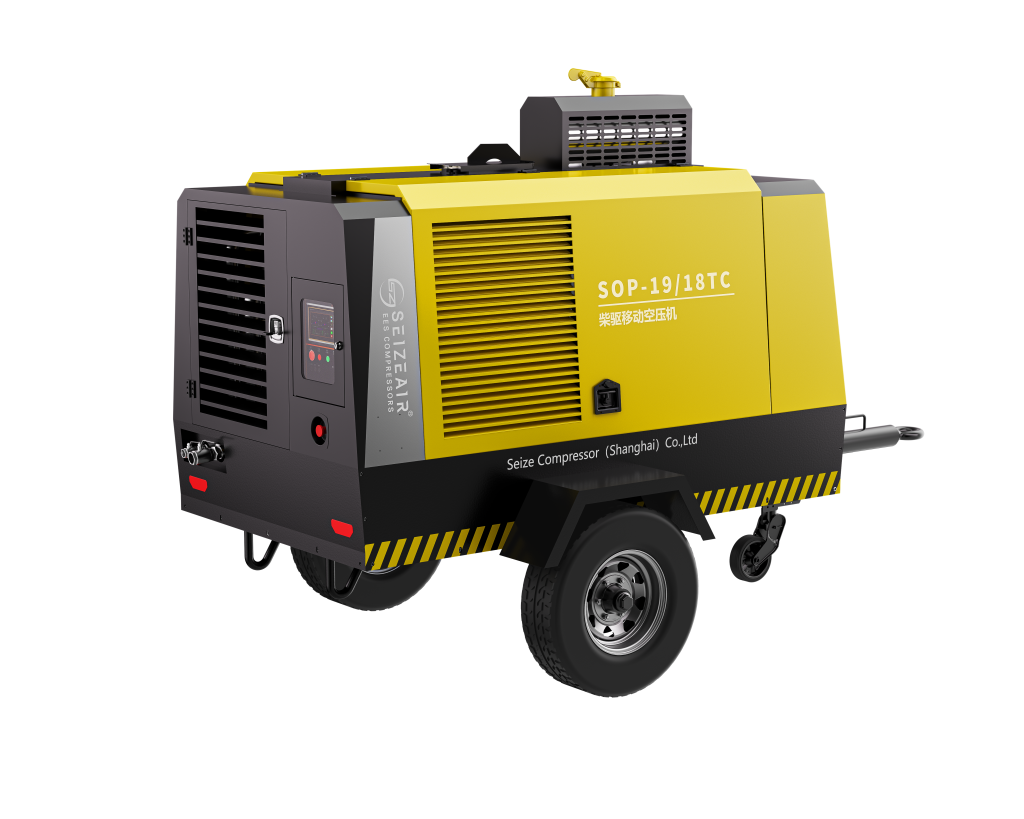
Introduction
Compressed air is often called the fourth utility in industrial operations—right behind electricity, water, and natural gas. But unlike those fixed utilities, compressed air doesn’t need to be tied to a permanent installation. Mobile air compressors bring this essential power source directly to the job site, whether that’s a high-rise construction project in Dubai, an open-pit mine in Australia, or a rental yard in Texas.
For fleet managers, project engineers, and equipment buyers, understanding how mobile air compressors perform across different industries is the difference between selecting a machine that becomes a workhorse and one that gathers dust. This guide breaks down the real-world applications of mobile air compressors across three core industries—construction, mining, and equipment rental—and provides a framework for matching the right compressor to the right job.
1. Construction: The Backbone of Mobile Compressed Air
Construction remains the single largest consumer of portable air compressors worldwide. From small-scale residential projects to multi-billion-dollar infrastructure developments, compressed air drives the tools that shape the built environment.
1.1 Pneumatic Tool Operation
The most common construction application is powering pneumatic hand tools. Modern construction sites rely on a suite of air-powered equipment:
- Pneumatic breakers and jackhammers: For concrete demolition, asphalt cutting, and rock breaking. These tools demand consistent high-volume airflow—typically 90 to 185 CFM at 100 PSI for mid-sized breakers. Undersized compressors cause tool stalling and productivity losses that compound across shifts.
- Rock drills: Used in foundation work, anchoring, and blasthole preparation. Rock drills require both high pressure and sustained flow rates, often pushing 150-200 CFM for deep drilling applications.
- Nail guns and framing tools: Lighter-duty but high-cycle. A crew running multiple framing nailers simultaneously needs a compressor that can maintain 7-10 CFM per tool without pressure drop.
- Impact wrenches, grinders, and sanders: Common in steel erection, pipefitting, and surface preparation. These rotary tools are flow-hungry and benefit from compressors with large air receiver tanks to buffer demand spikes.
The key takeaway for construction buyers: match compressor output not to the largest single tool, but to the simultaneous demand of all tools expected to run at once. A common mistake is sizing for one breaker when the crew operates two.
1.2 Sandblasting and Surface Preparation
Abrasive blasting is one of the most demanding applications for any air compressor. Whether removing rust from structural steel, preparing concrete surfaces for coating, or cleaning brick and stone facades, sandblasting consumes enormous volumes of compressed air.
A typical sandblasting setup requires:
| Nozzle Size | Pressure (PSI) | Air Demand (CFM) |
|---|---|---|
| 1/8 inch | 90-100 | 20-35 |
| 3/16 inch | 90-100 | 40-60 |
| 1/4 inch | 90-100 | 80-110 |
| 5/16 inch | 90-100 | 120-160 |
| 3/8 inch | 90-100 | 160-210 |
For heavy industrial blasting with 3/8-inch nozzles, a single compressor may not suffice—operators often daisy-chain two mobile units or spec a large tow-behind diesel compressor in the 375-425 CFM range.
2.3 Mineral Processing Support
Above-ground mineral processing plants use compressed air extensively:
- Flotation cells: Air injection for mineral separation
- Filter press operation: Pneumatic membrane squeezing for dewatering
- Instrument air: Powering pneumatic control valves and actuators
- Dust collection: Pulse-jet baghouse cleaning systems
While processing plants typically have permanent compressor installations, mobile units serve as backup capacity during maintenance shutdowns or as temporary capacity during production ramp-ups.
2.4 Remote Site Operations
Mining exploration often occurs in locations with zero infrastructure—no grid power, no permanent roads, and extreme weather. Mobile compressors serving these sites must meet stringent criteria:
- Trailer-mounted with off-road capability: Heavy-duty axles, high ground clearance
- Integrated fuel tanks: 8-24 hour runtime without refueling
- Cold-weather starting packages: Block heaters, ether injection, battery warmers
- Dust-resistant filtration: Multi-stage intake filters rated for high-dust environments
3. Equipment Rental: Versatility Is the Product
The equipment rental industry represents a distinct application category with its own set of requirements. Rental companies don’t buy compressors for a specific job—they buy compressors that can serve dozens of different jobs across multiple industries, often with different operators each time.
3.1 The Rental Value Proposition
Rental companies evaluate compressors through a fundamentally different lens than end-users. Key considerations include:
- Utilization rate: How many days per year will this unit be on rent? A compressor that only serves one niche application has poor utilization. The ideal rental compressor handles construction, light industrial, and emergency backup roles equally well.
- Operator-proof design: Rental equipment endures abuse. Simple controls, clear labeling, foolproof safety interlocks, and rugged construction reduce damage and downtime.
- Service interval length: Every service event costs the rental company a day of lost revenue. Compressors with 500-hour service intervals generate significantly more annual revenue than units requiring service every 250 hours.
- Residual value: Rental companies typically rotate fleets every 3-5 years. Strong brand reputation and durable construction translate into higher resale values.
- Telematics integration: Modern rental fleets increasingly rely on GPS tracking, hour-meter logging, and remote diagnostics. Compressors with factory-integrated telematics reduce the retrofit burden.
3.2 Common Rental Applications
A single mobile compressor in a rental fleet might see the following applications in a single year:
| Month | Application | Industry | CFM Demand |
|---|---|---|---|
| January | Frozen pipe thawing | Municipal | 100-150 |
| March | Bridge deck sandblasting | Infrastructure | 250-375 |
| May | Foundation drilling | Commercial construction | 185-250 |
| July | Festival stage setup | Events | 100-150 |
| September | Grain silo aeration | Agriculture | 150-185 |
| November | Factory backup during compressor maintenance | Manufacturing | 250-375 |
This diversity is exactly why rental companies gravitate toward the 185-375 CFM diesel portable compressor class: it covers the widest range of applications with a single unit type.
3.3 Diesel vs Electric for Rental Fleets
The diesel-versus-electric question takes on unique dimensions in the rental context:
Diesel advantages for rental:
- Self-contained—no dependency on site power availability
- Higher CFM output per footprint
- Familiar to all operator skill levels
Electric advantages for rental:
- Lower maintenance costs and longer service intervals
- Permitted for indoor and underground use
- Zero local emissions—increasingly required by urban job site regulations
- Quieter operation—critical for residential areas and night work
Leading rental companies are increasingly running mixed fleets: diesel for heavy outdoor applications, electric for urban, indoor, and environmentally sensitive projects.
Electric mobile compressors are gaining share rapidly in:
- Indoor and underground operations: Zero emissions eliminate the need for expensive ventilation upgrades
- Urban construction: Noise ordinances in cities like London, New York, and Singapore increasingly mandate electric equipment for night work and residential-adjacent sites
- Tunneling and confined spaces: Combined noise and emissions restrictions make electric the only viable choice
- Facilities with available high-voltage power: Quarries, processing plants, and established mine sites with existing electrical infrastructure can operate electric compressors at substantially lower cost per CFM
- Total cost of ownership (TCO) calculations over 5+ years: Electric compressors have fewer wearing components—no engine oil changes, no fuel filters, no DPF regeneration—which can offset higher initial purchase prices in high-utilization scenarios
4.3 The Hybrid Future
A small but growing segment of the market is adopting hybrid compressor systems that pair a smaller diesel engine with battery-electric drive and energy recovery. These systems allow:
- Zero-emission operation for short-duration tasks
- Diesel backup for extended high-demand work
- Engine-off operation at idle—eliminating the inefficiency of diesel engines running at low load
While still a niche category, hybrid compressors point toward a future where application flexibility is built into a single platform.
5. Key Features to Evaluate by Application
Different applications demand different compressor features. The table below summarizes critical specifications by industry:
| Feature | Construction | Mining | Rental |
|---|---|---|---|
| CFM Range | 90-425 | 250-1,600 | 100-425 |
| Pressure (PSI) | 100-150 | 150-350 | 100-175 |
| Fuel Type Priority | Diesel (remote sites) | Diesel (surface), Electric (underground) | Mixed fleet |
| Runtime per Tank | 8-10 hours | 10-24 hours | 8-12 hours |
| Dust Filtration | Standard | Heavy-duty multi-stage | Standard to heavy-duty |
| Noise Level | Secondary concern | Concern for underground | Primary concern (urban) |
| Towability | Highway-speed trailer | Off-road trailer | Highway-speed trailer |
| Telematics | Growing importance | Standard requirement | Standard requirement |
| Cold Weather Package | Seasonal requirement | Standard requirement | Optional |
6. Why SEIZE AIR for Your Mobile Compressor Needs
SEIZE AIR designs and manufactures mobile air compressors purpose-built for demanding applications across construction, mining, and rental industries. Our engineering philosophy centers on three principles that directly impact application performance:
Purpose-matched output curves: Rather than offering generic compressor profiles, SEIZE AIR tunes each model’s pressure-flow curve to the applications it serves. Construction models prioritize high volume at moderate pressure; mining models deliver sustained high pressure with surge capacity for hammer drilling.
Application-specific filtration: Standard compressors fitted with off-the-shelf filters fail prematurely in mining dust and construction debris. SEIZE AIR integrates multi-stage cyclonic pre-filtration and extended-surface-area primary elements that extend service intervals by up to 2x in high-dust environments.
Modular configuration platform: Every SEIZE AIR compressor is built on a modular architecture that allows buyers to specify exactly what their application requires—aftercoolers, dryers, generator integration, cold-weather packages, or telematics—without the lead times and costs of full customization.
Explore our full range of diesel and electric portable compressors at sz-portable.com.
7. Conclusion: Start with the Application, Not the Spec Sheet
The most expensive mistake in mobile compressor purchasing is starting with the spec sheet instead of the application. Buyers who lead with “I need 375 CFM at 150 PSI” often end up with exactly the right specification—for the wrong job.
A better approach:
- Define the application first: What are you actually doing with the compressed air? List every tool, every process, every job site condition.
- Map application requirements to compressor specifications: Simultaneous tool demand, altitude, temperature extremes, mobility needs, runtime requirements.
- Evaluate fuel type based on site conditions: Not habit, but reality—is grid power available? Are emissions regulated? What’s the total cost of ownership over your planned ownership period?
- Select by total lifecycle value: Purchase price is one data point. Fuel consumption, service costs, downtime risk, and residual value matter more across 5-10 years of operation.
Mobile air compressors are not commodities—they are application-critical production assets. Choosing the right one starts with understanding the work it needs to do.