Choosing between a diesel and electric portable air compressor is one of the first decisions every project manager, rental fleet operator, or contractor faces. It is not a trivial one. The power source defines where you can work, how much you spend per hour, and how long your equipment lasts.
In this guide, we break down the diesel-vs-electric decision across five dimensions: fuel cost, mobility, noise regulations, maintenance, and real-world application scenarios. By the end, you will know exactly which type fits your jobsite—and when you might need both.
1. Fuel Cost: Diesel’s Flexibility vs Electric’s Efficiency
Fuel is the largest variable cost over a portable compressor’s lifetime. Here is how the two stack up.
Diesel Portable Compressors
Diesel units burn fuel onsite. At current global diesel prices (averaging $1.00-1.50/L depending on region), a mid-size diesel compressor consuming 8-12 L/hour at 75% load costs roughly $8-$18 per operating hour in fuel alone.
The advantage? No grid dependency. You bring the fuel with you. This is non-negotiable for remote construction sites, mining operations, and emergency response scenarios where electrical infrastructure simply does not exist.

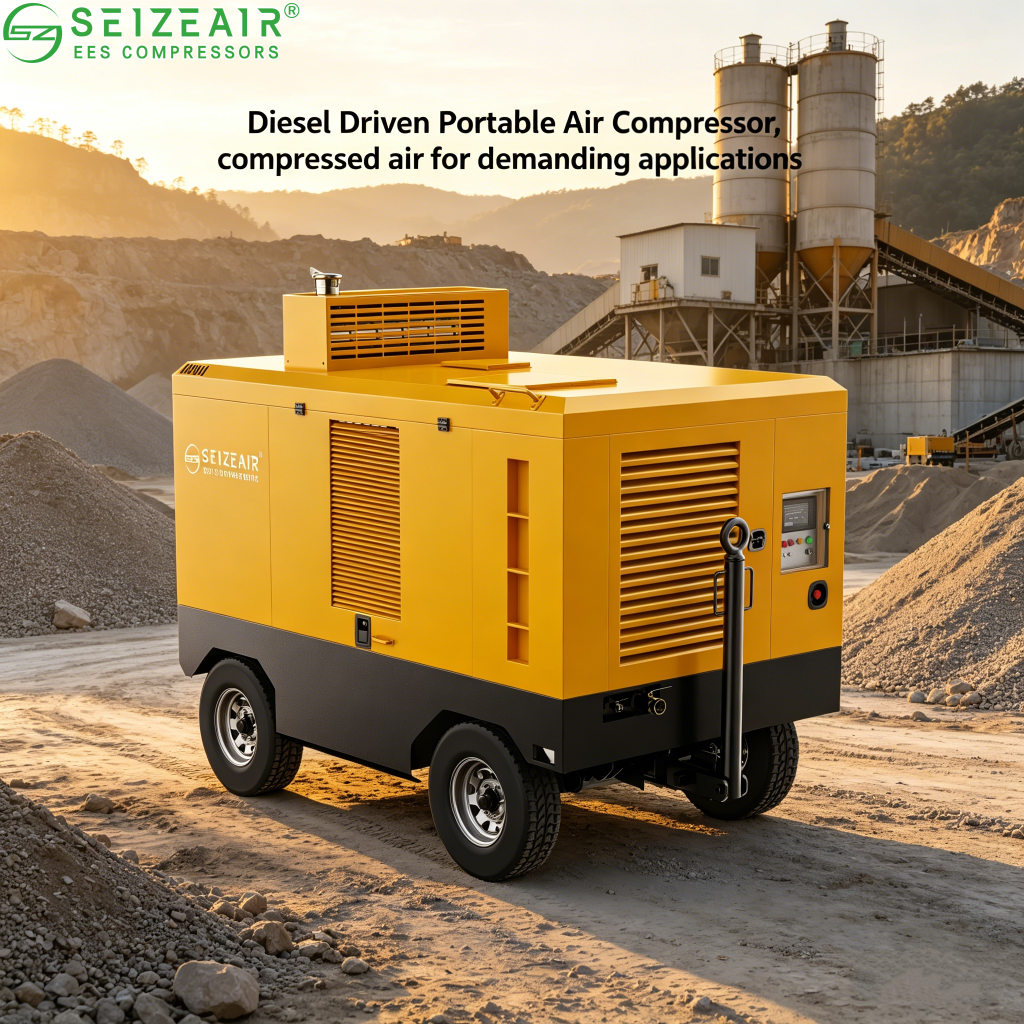
SEIZE AIR diesel portable compressor — designed for remote and heavy-duty applications.
Electric Portable Compressors
Electric models connect to grid power or a generator. At an industrial electricity rate of $0.08-0.15/kWh, a comparable electric unit costs $3-$6 per hour to run—roughly 60-70% less than diesel.
But the catch is access. If your jobsite has stable three-phase power within reach, electric is the clear winner on operating cost. If it does not, the savings are theoretical.
SEIZE AIR electric portable compressor — ideal for urban sites with grid access.
Quick Comparison Table
| Factor | Diesel Portable | Electric Portable |
|---|---|---|
| Fuel cost per hour | $8-$18 | $3-$6 |
| Grid dependency | None | Required or generator |
| Fuel storage needed | Yes (diesel tank) | No |
| Carbon emissions | Higher | Lower (grid-dependent) |
| Best for | Remote sites, mining, emergency | Urban construction, indoor-adjacent, rental |
2. Mobility: Where Can You Actually Take It?
Portability is the whole point of a mobile compressor. But diesel and electric units have different mobility profiles.
Diesel units are self-contained. The engine, compressor, fuel tank, and controls are all on one chassis. Hook it to a truck and go. SEIZE AIR’s diesel portable line is built on a rugged trailer frame with highway-rated axles, making it towable at full speed between sites.
Electric units are physically lighter (no engine block, no fuel tank), but they need a cable. On a large construction site, that cable might run 50-100 meters. Beyond that, you need a generator—which reintroduces fuel logistics and partially defeats the purpose.
Winner by scenario:
- Multi-site contractors moving every few days → Diesel
- Fixed-location urban sites with power hookup → Electric
- Underground mining → Electric (ventilation regulations often ban diesel exhaust)
3. Noise: The Regulation That Is Changing Everything
Urban noise ordinances are getting stricter. Many European and North American cities now cap jobsite noise at 65-70 dB(A) during daytime hours, with even lower limits near hospitals, schools, and residential zones.
Diesel Noise Profile
A standard diesel portable compressor runs at 75-85 dB(A) at 7 meters. With acoustic canopies, premium models bring this down to 68-72 dB(A). That is roughly the sound level of a vacuum cleaner—acceptable on a highway project, but potentially problematic in a dense urban block.
Electric Noise Profile
Electric models have a fundamental advantage: no combustion noise. An electric portable compressor typically runs at 55-65 dB(A), comparable to normal conversation. This opens up night work, residential retrofits, and indoor-adjacent applications that diesel units simply cannot handle.
Key takeaway: If you bid on urban infrastructure projects, check the noise spec in the contract. Electric may be your only compliant option.
Noise Comparison
| Compressor Type | Typical dB(A) at 7m | Comparable To |
|---|---|---|
| Diesel (standard) | 78-85 | Busy street traffic |
| Diesel (acoustic canopy) | 68-72 | Vacuum cleaner |
| Electric | 55-65 | Normal conversation |
4. Maintenance: Hours, Intervals, and Downtime
Maintenance is where electric compressors pull ahead decisively.
Diesel Maintenance Burden
A diesel engine adds roughly 30-40% to the total maintenance load of a portable compressor. You are dealing with:
- Engine oil and filter changes every 250-500 hours
- Fuel filter replacements
- Air filter cleaning (diesel engines breathe dirty air on jobsites)
- Belt inspections and replacements
- Coolant system maintenance
- DPF (Diesel Particulate Filter) regeneration on newer Tier 4/Stage V compliant models
Annual maintenance costs for a diesel portable typically run $1,500-$3,000 depending on utilization.
Electric Maintenance Profile
An electric motor has exactly one major wear item: bearings. No oil changes. No filters. No belts. No exhaust system. Annual maintenance costs are typically $300-$600—an 80% reduction.
Over a 10-year service life, that difference alone can exceed $15,000 per unit. For a rental fleet with 20 machines, we are talking real money.
Learn more about SEIZE AIR’s full portable compressor lineup
5. Application Match: Which One for Your Industry?
Here is a decision matrix based on real-world deployments.
| Industry / Application | Recommended Type | Why |
|---|---|---|
| Remote mining & quarrying | Diesel | No grid access, long operating hours |
| Highway & road construction | Diesel | Mobile, no fixed power along route |
| Urban building construction | Electric | Noise limits, grid access available |
| Utility trenching (urban) | Electric | Short-duration work, noise-sensitive |
| Emergency / disaster response | Diesel | Grid may be down, need self-sufficiency |
| Rental fleet (mixed) | Both | Offer diesel for remote jobs, electric for urban |
| Underground mining | Electric | Ventilation regulations restrict diesel |
| Shipyard / dock work | Electric or Diesel | Depends on power access, electric preferred near water |
| Pipeline testing | Diesel | Remote locations, extended continuous run |
6. The Total Cost of Ownership (TCO) Picture
Let us run the numbers on a 5-year ownership for a mid-size portable compressor (185 CFM class).
| Cost Category | Diesel (5-Year) | Electric (5-Year) |
|---|---|---|
| Purchase price | $25,000-$35,000 | $18,000-$28,000 |
| Fuel / electricity | $45,000-$90,000 | $15,000-$30,000 |
| Maintenance | $7,500-$15,000 | $1,500-$3,000 |
| Consumables (filters, oil, belts) | $3,000-$5,000 | $200-$500 |
| 5-Year TCO | $80,500-$145,000 | $34,700-$61,500 |
Assumes 2,000 operating hours per year. Actual figures vary by region and utilization.
The electric unit’s TCO is roughly 50-60% lower over five years—provided you have reliable grid access. For a contractor running multiple machines, the fleet-level savings are transformational.
7. Frequently Asked Questions
Q: Can I convert a diesel portable compressor to electric?
A: Not cost-effectively. The chassis, drivetrain, and control systems are fundamentally different. It is cheaper to buy a dedicated electric unit.
Q: How long can a diesel portable compressor run on a full tank?
A: A typical 185 CFM diesel unit with a 100L tank runs 8-12 hours at 75% load. Larger models may have extended-range tanks for 24-hour operation.
Q: Do electric portable compressors work with generators?
A: Yes, but the generator must supply stable three-phase power and handle the compressor’s starting current (typically 3-5x running current). Undersized generators cause voltage drop and motor damage.
Q: Which type has better resale value?
A: Diesel units generally hold value better in developing markets with limited grid infrastructure. Electric units depreciate faster but have growing demand in regulated urban markets.
Q: Are there hybrid portable compressors?
A: Emerging technology. Some manufacturers are piloting diesel-electric hybrids that run electric in urban zones and switch to diesel for transport or remote work. SEIZE AIR monitors this space closely.
The Bottom Line
There is no universal “better” choice—only the right choice for your jobsite.
Choose diesel if you work in remote locations, move frequently, or need complete independence from the grid. The higher operating cost is the price of freedom.
Choose electric if you work in urban or regulated environments, have stable power access, and want to slash your operating and maintenance costs by more than half.
Choose both if you run a rental fleet or a multi-site operation. Segment your inventory by application and optimize each machine for its primary jobsite type.
Still unsure? Contact SEIZE AIR for a personalized consultation. Our application engineers can analyze your specific jobsite conditions—power availability, runtime requirements, noise limits, and duty cycle—and recommend the optimal configuration.