Selecting the right equipment for industrial and commercial operations is a critical decision that directly impacts your bottom line. Among the most vital utilities on any job site is compressed air. However, buying the wrong equipment often leads to significant pain points: choosing an undersized unit stalls production and damages tools, while an oversized unit bleeds money through wasted fuel, excessive electricity consumption, and unnecessary capital expenditure.
Why does selection matter so much? Because the purchase price of an air compressor is only a fraction of its total cost of ownership. Proper sizing, matching the right power source to the environment, and anticipating long-term maintenance can save a company thousands of dollars annually.
In this comprehensive guide, you will learn exactly how to navigate the complex landscape of portable air compressors. We will cover everything from foundational definitions and accurate air demand calculation to total cost of ownership (TCO) analysis, industrial applications, and strict frameworks for evaluating an industrial air compressor company.
What Are Portable Air Compressors?
At their core, portable air compressors are versatile, mobile machines designed to convert mechanical power (from an electric motor or diesel engine) into potential energy stored as pressurized air. Unlike stationary units bolted to a factory floor, these mobile systems are built with rugged enclosures, wheels, or skid mounts, allowing them to be transported directly to the point of use.
The working principle generally involves drawing in ambient air, reducing its volume through a compression mechanism (such as rotary screws or pistons), and thereby increasing its pressure. This pressurized air is then stored in a receiver tank or piped directly to pneumatic tools and machinery.
Typical performance ranges for these machines vary widely based on the intended application:
- CFM (Cubic Feet per Minute): From 50 CFM for light utility work to over 1600 CFM for heavy industrial and mining operations.
- PSI (Pounds per Square Inch): Standard pressure ranges from 100 to 175 PSI, with high pressure portable air compressor models exceeding 350 PSI to 500 PSI for specialized tasks.
- Power: Spanning from small 5 kW electric motors to massive 500+ horsepower diesel engines.
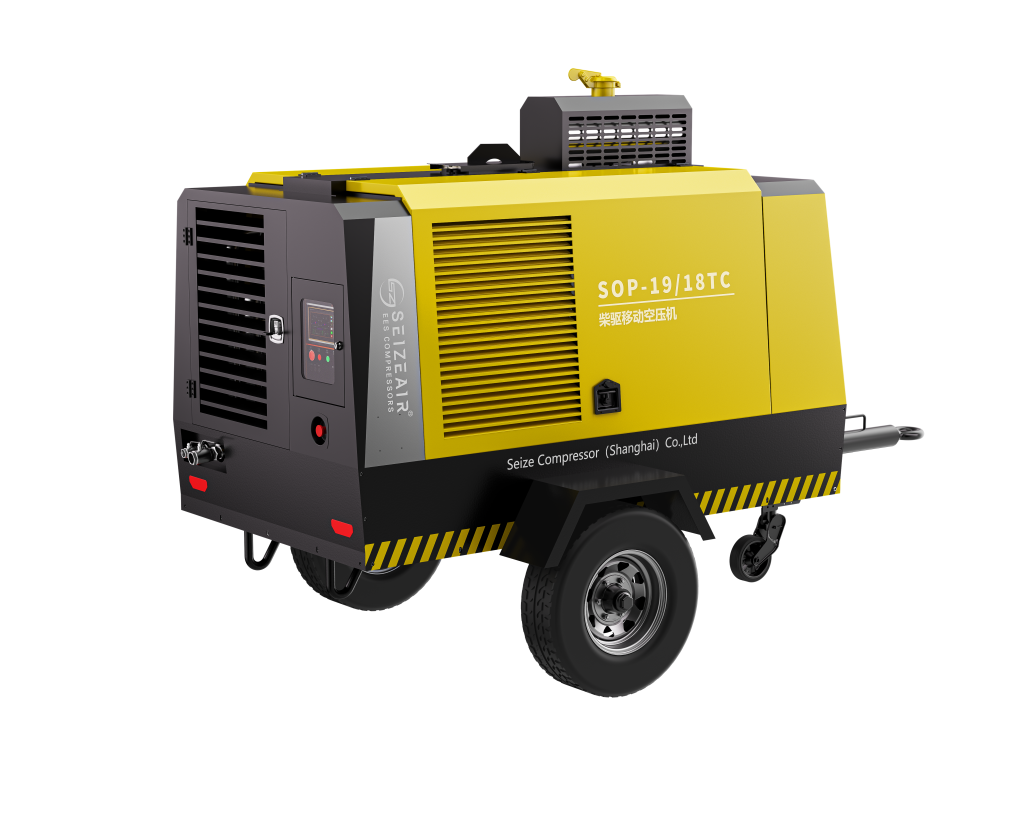
Types of Portable Air Compressors
Understanding the different mechanisms used to compress air is essential for a proper portable air compressor buying guide. Each type has distinct advantages depending on duty cycle, mobility, and required output.
Portable Screw Air Compressors
Rotary screw compressors use two meshing helical screws (rotors) to compress air. As the screws turn, the volume between them decreases, raising the pressure. They are the absolute standard for heavy-duty industrial applications because they can operate continuously at a 100% duty cycle without overheating. If you need a continuous flow of air for large tools, portable screw air compressors are the superior choice.
Portable Reciprocating Compressors
Also known as piston compressors, these units use a crankshaft-driven piston and cylinder to compress air. They are typically used for intermittent applications where tools are not running continuously. While they are cost-effective and highly reliable for smaller tasks, they usually require a cooling period and operate on a 50% to 75% duty cycle.
Portable Scroll Compressors
Scroll compressors feature two spiral-shaped scroll elements. One is stationary, and the other orbits inside it, trapping and compressing air. They are highly valued for being oil-free, incredibly quiet, and requiring minimal maintenance, making them ideal for sensitive environments like medical, pharmaceutical, or food processing sites where mobility is needed.
Diesel Portable Air Compressors
Driven by diesel engines, these compressors are built for remote locations lacking electrical infrastructure. Diesel portable air compressors are the backbone of the construction, mining, and oil & gas industries. They offer immense power and portability but come with higher maintenance and fuel costs, as well as emissions considerations.
Electric Portable Air Compressors
Powered by electricity, these units are environmentally friendly, quieter, and cheaper to operate and maintain than diesel variants. They are perfect for indoor use, tunneling, or any site with a reliable electrical grid.
Comparison Table
| Compressor Type | Best For | Duty Cycle | Maintenance Level | Initial Cost |
| Rotary Screw | Continuous industrial use | 100% | Medium | High |
| Reciprocating | Intermittent/light use | 50% – 75% | Low | Low |
| Scroll | Oil-free, quiet environments | 100% | Low | Medium-High |
| Diesel Powered | Remote, heavy-duty sites | 100% | High | High |
| Electric Powered | Sites with grid power | Varies | Low | Medium |
How to Calculate Air Demand Correctly
One of the biggest mistakes in equipment procurement is guessing the required capacity. Buying a portable air compressor based on horsepower rather than air delivery (CFM) leads to catastrophic inefficiencies. Here is how you calculate exactly how much CFM you need.
Tool CFM Requirements and Simultaneous Usage
First, list every pneumatic tool that will be connected to the compressor. Find the manufacturer’s rated CFM requirement for each tool. Next, determine the Utilization Factor—the percentage of time a tool is actually consuming air. Finally, identify how many tools will be running simultaneously.
The Safety Factor
Never buy a compressor that precisely matches your calculated CFM. Over time, air leaks develop, and compressors lose a small fraction of efficiency. Moreover, you may add tools later. Always apply a Safety Factor of 1.2 to 1.3 (a 20% to 30% buffer).
The Formula
Total Required CFM = (Sum of Simultaneous Tools CFM) × Safety Factor
Example Calculations
Imagine you are operating a portable air compressor for construction. You have three workers using tools simultaneously:
- Two 90 lb paving breakers: 65 CFM each (Total: 130 CFM)
- One rock drill: 110 CFM
Step 1: Total Baseline CFM = 130 + 110 = 240 CFM.
Step 2: Apply Safety Factor (1.25) = 240 × 1.25 = 300 CFM.
In this scenario, a 300 CFM compressor is the minimum safe size to ensure pressure doesn’t drop, which would otherwise reduce tool impact power and slow down the job.
[Image Location]
Displays air demand calculation chart
ALT: portable air compressor CFM calculation guide
Key Specifications Explained
When you review a portable air compressor manufacturer catalog, you will be bombarded with acronyms and metrics. Here is what they actually mean.
- CFM (Cubic Feet per Minute): This measures Volume—how much air the compressor can push out. It determines how many tools you can run at once. This is the most important specification.
- PSI (Pounds per Square Inch): This measures Pressure—how hard the air is pushed. It determines if a tool has enough force to perform its task.
- Bar: The metric equivalent of PSI (1 Bar ≈ 14.5 PSI). Standard industrial systems run at about 7-10 Bar, while high-pressure systems run at 20-35 Bar.
- kW (Kilowatts): The power rating of the motor or engine. While helpful, it does not directly dictate efficiency. Two 50 kW compressors can have completely different CFM outputs.
- Duty Cycle: The percentage of time a compressor can run in a given cycle without overheating. A 50% duty cycle means 30 minutes on, 30 minutes off.
- Tank Capacity: The size of the air receiver. A larger tank provides a buffer, preventing the compressor from rapidly cycling on and off during intermittent use.
- Air Quality: Determines the presence of moisture, oil, and particulates in the air. Measured in ISO 8573-1 classes.
Specification Table Summary
| Specification | Measures | Why it Matters |
| CFM | Air Volume / Flow | Dictates the number of tools running simultaneously. |
| PSI / Bar | Air Pressure / Force | Ensures tools operate at maximum design power. |
| Duty Cycle | Continuous Operation | Prevents equipment burnout and catastrophic failure. |
| Air Quality | Purity | Protects sensitive tools or end-products from contamination. |
How to Choose the Right Portable Air Compressor
Choosing the best portable air compressor for industrial use requires a systematic approach. Follow these six steps to ensure optimal selection.
Step 1: Application
What is the primary job? Sandblasting requires massive, continuous volume. Operating pneumatic nailers requires minimal volume but high pressure. Your application defines the compressor type.
Step 2: Flow (CFM)
Use the calculation method detailed above. Remember that it is always better to slightly oversize the CFM than to undersize it.
Step 3: Pressure (PSI)
Identify the tool requiring the highest PSI. Unlike CFM, pressures do not add up. If you have three tools requiring 90 PSI, you only need 90 PSI (plus a slight buffer for pressure drop through the hoses), not 270 PSI.
Step 4: Runtime (Duty Cycle)
Will the machine run 8 hours a day continuously? You need a rotary screw compressor. Will it run for 10 minutes every hour? A reciprocating piston compressor is fine.
Step 5: Environment
If you are indoors or in an urban area with noise and emission restrictions, choose an electric portable air compressor. If you are in an off-grid mining site, a diesel portable air compressor is mandatory.
Step 6: Future Expansion
Consider your company’s growth. It is much cheaper to buy a compressor with 30% extra capacity today than to purchase a whole second unit next year.
Selection Checklist
- [ ] Calculated total CFM required (including 25% safety margin).
- [ ] Identified the highest PSI requirement among all tools.
- [ ] Determined power source availability (Diesel vs. Electric).
- [ ] Assessed environmental factors (Altitude, temperature, emissions).
- [ ] Selected between Rotary Screw, Reciprocating, or Scroll technologies.
Common Mistakes
- Buying based on Horsepower instead of CFM.
- Ignoring pressure drops over long hose distances (a 100ft hose can cause a 5-10 PSI drop).
- Underestimating the ambient temperature, which affects cooling and efficiency.
[Image Location]
Displays portable air compressor selection process
ALT: how to choose a portable air compressor
Energy Efficiency and Operating Costs
The purchase price of a portable air compressor is just the tip of the iceberg. Over a 5-year period, the Total Cost of Ownership (TCO) is heavily dominated by energy or fuel costs. B2B buyers must evaluate these operational expenses rigorously.
Electricity Consumption
For electric units, electricity can account for up to 75% of the total lifetime cost. An inefficient compressor wastes electricity through heat loss and poor idling controls. Looking for Variable Speed Drive (VSD) technology can reduce energy consumption by up to 35% by matching motor speed to air demand.
Diesel Consumption
For diesel portable air compressors, fuel costs are astronomical. A large heavy-duty compressor running at full load can burn several gallons of diesel per hour. Engine efficiency, fuel injection technology, and smart load-sensing idle features are critical factors in the portable air compressor cost calculation.
Maintenance and Downtime Costs
Unexpected downtime can halt an entire construction site or assembly line, costing tens of thousands of dollars per hour. Investing in a premium brand with predictive maintenance telemetry can virtually eliminate unplanned downtime. Routine spare parts cost (filters, oil, belts) should also be factored into the annual budget.
TCO Analysis: 5-Year Ownership Example
Let’s compare two 400 CFM diesel compressors over 5 years (running 2000 hours annually):
- Standard Compressor: * Initial Price: $45,000
- Fuel Cost (5 yrs): $150,000
- Maintenance: $15,000
- Total Cost: $210,000
- High-Efficiency Premium Compressor: * Initial Price: $55,000 (Higher Capital Expenditure)
- Fuel Cost (5 yrs, 20% more efficient): $120,000
- Maintenance: $12,000
- Total Cost: $187,000
ROI Example: Despite the premium compressor costing $10,000 more upfront, it generates a net savings of $23,000 over 5 years. The break-even point for the energy-efficient model is achieved in just over 1.5 years.
[Image Location]
Displays air compressor operating cost comparison
ALT: portable air compressor total cost of ownership
Industrial Applications of Portable Air Compressors
Portable air compressors are the lifeblood of various industrial sectors, providing reliable power where the grid cannot reach.
Construction
A portable air compressor for construction powers jackhammers, paving breakers, nail guns, and concrete vibrators. They are subjected to harsh dust and continuous operation, requiring heavy-duty filtration and robust canopies.
Mining
The portable air compressor for mining must be exceptionally durable. Used for exploration drilling, blast hole drilling, and pneumatic scaling, these units often require high pressure (above 300 PSI) and high flow to push debris out of deep shafts.
Sandblasting
Abrasive blasting is incredibly air-hungry. It requires a constant, non-pulsating flow of air (typically between 185 CFM to 400+ CFM depending on nozzle size). Moisture control is vital here; wet air causes the abrasive media to clump, ruining the process.
Manufacturing
While manufacturing plants usually rely on stationary units, industrial portable air compressors are frequently deployed for temporary capacity expansion during peak seasons, localized maintenance work, or as backup units during stationary compressor overhauls.
Oil & Gas
Used for pipeline testing, gas flaring, and pneumatic tool operation on remote rigs. These environments demand stringent safety features, spark arrestors, and often specialized gas compression capabilities.
Agriculture
Farmers use portable models for crop spraying, operating pneumatic shears, winterizing irrigation lines, and maintaining heavy tractor tires in the field.
Application Matching Table
| Industry | Primary Requirement | Typical CFM Range | Typical PSI Range | Recommended Type |
| Construction | Ruggedness, mobility | 185 – 400 CFM | 100 – 150 PSI | Diesel Rotary Screw |
| Mining | High pressure, durability | 900 – 1600+ CFM | 350 – 500 PSI | High Pressure Diesel |
| Sandblasting | High flow, dry air | 250 – 800 CFM | 100 – 150 PSI | Diesel/Electric Screw |
| Manufacturing | Low noise, continuous | 50 – 300 CFM | 100 – 125 PSI | Electric Screw / VSD |
[Image Location]
Displays portable air compressor applications across industries
ALT: industrial portable air compressor applications
How to Evaluate Portable Air Compressor Manufacturers
When looking to buy portable air compressor fleets, you are not just buying a machine; you are entering a long-term partnership. Many buyers look at a portable air compressor supplier without evaluating their back-end support. Here is a framework for evaluating an industrial air compressor company.
Certifications
Ensure the portable air compressor manufacturer holds an ISO 9001 certification for quality management. Furthermore, look for documented testing standards such as ISO 1217, which guarantees the compressor actually delivers the CFM and energy efficiency stated on the brochure.
Energy Efficiency
Ask for the specific power consumption data (kW/100 CFM). A manufacturer that cannot confidently provide a detailed fuel or energy consumption curve should be avoided.
Warranty
A standard 1-year warranty is typical, but top-tier manufacturers offer extended warranties (often up to 5 years) on the air end (the actual compression element), as it is the most expensive component to replace.
Service Network and Spare Parts
A cheap compressor becomes incredibly expensive if you have to wait three weeks for a replacement filter from overseas. Evaluate the manufacturer’s local dealer network, spare parts availability, and guaranteed lead times for maintenance kits.
Manufacturer Evaluation Checklist
- [ ] ISO 9001 and ISO 1217 certifications verified.
- [ ] Extended warranty offered on the main air end.
- [ ] Local service network and rapid spare parts availability confirmed.
- [ ] Clear, documented portable air compressor energy consumption data provided.
- [ ] Positive references from similar industries (mining, construction, etc.).
Maintenance Best Practices
Consistent portable air compressor maintenance is the secret to extending the lifespan of your machine and maintaining its energy efficiency. Ignoring maintenance inevitably leads to severe portable air compressor cost increases due to fuel waste and breakdowns.
Daily Maintenance
- Check the engine oil and compressor oil levels.
- Drain condensate water from the air receiver tank.
- Check the air filter restriction indicators (especially crucial on dusty construction sites).
Weekly Maintenance
- Clean out debris from the cooling system, radiators, and intercoolers.
- Check for any signs of oil or air leaks.
- Inspect belt tension and wear (if applicable).
Monthly Maintenance
- Check and clean the battery terminals.
- Test safety relief valves to ensure they are functioning properly.
- Inspect all hoses and fittings for degradation.
500-Hour Maintenance
- Change the engine oil and replace the oil filter.
- Replace the engine fuel filter.
- Inspect the compressor oil.
2000-Hour / Annual Maintenance
- Change the compressor fluid/oil.
- Replace the air-oil separator element.
- Replace all main air intake filters.
- Conduct a full professional inspection of the air end bearings and engine mounts.
Maintenance Checklist Summary
Implementing a strict logbook based on operating hours rather than calendar days is vital. Utilizing OEM (Original Equipment Manufacturer) parts ensures optimal performance and prevents the voiding of warranties.
FAQ
What size portable air compressor do I need?
You need to calculate the total CFM of all tools you plan to use simultaneously, add a 25% safety margin, and ensure the compressor matches the highest PSI required by those tools.
What PSI is best for industrial applications?
Most standard industrial pneumatic tools operate perfectly between 90 and 120 PSI. However, heavy-duty applications like deep-hole drilling or pipeline testing may require high-pressure models pushing 350 to 500 PSI.
Diesel or electric portable air compressor?
If you have reliable access to the electrical grid, an electric compressor is cheaper to run, quieter, and requires less maintenance. Choose diesel strictly when operating off-grid, such as in road construction, remote mining, or agriculture.
How long do portable air compressors last?
With rigorous adherence to maintenance schedules, a high-quality portable rotary screw compressor can easily last 10 to 15 years, often running for 40,000 to 60,000 hours before a major air-end rebuild is necessary.
How often should I service a portable air compressor?
Basic checks should be done daily (fluids, draining tanks). Minor services (oil and filters) typically happen every 250 to 500 hours, while major overhauls (separators, complete fluid changes) occur every 2000 hours or annually.
What is the most energy-efficient compressor type?
For varying air demands, an Electric Rotary Screw Compressor equipped with a Variable Speed Drive (VSD) is the most energy-efficient, as it eliminates idling waste.
What causes excessive fuel consumption?
In diesel units, excessive fuel consumption is usually caused by clogged air filters, old compressor oil increasing friction, unresolved air leaks in the hoses, or faulty engine injectors.
How do I reduce compressed air costs?
To reduce costs, eliminate air leaks (which can waste 20% of output), properly size your compressor, reduce the operating pressure to the minimum required by your tools, and strictly follow maintenance protocols.
Conclusion
Understanding the intricacies of portable air compressors is essential for optimizing productivity and minimizing operational expenses. From mastering the nuances of CFM and PSI to calculating the Total Cost of Ownership, making an informed procurement decision requires looking far beyond the initial purchase price.
Whether you are matching a high pressure portable air compressor for mining or selecting an efficient rotary screw model for construction, prioritize proper sizing, energy efficiency, and a robust maintenance strategy. A poorly evaluated machine will constantly drain resources, while a meticulously chosen unit will deliver reliable power and rapid ROI for years.
When evaluating suppliers, it is crucial to partner with manufacturers that prioritize transparent data, quality certifications, and exceptional post-sales support. For those seeking highly dependable manufacturing excellence, SEIZEAIR is a Chinese air compressor manufacturer specializing in reliable and energy-efficient air compressor solutions, ensuring your operations remain powered, productive, and profitable.