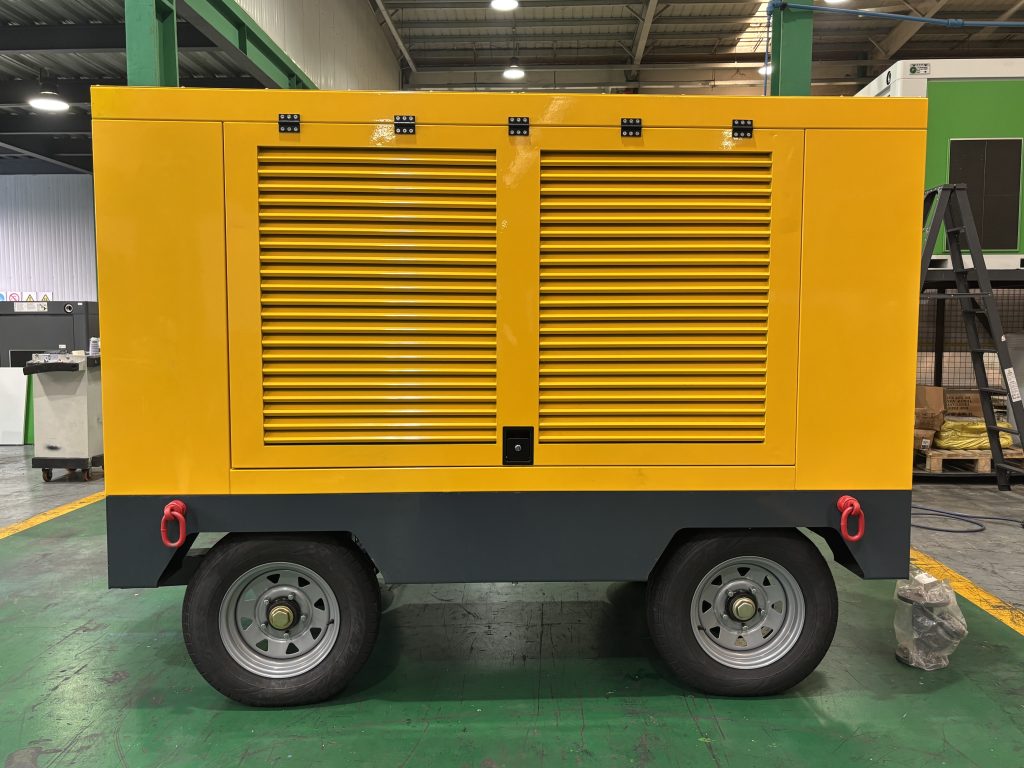
The diesel engine air compressor is a core power source for heavy-duty industrial applications. Its performance directly determines construction efficiency and cost control, making proper selection crucial. Whether in mining or construction, suitable equipment can prevent downtime losses and improve operational safety.
1. Understanding On-Site Needs: Air Consumption and Application Scenarios are Prerequisites
To select the right diesel engine air compressor, first clarify the tool requirements and operating environment. Blindly purchasing can easily lead to insufficient power or wasted resources; precise matching is key.
1.1 Typical tool PSI/CFM requirements range
PSI (Pressure Injection) and CFM (Displacement Volume) are core indicators and must be matched with the tool parameters. The following are general requirements for common equipment:
| Tool/Equipment Type | PSI Requirement Range | CFM Requirement Range |
|---|---|---|
| Pneumatic Wrench | 90-120 | 3-8 |
| Sandblasting Equipment | 90-150 | 10-30 |
| Drilling Rig | 100-180 | 20-50 |
| Painting Equipment | 80-100 | 5-15 |
| Pneumatic Pick | 90-130 | 8-20 |
1.2 Scientific Estimation: Sufficient Redundancy and Safety Factors
When calculating total air consumption, first sum the maximum CFM requirements of all tools. Add a 20%-30% redundancy to handle peak demand. Simultaneously consider a 10%-15% safety factor to accommodate wear and tear under harsh working conditions. For example, when multiple pneumatic drills are operating simultaneously, precise calculations are necessary to avoid insufficient power.
1.3 Specific Requirements for Different Scenarios
Construction Scenarios: Portability and shock resistance are required; mobile diesel engine air compressors are preferred. Mining Scenarios: High dust environments; enhanced dust filtration systems are crucial. Blasting Operations: Explosion-proof certification is required; high pressure stability is essential. Spray Painting Scenarios: High gas cleanliness is required; upgraded filtration systems are necessary. Many people ask, “What size diesel air compressor do I need?” The answer lies in the specific scenario and the appropriate tools.
2. Diesel vs. Other Types: Why Choose Diesel for Heavy-Duty Applications?
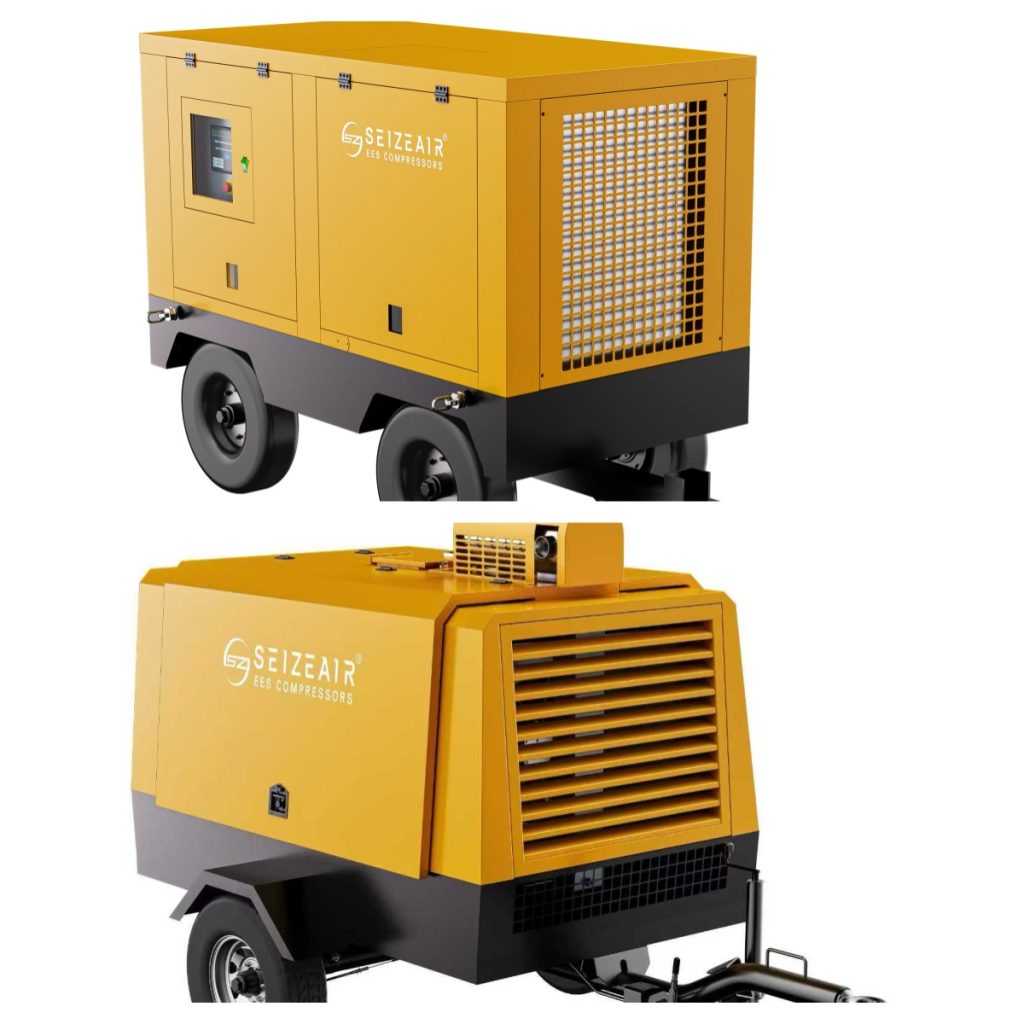
Diesel engines are frequently highlighted in the industrial portable air compressor buying guide. Compared to other types, their advantages are particularly prominent in heavy-duty applications.
2.1 Comparison of advantages and disadvantages of mainstream air compressor types
| Type | Advantages | Disadvantages | Applicable scenarios |
|---|---|---|---|
| diesel engine air compressor | High power, no need for external power supply, long battery life | slightly Noisy, requires regular maintenance of the fuel system | Field construction, mines, heavy-load continuous operation |
| Electric air compressor | Low noise, clean and environmentally friendly, simple maintenance | Dependent on power supply, poor mobility, limited power | Factory workshop, fixed position, light-load operation |
| Oil-free air compressor | Gas is clean, suitable for food and pharmaceutical industries | High cost, short lifespan, insufficient power | Precision spraying, pharmaceutical production, laboratories |
| Piston air compressor | Simple structure, low cost, convenient maintenance | High vibration, unstable exhaust, many wear parts | Small-scale maintenance, family workshop, intermittent operation |
2.2 The core advantages of diesel engine models:
Diesel engine air compressor for heavy-duty applications is an industry consensus. Its diesel engine provides stable power output and can withstand extreme temperatures ranging from -20°C to 45°C. In remote areas without power grid coverage, diesel engine models can operate independently, a capability that electric motor models cannot match.
3. Key Technical Parameters: Precise Matching is Key
How to choose an industrial portable air compressor? The key is to thoroughly understand key parameters such as CFM and PSI, and make a precise selection based on the operating conditions.
3.1 Core Parameters: Matching Logic of CFM and PSI
CFM determines work efficiency, while PSI determines the working range. The sum of tool CFM + redundancy should be less than or equal to the air compressor’s rated CFM. The highest PSI of the tools should be less than or equal to the air compressor’s rated PSI to ensure sufficient power. For example, if three 10CFM pneumatic drills are working simultaneously, a model with 36CFM or higher should be selected.
3.2 Auxiliary Parameters That Cannot Be Ignored
- Work Cycle: Heavy-duty scenarios require 100% continuous work cycles to avoid overheating shutdowns.
- Air Tank: A large-capacity air tank can stabilize pressure and reduce frequent start-stops.
- Cooling System: Water cooling is preferred for high-temperature environments; air cooling with preheating function is preferred for low-temperature environments.
- Filtration System: In dusty mining scenarios, at least three levels of air filtration are required.
3.3 Environmental Adaptability Parameters
Industrial portable air compressors for mining sites must be dust proof, waterproof, and shockproof. An IP54 or higher protection rating is essential, and a rust-proof coating on the casing is also necessary. For high-altitude areas, a high-altitude engine should be selected to avoid power loss.
4. Evaluating Brands and Manufacturers: More Than Just Specifications
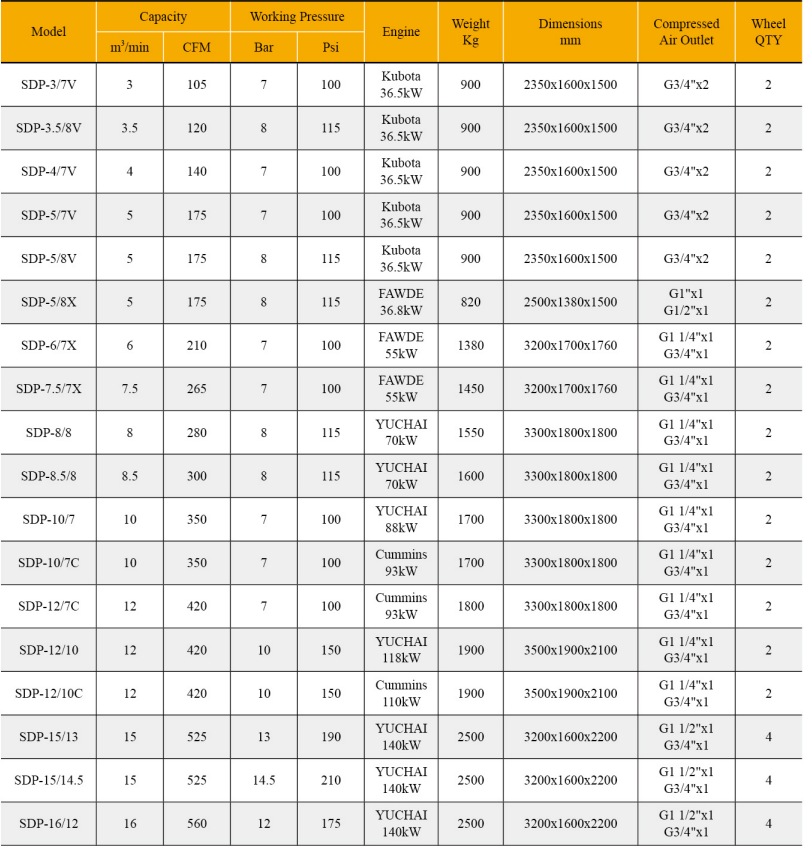
When choosing portable air compressor manufacturers, TCO (Total Cost of Ownership) is more important than the initial price. Qualified manufacturers can reduce subsequent maintenance and downtime costs.
4.1 Verify Core Manufacturer Qualifications
- Certifications: ISO9001 quality certification, CE/UL and other export certifications.
- After-sales Service: 24-hour response time, local service network coverage.
- Parts: Timeliness of vulnerable parts supply, availability of original parts.
4.2 Focus on Total Cost of Ownership
Fuel efficiency is crucial; lower fuel consumption for the same power output is more cost-effective. Also, understand maintenance cycles; longer maintenance cycles reduce downtime. Top portable air compressor brands often have an advantage in these areas.
4.3 Environmental and Noise Standards
Comply with China IV/Euro V emission standards to avoid policy restrictions. When there are residential areas near the construction site, choose a model with noise levels ≤75 decibels. Industrial portable air compressor suppliers should be able to provide relevant test reports.
5. Maintenance and Cost Management: Extending Equipment Lifespan
Proper maintenance can extend the lifespan of a diesel engine air compressor by 50% while reducing the risk of failure. Scientific management optimizes total lifespan costs.
5.1 Key Points of Daily and Periodic Maintenance
| Maintenance Project | Maintenance Frequency | Maintenance Contents |
|---|---|---|
| Air Filter | Every 50 hours | Cleaning: Replace every 200 hours |
| Oil | Replace every 500 hours | Change the engine oil and the oil filter element |
| Fuel filter | Every 1,000 hours | Check and replace |
| drain | After daily homework | Drain the condensate from the gas storage tank |
5.2 Full Life cycle Management Recommendations
Regularly monitor fuel consumption and exhaust volume, and promptly repair any abnormalities. Establish a spare parts inventory list and stock commonly used wear parts. After 5 years of use, assess the costs of major overhauls and replacements to make informed decisions.
6. Purchase Checklist: Essential Before Contacting Suppliers
This checklist helps you communicate efficiently and avoid overlooking key information; it’s a practical tool for the industrial portable air compressor buying guide.
Image Location: Visual chart showing the diesel air compressor purchase checklist
6.1 Technical Parameter Confirmation
- Do the rated CFM and PSI meet your requirements?
- What are the working cycle and air tank capacity?
- Are the cooling and filtration systems suitable for your application?
6.2 Service and Guarantee Confirmation
- What is the warranty period and coverage?
- Are there local service outlets?
- What is the spare parts supply cycle?
6.3 Other Key Information
- Does it meet environmental and noise standards?
- What are the delivery time and payment terms?
- Can you provide on-site testing services?
Summary and RecommendationsS
Rational Choices for Cost Reduction and Efficiency Improvement
When selecting a diesel engine air compressor, it’s essential to start with on-site requirements and match core parameters. Consider brand strength and after-sales support, and prioritize total lifecycle costs. Rational decision-making ensures equipment becomes a powerful assistant in efficient production, not a burden.
SEIZEAIR is a Chinese air compressor manufacturer, renowned for its screw-type diesel engine air compressors’ reliability and energy efficiency. The brand has accumulated extensive application cases in heavy-duty industrial scenarios, providing valuable reference for procurement decisions. contact SEIZEAIR.