In industrial production, compressed air is widely known as the “fourth utility,” standing alongside electricity, natural gas, and water. Its importance spans manufacturing, construction, mining, transportation, and equipment leasing. Selecting reliable portable air compressor manufacturers ensures stable production, reduced downtime, and lower lifecycle costs. In contrast, choosing poorly built equipment can lead to frequent failures, rising energy consumption, and severe compliance risks. This guide provides a structured framework to help industrial users evaluate manufacturers accurately and select equipment with confidence.
1. Why Choosing the Right Manufacturer Matters
Compressed air is not simply auxiliary energy. It is the core power source behind essential industrial systems. In mining, it drives rock drills. In construction, it powers high-load pneumatic tools. In food and pharmaceutical sectors, clean compressed air affects product safety. Because of this, the quality of industrial portable air compressor suppliers directly influences operational continuity.
Poor manufacturer selection introduces several risks:
- Unplanned downtime may cause losses of tens of thousands of dollars per incident.
- Energy waste becomes severe, as energy use accounts for up to 75% of compressor lifecycle cost.
- Air quality failures may contaminate products, especially when oil content exceeds acceptable levels.
- Compliance issues arise when equipment exceeds noise or emission limits.
- Weak after-sales support creates bottlenecks when spare parts or technicians are required urgently.
Reliable manufacturers serve as technical consultants, long-term partners, and lifecycle support providers, not just equipment sellers.
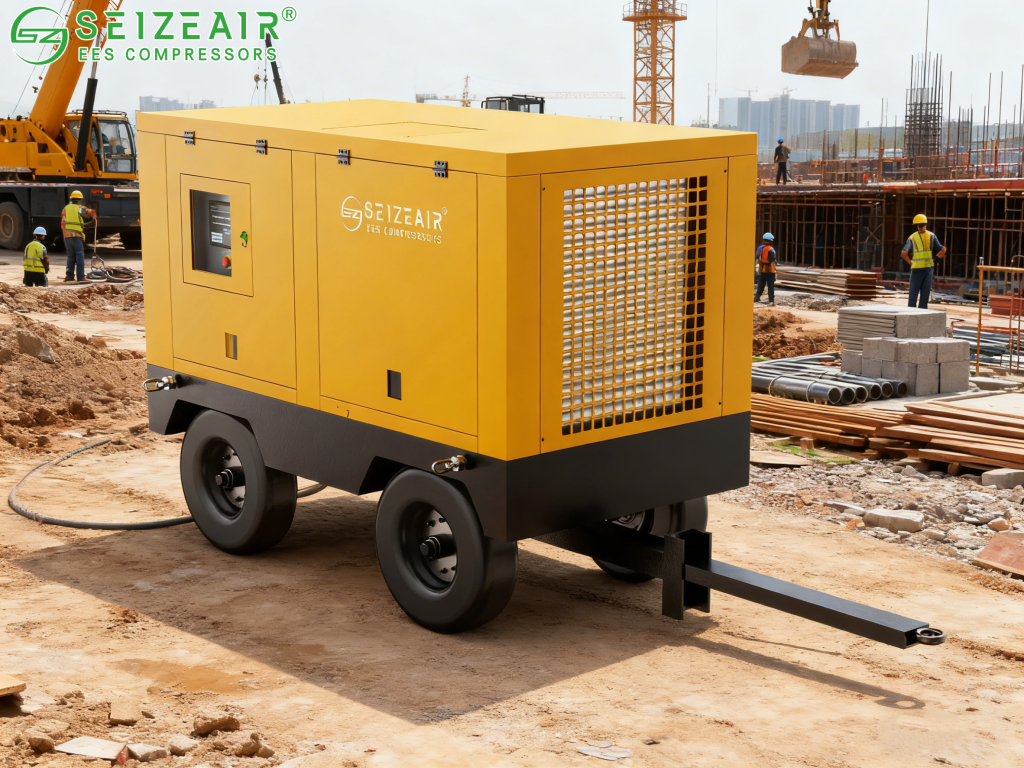
2. Understand Your Industrial Compressed Air Demand (Air Demand Analysis)
Before reviewing products or comparing top portable air compressor brands, companies must define their airflow requirements. Pressure, flow rate, purity, and duty cycle differ significantly across industries. Proper planning avoids oversizing, undersizing, and hidden operational risks.
2.1 Define Your Application and Usage Scenario
Begin by listing all pneumatic tools. Review their rated pressure and flow. Identify concurrent operation levels. Construction sites, mining operations, assembly lines, and cleaning processes each demand unique performance levels.
Usage patterns typically fall into three categories:
- Intermittent use: Occasional tool operation or maintenance tasks.
- Continuous light-load use: Automated production lines with stable airflow demand.
- Continuous heavy-load use: Rock drilling, sandblasting, and concrete spraying.
Always include a 20–30% reserve margin to support future expansion or unexpected peak loads.
2.2 Consider Air Quality, Oil-Free vs Oil-Injected, Duty Cycle & Environment
Air quality determines compressor technology type:
- High-cleanliness industries such as food, pharmaceuticals, and electronics require oil-free air that meets ISO 8573-1 Class 0 standards.
- General industrial sectors such as construction and mining can use oil-lubricated screw compressors for cost-effective performance.
Duty cycle must match operational conditions:
- Continuous operations: Require screw compressors with 100% duty cycle.
- Intermittent operations: Can sometimes use piston compressors.
Operating environment is the core consideration for portable air compressor selection:
| Outdoor / Construction sites | Diesel-powered models with dustproof, shockproof, and rainproof design are required, featuring cooling systems adapted for extreme temperatures |
| High-temperature / High-dust environments | Manufacturers must provide heavy-duty air filters (dust removal precision ≥1μm) and high-efficiency coolers |
| Indoor / environmentally sensitive settings | Electric models are preferable, must comply with GB12348-2008 ‘Environmental Noise Emission Standards for Boundaries of Industrial Enterprises’ functional zone limits; oil-free silent models achieve lower noise levels |
| Marine / offshore environments | Select corrosion-resistant designs with classification society certification to ensure stable operation in high humidity and salt spray conditions |
3. Evaluate Manufacturer Capabilities — What to Check When Choosing a Supplier
This step shapes the foundation of a proper portable air compressor manufacturer comparison. Strong manufacturers demonstrate technical strength, lifecycle value, and compliance across several key dimensions.
3.1 Product Range and Technical Expertise
The supplier’s product range reveals their ability to address varied industrial requirements. Evaluate:
- Coverage for multiple pressure and flow ranges
- Ability to supply diesel and electric models
- Availability of oil-free and oil-injected systems
- Variety of transmission types: belt, direct-drive, or gear
- Capacity for environmental customization such as dustproofing or corrosion resistance
Manufacturers with strong engineering teams can tailor designs to client-specific conditions.
3.2 Total Cost of Ownership (TCO)
Initial price reflects only a small fraction of long-term cost. TCO includes:
- Energy consumption: The largest contributor to lifecycle cost.
- Maintenance expenses: Filters, lubricants, separator elements, and scheduled servicing.
- Compliance costs: Noise controls and environmental measures.
- Depreciation: High-quality units last more than a decade.
Request TCO comparisons for 5- and 10-year periods when evaluating the best portable air compressor manufacturers for industrial use.
3.3 Service and Support
Service capability determines how quickly operations recover after unexpected issues. Evaluate:
- Local service coverage and technician availability
- Spare parts distribution warehouses
- Response time for service requests
- Optional maintenance agreements
- Remote monitoring capabilities
Top manufacturers provide structured service plans to reduce unplanned downtime.
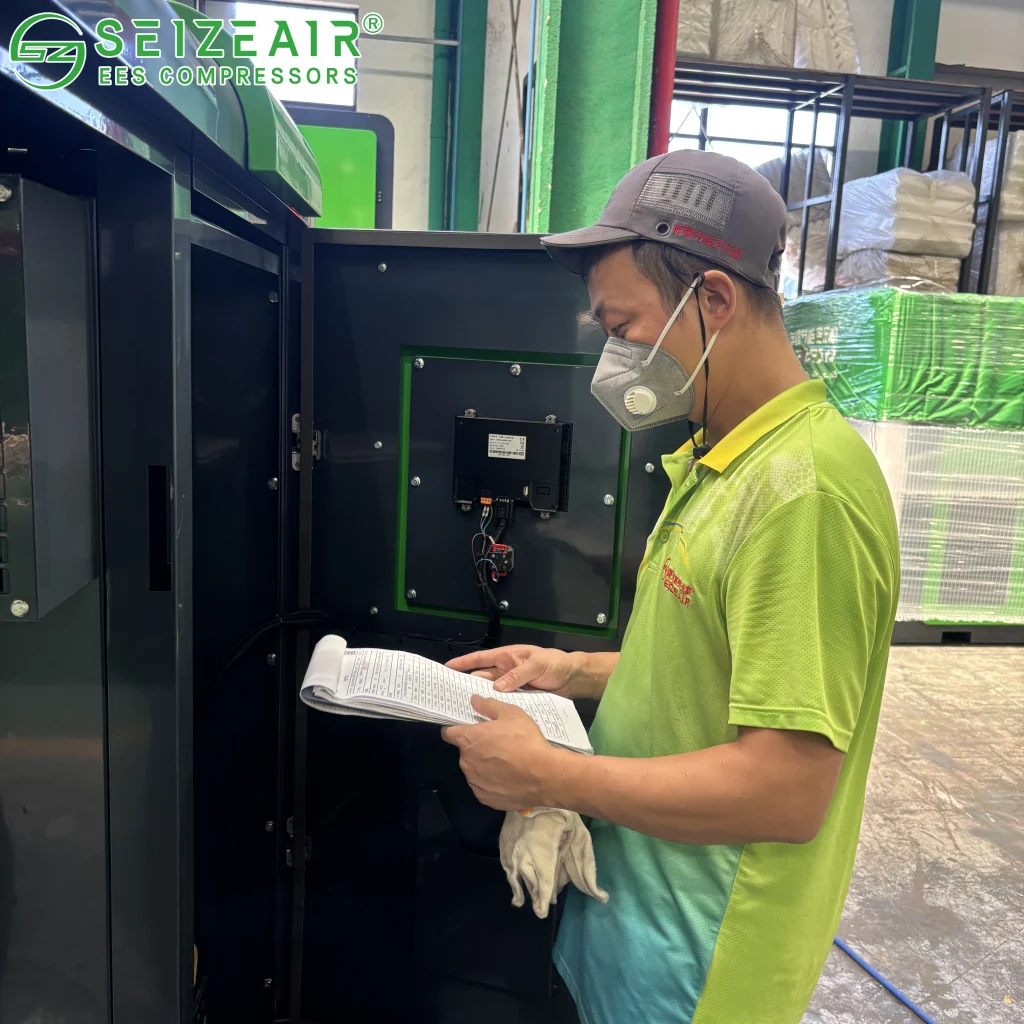
3.4 Certification and Compliance
Manufacturers must meet strict industry and international standards, including:
- ISO 9001 for quality management
- ISO 8573-1 for air purity
- Energy efficiency standards such as GB19153-2019
- Noise regulations for indoor and outdoor use
- Sector-specific certifications like marine classification, API, or mining approvals
Always request official documentation for verification.
3.5 Client Case Studies and Industry Expertise
Request application cases similar to your operating environment. Strong case studies demonstrate:
- Experience in high-temperature, dusty, or high-altitude environments
- Customization success stories
- Long-term client partnerships
- Third-party testing or evaluation reports
These references offer insight into real-world performance.
4. What to Do Before You Buy — Pre-Purchase Checklist & Questions to Ask Suppliers
After clarifying requirements and evaluation criteria, targeted communication must be conducted to further validate the manufacturer’s capabilities and mitigate procurement risks. The following core questions must be addressed prior to purchase and may be compiled into a Pre-purchase checklist for team reference:
- Based on our gas consumption requirements (specifying CFM/PSI/number of concurrently operating units/safety margin), what are the core parameters of your recommended model? Can you provide a performance matching calculation report?
- What is the air quality rating of the recommended model? Does it hold ISO 8573-1 Class 0 certification (where applicable)? What are the metrics for oil content, particulate matter, etc.?
- What specialised designs have been incorporated for our operating environment (e.g., high temperatures, dusty conditions, outdoor/indoor use)? Can environmental adaptability test data be provided?
- What is the energy efficiency rating of the equipment? Can a GB19153-2019 energy efficiency test report be provided? Based on our projected usage duration, what is the estimated annual energy consumption?
- What components constitute the Total Cost of Ownership (TCO)? Can you provide a detailed breakdown of TCO over 5/10 years (equipment cost + energy consumption + maintenance + spare parts + compliance costs)?
- Where are your service centres located? What is the typical engineer response time? What are the lead times and pricing for commonly used spare parts?
- What are the specific warranty terms? What are the warranty periods for core components and the entire unit? Does the warranty cover labour and parts?
- Are there successful case studies in industries similar to ours? Can you provide client contact details or arrange site visits? Are there third-party test reports or industry certifications?
- Can you accommodate our custom requirements (e.g., special pressure/flow specifications, dustproofing, corrosion resistance, mobile chassis)? What is the customisation lead time and associated additional cost?
- What are the installation requirements for the equipment? Do you offer installation, commissioning, and operator training services? What is the scope and duration of the training?
5. After Purchase — Maintenance, Operation, and Lifecycle Cost Management
Even the strongest compressors need proper installation and maintenance. Following best practices maximizes equipment reliability and efficiency.
5.1 Correct Installation and Environmental Preparation
Install compressors in well-ventilated areas with at least one metre of clearance. Keep equipment on level ground. Use flexible pipeline connections to reduce vibration. Remove condensate regularly to prevent internal corrosion.
5.2 Scheduled Maintenance
Follow the manufacturer’s maintenance plan:
- Daily: Check oil level, temperature, and alarms.
- Monthly: Inspect belts, filters, and safety valves.
- 500 hours: Replace initial lubricants and filters.
- 1000 hours: Clean coolers and replace air filters.
- 3000 hours: Replace key components such as oil-air separators.
- Annually: Conduct full system inspections.
5.3 Monitoring and Optimisation
Monitor energy consumption to detect abnormalities early. Maintain consistent exhaust pressure. Avoid frequent start-stop cycles. Keep a detailed maintenance log to support long-term planning.
5.4 Spare Parts and Service Partnerships
Maintain an inventory of essential spare parts to avoid delays. Consider long-term service contracts for preventive maintenance. For ageing equipment, consult the manufacturer regarding upgrades or replacement.
Summary
Selecting the right portable air compressor manufacturers requires a precise understanding of operational needs, supplier capability, and long-term cost performance. Companies should evaluate suppliers based on product range, TCO, certification, service strength, and real-world application experience. A structured approach ensures safer investment and greater operational efficiency.
SEIZEAIR, a Chinese air compressor manufacturer, produces reliable and energy-efficient screw air compressors. It offers a complete product range that supports diverse industrial applications with long-term stability.